
You can get startup funding with no revenue. The most reliable routes are SBA microloans, federal grants through SBIR/STTR, angel and pre-seed equity, accelerators, and reward or equity crowdfunding. Platforms like Lending Gurus can also match you to lending partners that work with early-stage businesses. Your immediate next step: pick the route that fits your stage, then pull together three core documents — a business plan, a one-page use-of-funds summary, and a basic financial model.
Table of Contents
- What funding options actually work for pre-revenue startups?
- Loans that can work before you have revenue
- How angels, pre-seed funds, and accelerators fund startups before revenue
- Non-dilutive options: government grants and SBIR/STTR
- Crowdfunding, pre-sales, and customer-funded pilots
- What lenders and investors actually look for when there’s no revenue
- Step-by-step: how to prepare and apply for pre-revenue funding
- Risks and tradeoffs: debt, equity, personal guarantees, and dilution
- A simple framework to choose your first funding route
- What founders usually get wrong about pre-revenue fundraising
- How Lending Gurus connects pre-revenue founders to the right lenders
- Sources
What funding options actually work for pre-revenue startups?
Pre-revenue founders have more routes than most realize. The key is matching the right structure to your situation — debt, equity, or non-dilutive — before you spend time applying.
- SBA microloans — Best for: founders who need $5,000–$50,000 for working capital, inventory, or equipment. Downside: requires personal credit review and a business plan; not for pure R&D. Non-dilutive debt.
- CDFI microloans — Best for: underserved founders or those in low-income markets. Downside: geographic and mission-based eligibility restrictions. Non-dilutive debt.
- Equipment financing / leasing — Best for: businesses that need specific machinery or technology. Downside: the equipment itself is collateral; limited to asset-backed needs. Non-dilutive debt.
- Angel investors / pre-seed VCs — Best for: scalable tech or product companies with a prototype and customer discovery. Downside: dilution; requires a warm network or strong pitch. Equity.
- Startup accelerators — Best for: first-time founders who need capital, mentorship, and investor introductions simultaneously. Downside: competitive acceptance; typically takes 5–10% equity. Equity.
- Reward-based crowdfunding (Kickstarter / Indiegogo) — Best for: consumer products with a compelling story and a prototype. Downside: fulfillment risk; platform fees; marketing costs. Non-dilutive.
- Reg CF equity crowdfunding — Best for: founders who want to raise from a broad community of supporters. Downside: SEC compliance costs; campaign management is time-intensive. Equity (up to $5 million in a 12-month period).
- SBIR / STTR federal grants — Best for: R&D-intensive startups in tech, biotech, or energy. Downside: multi-month application cycles; heavy reporting requirements. Non-dilutive.
- Friends and family — Best for: very early capital before any formal structure exists. Downside: relationship risk; must be documented properly. Debt or equity.
- Paid pilots / pre-sales — Best for: B2B founders who can land a paying customer before the product is fully built. Downside: requires a credible pitch and some delivery capability. Non-dilutive revenue.
Loans that can work before you have revenue
Getting a loan without revenue is harder than with it, but not impossible. Experian’s guidance on startup loans confirms that lenders will consider pre-revenue applicants who demonstrate strong personal credit, a credible business plan, collateral, or a personal guarantee. The underwriting logic shifts: the lender is betting on you as much as the business.
SBA and CDFI microloans
The SBA microloan program lends up to $50,000 through nonprofit intermediary lenders, with an average loan size of roughly $13,000. Funds can cover working capital, inventory, supplies, furniture, and equipment — not debt refinancing. Intermediaries set their own credit and eligibility criteria, so requirements vary, but most will want:
- A completed business plan with a market analysis
- Personal credit history and score (the lender’s primary risk signal at this stage)
- A one-page use-of-funds statement
- Business formation documents (LLC operating agreement, EIN, licenses)
- Personal financial statements and tax returns (typically two years)
- Collateral or a personal guarantee in many cases
CDFI lenders follow a similar model but often serve founders in underserved communities or rural areas, sometimes with more flexible credit requirements.
Equipment financing
If your startup needs specific equipment to operate, financing that equipment is often easier than a general working capital loan. The equipment itself serves as collateral, which reduces lender risk significantly. Leasing is another option if you want to preserve cash and upgrade hardware as the business grows.

Pro Tip: When you have no revenue, the strongest loan application you can build is one that shows committed demand. A signed letter of intent from a potential customer, a supplier agreement, or a confirmed pilot contract tells a lender that revenue is imminent — not hypothetical. Attach it to your use-of-funds document.
How angels, pre-seed funds, and accelerators fund startups before revenue
Equity investors at the pre-seed stage are not looking for a P&L. They are looking for evidence that the problem is real, the market is large, and you are the right team to solve it. Stripe’s pre-seed capital guide is direct on this: investors routinely replace revenue with structured demand evidence — founder-market fit, customer discovery interviews, an MVP or prototype, and letters of intent.
What angels and pre-seed VCs want to see
- Founder-market fit: Why are you the right person to build this? Domain expertise, prior industry experience, or a personal connection to the problem all count.
- Customer discovery: Documented interviews (20–50 is a credible number) that validate the pain point and willingness to pay.
- MVP or prototype: Even a non-functional mockup demonstrates that you can ship.
- LOIs or pilot agreements: A signed letter of intent from a potential customer is one of the strongest pre-revenue signals you can show.
- A milestone-driven use-of-funds plan: Investors want to know exactly what the money buys and what metrics unlock the next round.
Deal structures at pre-seed
Most pre-seed rounds use SAFEs (Simple Agreements for Future Equity) or convertible notes rather than priced equity rounds. Both instruments delay the valuation conversation until a later, priced round — which makes sense when pricing a pre-revenue company is genuinely difficult. SAFEs are simpler and have no interest or maturity date; convertible notes carry interest and a maturity date. Neither constitutes legal advice — consult a startup attorney before signing either.
Accelerators as a fast track
Programs like Y Combinator, Techstars, and sector-specific accelerators provide a check (typically $20,000–$500,000 depending on the program), structured mentorship, and a demo day that puts you in front of dozens of angels at once. For first-time founders without a warm investor network, that demo day is often worth more than the initial capital. Acceptance rates are competitive, so apply to multiple programs in parallel and treat the application like a pitch.
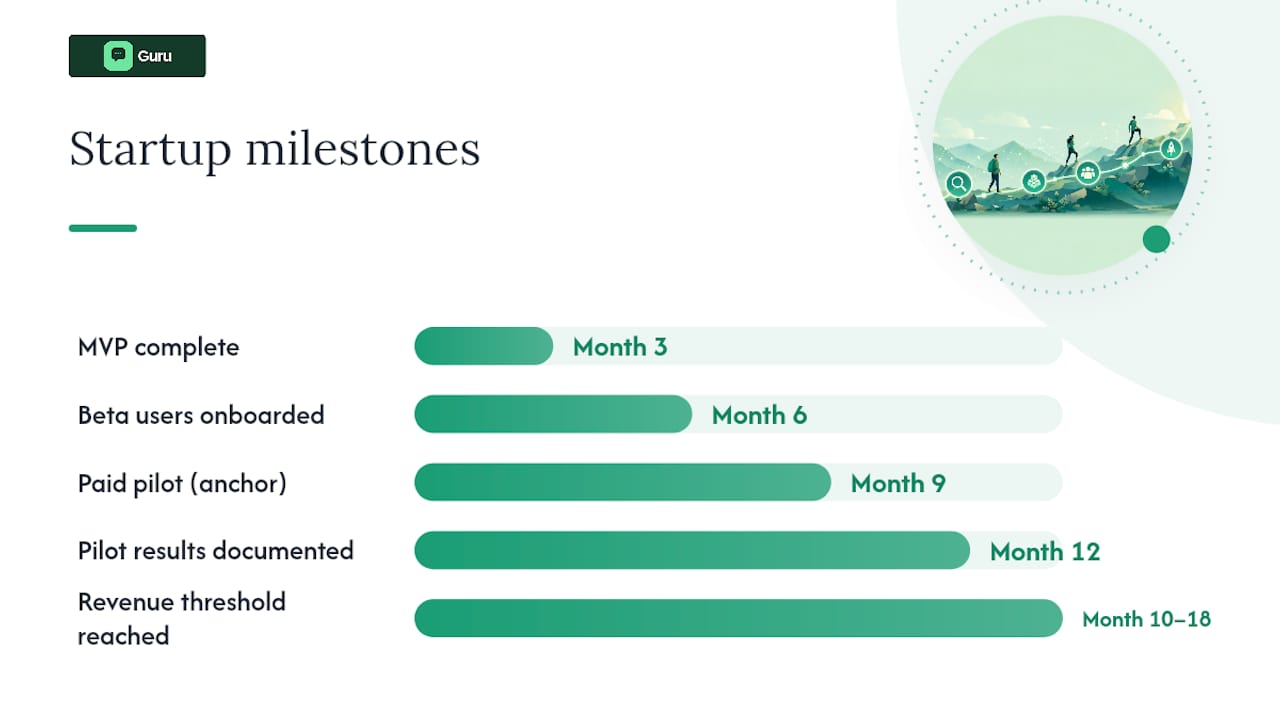
A realistic 12–18 month milestone plan that an investor will fund looks like this: months 1–4 close beta users and document conversion metrics; months 5–9 run a paid pilot with one anchor customer; months 10–18 reach a defined revenue threshold that justifies a seed round. The specifics vary by sector, but the structure — clear milestones, clear metrics, clear next raise trigger — is consistent.
Non-dilutive options: government grants and SBIR/STTR
Grants are the most attractive funding structure for pre-revenue startups: no repayment, no dilution. The tradeoff is time and specificity.
SBIR and STTR: America’s seed fund for R&D startups
The SBIR and STTR programs are federal non-dilutive programs that award grants and contracts to small businesses conducting commercializable R&D. Eleven federal agencies participate, including the DOE, NIH, NSF, and DoD. Phase I awards typically fund feasibility research; Phase II funds full R&D development. Application cycles run several months from solicitation to award, so plan accordingly.
Other grant sources worth checking
- Grants.gov: — The federal clearinghouse for all government grant opportunities. Search by CFDA number or keyword for your sector.
Grants require detailed applications, specific eligibility criteria, and post-award reporting. The reporting burden is real — budget time for it before you apply.
Pro Tip: Never pause other fundraising while waiting for a grant decision. Run your SBIR application in parallel with an angel pitch or an accelerator application. Grant cycles are long enough that you could close a bridge check before the award arrives — and that bridge check may be what keeps you alive long enough to receive the grant.
Crowdfunding, pre-sales, and customer-funded pilots
Crowdfunding does two things at once: it raises capital and it proves demand. That dual function is why investors often look favorably on founders who have run a successful campaign — it is structured market validation.
Reward-based vs. equity crowdfunding
Reward-based campaigns on Kickstarter or Indiegogo let backers pre-purchase your product or receive a non-financial reward. There is no equity transfer, no SEC registration, and no investor relationship to manage. The signal it sends to future investors is clear: real people paid real money before the product existed.
Regulation Crowdfunding (Reg CF) is a different structure. Eligible issuers can raise up to $5 million from the general public in a 12-month period through an SEC-registered intermediary. Backers receive actual equity. The compliance costs are higher, but so is the potential raise size.
Readiness checklist for a crowdfunding or pre-sales campaign
- A working prototype or compelling demo — backers need to see what they are funding.
- A clear, specific story — who has the problem, how your product solves it, and why now.
- A marketing plan with a pre-launch audience — campaigns that hit 30% of their goal in the first 48 hours almost always succeed; that requires a warm list before launch day.
- A realistic fulfillment plan — map out production timelines, supplier relationships, and shipping logistics before you go live.
- A campaign budget — platform fees (typically 5% on Kickstarter), payment processing fees, video production, and paid promotion all add up. Budget these before setting your funding goal.
Common pitfalls: overpromising delivery timelines, underestimating manufacturing costs, and launching without a pre-built audience. All three are avoidable with product demand testing before you set your campaign live.
What lenders and investors actually look for when there’s no revenue
The evaluation criteria shift depending on whether you are talking to a lender or an equity investor, but several signals matter to both.
The pre-revenue eligibility checklist
- Personal credit score and history: For loan-based products, this is often the primary underwriting variable when business revenue does not exist yet.
- Proof of business existence: EIN, formation documents, business bank account, and any relevant licenses.
- Team experience: Prior startup experience, domain expertise, or a track record in the target industry all reduce perceived risk.
- Validated demand signals: Signed LOIs, pilot agreements, waitlist size with conversion data, or documented customer discovery interviews. These are the closest substitutes for revenue that both lenders and investors will accept.
- Collateral or guarantors: For debt products, lenders often require a personal guarantee or specific collateral when there is no business cash flow to underwrite against.
- A clear use-of-funds plan: Both lenders and investors want to know exactly where the money goes and what it produces.
Lenders weight personal credit and collateral most heavily. Equity investors weight team, market size, and demand validation most heavily. The overlap is the use-of-funds plan and the demand signals — get those right regardless of which route you pursue.
Validation signals that substitute for revenue: A signed LOI from a named potential customer carries more weight than a verbal commitment. A waitlist of 500 emails with a 40% click-through rate on a pre-launch page is a concrete metric. A paid pilot — even at a discounted rate — is the strongest signal of all because it shows a customer was willing to part with money.
Step-by-step: how to prepare and apply for pre-revenue funding
Application checklist
- Pull your personal credit report (free at AnnualCreditReport.com) and resolve any errors before applying anywhere.
- Write a one-page use-of-funds statement: what you need, how much, and what it produces in 12–18 months.
- Draft a business plan (executive summary, market analysis, product description, go-to-market, financial projections).
- Gather formation documents: EIN letter, LLC or corp documents, business bank account statements, licenses.
- Build a 12–18 month financial model with monthly cash flow projections — even pre-revenue projections show lenders you understand your unit economics.
- Prepare a pitch deck (10–12 slides: problem, solution, market, product, traction, team, ask).
- Collect validation evidence: LOIs, pilot agreements, customer discovery summaries, waitlist data.
- Identify and protect any IP before investor meetings — patenting early-stage ideas can strengthen your position significantly with both angels and SBIR reviewers.
- Research and list target funders by route: three to five SBA intermediaries, two to three accelerator programs, five to ten angel groups, and any open SBIR solicitations in your sector.
- Submit applications in parallel — never wait for one decision before starting the next.
Sample 12–18 month milestone table
| Milestone | Target Month | Capital Trigger |
|---|---|---|
| MVP / prototype complete | Month 3 | Friends & family or pre-seed angel check |
| Beta users onboarded (documented) | Month 6 | Accelerator acceptance or SBIR Phase I submission |
| Paid pilot with anchor customer | Month 9 | Bridge angel check or CDFI microloan |
| Pilot results documented | Month 12 | Seed round pitch or SBIR Phase II application |
| Revenue threshold reached | Month 10–18 | Seed round close |
Track every application in a simple spreadsheet: funder name, route type, amount requested, submission date, follow-up date, and status. Parallel processes require parallel tracking.
Risks and tradeoffs: debt, equity, personal guarantees, and dilution
Every funding route has a cost. Understanding it before you commit saves painful surprises later.
- Debt (microloans, equipment financing): You repay regardless of whether the business succeeds. A personal guarantee means your personal assets are on the line if the business cannot pay. Repayment pressure can constrain early decisions about pricing, hiring, and product scope.
- Equity (angels, pre-seed VCs, accelerators): You give up a percentage of the company permanently. Early dilution compounds — a 10% accelerator stake plus a 20% pre-seed round leaves you with 70% before you have raised a Series A. Investors also gain governance rights, which can affect decision-making speed.
- Grants: No repayment, no dilution — but multi-month timelines, specific eligibility requirements, and post-award reporting obligations. Grants rarely cover operating expenses; most are tied to specific R&D activities.
- Crowdfunding: Reward-based campaigns carry fulfillment risk. If you raise $200,000 and cannot deliver the product, you owe backers either the product or a refund. Equity crowdfunding adds SEC compliance costs.
Decision rule: If you need capital in under 90 days and have strong personal credit, a microloan or equipment financing is the fastest debt route. If you have 6–12 months of runway and a scalable product, pursue angels or an accelerator. If your startup is R&D-heavy and you can wait 6–12 months for a decision, SBIR is worth the effort. When in doubt, run two routes in parallel.
Personal guarantees are common for any loan product when the business has no revenue history. Understand what you are signing: a personal guarantee typically makes you personally liable for the full loan amount. Some lenders accept limited guarantees or specific collateral in lieu of a blanket personal guarantee — ask before you sign.
A simple framework to choose your first funding route
Three diagnostic questions narrow the field quickly.
Question 1: How long until you expect your first dollar of revenue?
- Under 6 months: prioritize a microloan or equipment financing to bridge the gap.
- 6–18 months: angels, accelerators, or a Reg CF campaign are realistic.
- 18+ months (deep R&D): SBIR/STTR is your primary non-dilutive route; add a small angel bridge.
Question 2: How R&D-intensive is your product?
- High R&D (biotech, cleantech, deep tech): SBIR/STTR first, angel bridge second.
- Moderate R&D (SaaS, hardware): accelerator or pre-seed angel round.
- Low R&D (services, consumer products): microloans, crowdfunding, or paid pilots.
Question 3: Do you have warm access to angel investors or a strong network?
- Yes: pursue angels directly with a tight pitch and documented demand signals.
- No: apply to accelerators, which provide the network as part of the program.
| Founder Profile | Recommended First Route | Typical Check Size |
|---|---|---|
| Biotech / deep tech, prototype stage | SBIR Phase I + angel bridge | SBIR: varies by agency; angel: — |
| SaaS, MVP built, 20+ customer interviews | Pre-seed angel or accelerator | $50K–$500K |
| Consumer product, prototype ready | Kickstarter / Indiegogo campaign | $10K–$500K (campaign-dependent) |
| Service business, strong personal credit | SBA microloan via CDFI | Up to $50K |
| First-time founder, no warm network | Accelerator program | Program-specific; often $20K or more |
The most fundable pre-revenue raises are milestone-based and tied to a 12–18 month plan that shows exactly what progress the money buys. Size your raise to reach the next meaningful milestone, not to fund the entire company to profitability.
What founders usually get wrong about pre-revenue fundraising
Most founders treat funding as a single-track process: apply to one thing, wait, then apply to the next. That approach is slow and fragile. The founders who close pre-revenue rounds consistently run parallel tracks — a grant application alongside an angel pitch alongside an accelerator application — and they treat validation as an ongoing activity, not a box to check before fundraising starts.
There is also a persistent misconception that investors need to see revenue before they will write a check. At the pre-seed stage, that is simply not how most deals get done. What investors need is evidence that the problem is real, that customers will pay to solve it, and that your team can execute. A signed LOI from a credible potential customer often carries more weight than three months of $500 monthly recurring revenue from friends.
The other underrated move: protect your intellectual property before you start pitching. An unprotected idea shared in investor meetings is a real risk, particularly in competitive sectors. Getting a provisional patent filed before your first angel meeting is a low-cost way to establish priority and signal seriousness to technical investors.
Finally, the instrument matters. SAFEs and convertible notes delay valuation, which protects founders from mispriced dilution at the pre-revenue stage. A priced round at a pre-revenue company often undervalues the business. If an investor insists on a priced round before you have meaningful traction, understand what you are giving up before you agree.
How Lending Gurus connects pre-revenue founders to the right lenders
Matching to the right lender when you have no revenue is genuinely difficult. Most founders waste weeks applying to lenders who simply do not work with pre-revenue businesses.
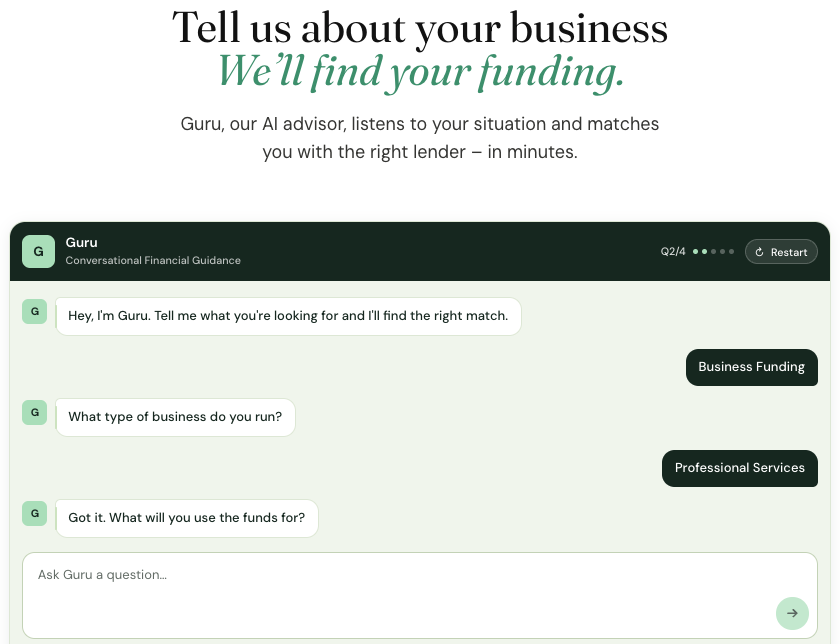
Lending Gurus cuts that search time significantly. Guru, the platform’s conversational intake tool, listens to your situation — business stage, funding need, use of funds — without a hard credit pull. It then matches you to vetted lending partners whose products fit your profile, including partners that work with microloans, equipment financing, and alternative capital structures suited to early-stage businesses.
How to start in two steps:
- Run a quick intake with Guru at Lending Gurus — describe your business, your funding need, and your timeline. No hard credit pull at this stage.
- Review your matched partners, compare their products, and follow each partner’s own application process to move forward.
Important: Lending Gurus is a matching platform and lead aggregator, not a lender or broker. Every approval decision, rate, term, and loan amount is made by the matched lending partner — not by Lending Gurus. No outcomes are guaranteed. Review the platform terms before you start.
Sources
- SBA microloans offer proven low-dollar financing for small businesses
- DOE Small Business Innovation Research (SBIR) and Small Business Technology Transfer (STTR)
- How to get a startup business loan with no money
- Regulation Crowdfunding
- Pre-seed capital for startups
This article is general information, not a substitute for advice from a qualified financial advisor. Consult a qualified financial professional about your own circumstances before acting on anything here.
