
You likely qualify to apply for an SBA loan if your business operates for profit, is based in the U.S., meets SBA size standards, and can show it generates enough cash flow to repay debt. That’s the short version. The lender you work with makes the final call on approval, rate, and terms, but the SBA’s own eligibility rules set the floor everyone has to clear first.
The single biggest disqualifier isn’t credit score. It’s an unclear or undocumented ability to repay. A business with mediocre credit but two years of clean bank statements and steady revenue often has a better shot than one with excellent credit and no financial paper trail. A handful of industries, including lenders, gambling operations, and businesses engaged in lobbying, are ineligible outright under federal SBA regulations, no matter how strong the financials look.
Table of Contents
- Complete Document Checklist Lenders Will Ask For
- Who Is Eligible for an SBA Loan?
- Program-by-Program Requirements: 7(a), 504, and Microloans
- How Lenders and the SBA Evaluate Your Application
- How to Apply and What the Timeline Looks Like
- Common Application Denials, and How to Fix Them
- From Our Experience: Practical Prep Tips Before You Apply
- If You Want Help: How Lending Gurus Can Connect You to SBA-Approved Lenders
- Frequently Asked Questions
- Sources
Complete Document Checklist Lenders Will Ask For
Every SBA lender wants proof you can run a business and pay back what you borrow. The paperwork exists to prove both. Gather these before you contact a lender, not after, because a slow document hunt is the number one reason applications stall in underwriting.
Start with the must-haves:
- Personal financial statement (SBA Form 413) for every owner with 20% or more equity
- Personal and business tax returns for the last two to three years
- Current profit and loss statement and balance sheet, ideally no older than 90 days
- Accounts receivable and inventory reports, if your business carries either
- Business plan or use-of-proceeds statement explaining exactly what the loan pays for
- Resumes for owners and key managers, especially for startups without a long operating history
- Legal documents: articles of incorporation, leases, contracts, and licenses
- Authorization and consent forms the lender needs to pull records and verify information
Two SBA forms show up in nearly every application package. Here’s what each one does and where to get it.
| Form | Purpose | Source |
|---|---|---|
| SBA Form 413 | Personal financial statement from each owner holding 20%+ equity; feeds directly into the lender’s guarantee analysis | Sba |
| Form 1919 | Borrower information form, usually one of the first documents a lender requests to open the file | SBA.gov |
Beyond the standard SBA paperwork, individual lenders often tack on their own requests: additional months of bank statements, aged accounts receivable reports, or personal tax transcripts pulled directly from the IRS. Ask your lender for their full document list on day one so you’re not scrambling later.
Pro Tip: Put together a one-page cash-flow summary that ties directly to what the loan will fund, before the lender even asks for it. Underwriters spend most of their time reconstructing exactly this picture from raw statements. Handing it to them already built often shaves real time off the review.

Who Is Eligible for an SBA Loan?
To qualify for any SBA-backed loan, your business must operate for profit, be physically located in the U.S., fall within your industry’s SBA size standard, and demonstrate a reasonable ability to repay. Miss any one of these, and no amount of paperwork will get you approved.
SBA size standards vary by industry and are usually based on either average annual receipts or number of employees, not a single number that applies to everyone. A construction company and a software firm face completely different thresholds. Before you apply, check your NAICS code against the SBA’s size standards to confirm you actually qualify as “small” in the government’s eyes.
The SBA excludes certain business types from its loan programs entirely, regardless of financial strength. Lending, investment, and speculative businesses; gambling operations; and businesses engaged in lobbying or political activities fall outside eligibility under 13 CFR 120.110. Passive real estate holding companies and businesses that restrict trade based on illegal criteria also fail eligibility, no matter how solid their financials look on paper.
Eligibility isn’t purely a numbers exercise, either. Lenders and the SBA look at the character and management background of owners, and individual banks frequently layer on their own underwriting standards beyond the federal minimum. Two lenders can look at the identical file and reach different conclusions.
If you’re not sure where your business falls, don’t guess. Your local Small Business Development Center offers free counseling and can walk through size standards and eligibility questions with you before you ever submit an application.
Program-by-Program Requirements: 7(a), 504, and Microloans
Most businesses should start by evaluating the 7(a) program. It’s the SBA’s most flexible option, and it covers the widest range of uses, from working capital to acquisitions to owner-occupied real estate. The 504 program and microloans serve narrower, more specific needs.
Here’s the quick version of what separates them:
- 7(a): Has a maximum loan amount set by the SBA and covers working capital, equipment, business acquisition, and owner-occupied real estate; delivered through SBA-approved lenders
- 504: SBA debenture caps at a set maximum amount, slightly higher for small manufacturers and certain energy projects; funds major fixed assets like real estate and heavy equipment; delivered exclusively through Certified Development Companies
- Microloans: Smaller loan amounts for startups and very small operations, often used for working capital, inventory, and equipment; delivered through nonprofit intermediary lenders
The programs also differ in how they structure risk and cost. A generic comparison makes the differences easier to scan:
| Feature | 7(a) | 504 | Microloan |
|---|---|---|---|
| Best for | General business needs, working capital, acquisitions | Long-term fixed assets, real estate, equipment | Very small startup or operating costs |
| Max SBA amount | $5 million | $5 million | Smaller, program-dependent |
| Permitted uses | Working capital, equipment, acquisition, owner-occupied real estate | Fixed assets only, not working capital | Working capital, inventory, supplies, equipment |
| Collateral posture | Business assets, sometimes personal assets | Real estate/equipment financed typically serves as collateral | Minimal to moderate |
| Typical down payment | Lower down payments common | Around 10% borrower equity in the standard structure | Varies by intermediary |
| Delivery channel | SBA-approved bank or Preferred Lender | Certified Development Company (CDC) paired with a bank | Nonprofit intermediary lender |
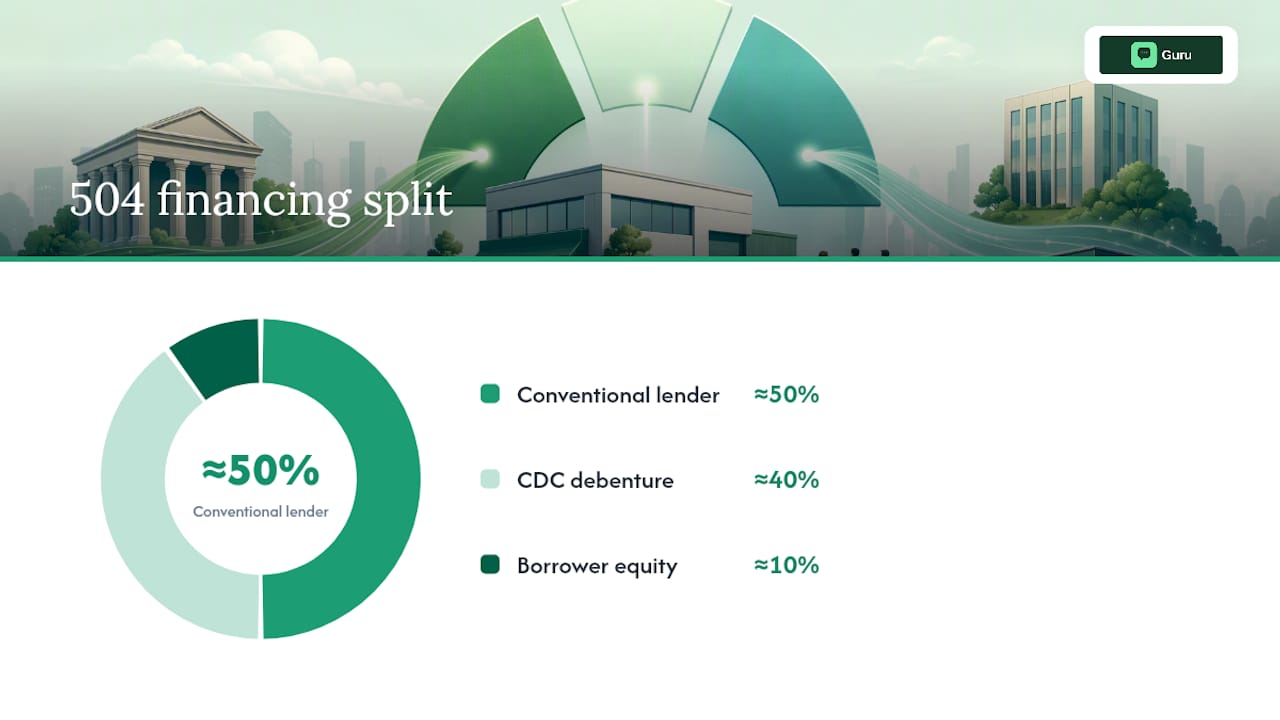
The 504 program splits financing across three parties: roughly half from a conventional lender, roughly 40% from the CDC debenture, and the remaining 10% from the borrower. That structure is why 504 loans tend to carry lower down payment requirements than a conventional commercial real estate loan.
One recent change worth knowing about: as of 2026, SBA policy allows combining 7(a) and 504 financing up to a cumulative $10 million cap on a single project. If your deal needs both working capital and a major real estate purchase, this blended structure is worth raising with your lender directly.
How Lenders and the SBA Evaluate Your Application
Lenders prioritize cash flow above everything else. Your documented ability to repay the loan out of business revenue matters more than your credit score, your collateral, or how long you’ve been in business, though all three still factor into the decision.
Personal guarantees come into play for any owner holding 20% or more of the business, which is why SBA Form 413 asks for detailed personal financial information from each of them. The guarantee means your personal assets stand behind the business debt if the company can’t pay. Lenders verify your repayment ability by working through tax returns, profit and loss statements, and bank statements, cross-checking that the numbers on paper match what’s actually moving through your accounts.
Credit score plays a role, but it’s one factor among several, not the gatekeeper. A lender weighs your credit history alongside monthly revenue trends, time in business, and how consistent your cash flow looks month over month. Weak credit paired with strong, well-documented cash flow can still result in approval. Strong credit paired with unpredictable revenue often struggles.
Pro Tip: The single most persuasive thing you can hand a lender is three months of reconciled bank statements alongside an owner-signed cash-flow projection that explicitly ties to what the loan will be used for. It shows the lender you understand your own numbers and have already thought through repayment, which speeds up underwriting more than almost anything else you can submit.

How to Apply and What the Timeline Looks Like
Start by preparing your full document package, then choose an SBA-approved lender, either directly or through SBA Lender Match, before submitting your application for underwriting.
Here’s the process broken into steps:
- Prepare your documents. Assemble tax returns, financial statements, your business plan, and the SBA forms covered earlier before you contact anyone.
- Choose a lender. Use SBA Lender Match or reach out directly to banks and credit unions that participate in SBA lending programs.
- Submit your application. Provide your complete package to the lender, including all required SBA forms.
- Go through underwriting. The lender reviews your financials, may request additional documents, and works through any conditions before final approval.
- Close and receive funding. Once approved, you sign loan documents and funds get disbursed according to the agreed use of proceeds.
Timelines vary widely depending on loan size, program, and lender. Preferred Lenders Program (PLP) participants can approve loans in-house without sending the file to the SBA for a separate signoff, which cuts weeks off the process. Some PLP lenders report approving smaller, well-documented 7(a) requests in roughly a week once they have a complete application in hand. Larger loans, 504 deals involving a CDC, or files with missing documentation take longer, sometimes stretching into months.
Pro Tip: The fastest applications share one trait: a complete package submitted on day one, with clear, consistent financial statements and a direct line of communication between you and your lender’s underwriter. Every round of “can you send us X” adds days, sometimes weeks, to your timeline.
Common Application Denials, and How to Fix Them
Most SBA loan denials trace back to one of a handful of issues: incomplete documentation, weak cash-flow projections, insufficient collateral for the lender’s risk appetite, unverifiable revenue, or a business activity that falls outside SBA eligibility.
Each of these is fixable, sometimes quickly:
- Incomplete documentation: Gather a full 12 months of bank statements and every tax return the lender requested before you resubmit anything.
- Weak cash-flow projections: Have a CPA prepare or review your profit and loss statement so the numbers hold up under scrutiny.
- Insufficient collateral: Talk to your lender about restructuring the deal, adding owner equity, or exploring whether a different SBA program fits the collateral you actually have.
- Unverifiable revenue: Reconcile your bank deposits against your reported revenue before you apply again; unexplained gaps are one of the fastest ways to trigger a denial.
- Ineligible business activity: Review 13 CFR 120.110 directly. If your business model falls into an excluded category, no amount of paperwork changes that outcome.
Some denials are final because the business itself doesn’t meet eligibility rules. Most, though, are reversible with better documentation or a different lender whose risk tolerance fits your situation. If one lender turns you down, that doesn’t mean every lender will. Appeal with the original lender if the issue is fixable, apply with a different SBA-approved lender, or work with a matching service like Lending Gurus to find lenders better suited to your specific financial profile.
From Our Experience: Practical Prep Tips Before You Apply
At Lending Gurus, we see certain applications move through faster than others, and the pattern isn’t subtle. The businesses that get matched to the right lender quickly are the ones that show up with their financial story already organized.
A few things consistently help. Clean up your cash-flow exhibits before a lender ever sees them, don’t leave the underwriter to reconstruct your numbers from raw statements. Make sure an owner is actually available to answer underwriting questions promptly; a file that sits waiting on a callback loses momentum fast. If your tax returns show a one-off expense or an unusual year, get ahead of it with a short written explanation rather than letting the lender guess. And match your loan request to the program that actually fits, a 504 loan for working capital needs is the wrong tool for the job. Every lender will flag that mismatch immediately.
None of this guarantees approval. Lending Gurus matches you with lending partners, but those partners make every decision on approval, rate, and terms. What good preparation does is make your file easier to say yes to.
If You Want Help: How Lending Gurus Can Connect You to SBA-Approved Lenders
Guru, the free conversational tool from Lending Gurus, matches you to vetted lending partners in minutes, without a hard credit pull, so you can find lenders that actually fit your situation instead of guessing.
Sorting through which lenders actively work with SBA programs, which ones lean toward Preferred Lender status for faster approvals, and which ones have relationships with Certified Development Companies for 504 deals takes real time when you’re doing it lender by lender. Guru shortens that search by asking about your business and matching you against partners suited to your revenue, time in business, and financing need.
Here’s what the service does, and doesn’t do:
- Matches you to lending partners based on your specific business profile, using a conversational interface, not a stack of forms
- Involves no hard credit pull at the matching stage
- Does not guarantee approval, and does not set rates, terms, or funding amounts; the lending partner decides all of that
- Covers a range of financing needs beyond SBA loans, including working capital, equipment financing, and lines of credit
If you’re ready to see which lenders fit your business, see how Lending Gurus works and start the matching conversation with Guru today.
Frequently Asked Questions
What credit score do I need for an SBA loan?
There’s no single published cutoff. Credit score is one factor lenders weigh alongside cash flow, time in business, and revenue consistency, not the deciding factor on its own.
Can I get an SBA loan for a startup with no revenue history?
It’s harder, but not impossible. Lenders lean more heavily on your business plan, owner resumes, and personal financial strength when there’s no operating history to review. Microloans and 7(a) loans are both options worth exploring for newer businesses.
Do I need collateral for every SBA loan?
Collateral requirements depend on the program and the lender’s risk tolerance. 504 loans typically use the financed asset itself as collateral, while 7(a) loans may require additional business or personal assets depending on the deal size and lender.
How long does SBA loan approval usually take?
It varies by program, loan size, and lender. Preferred Lenders Program participants can sometimes approve smaller, well-documented 7(a) requests in about a week; larger loans or 504 deals involving a CDC typically take longer.
Is Lending Gurus a lender?
No. Lending Gurus is a free matching platform that connects you to vetted lending partners. Those partners make all final decisions on approval, rates, and terms.
This article is general information, not a substitute for advice from a qualified financial advisor. Consult a qualified financial professional about your own circumstances before acting on anything here.
Sources
These are the pages worth bookmarking if you want to verify anything in this article directly from the source.
Use the 504 page specifically when you’re hunting for a Certified Development Company in your region, and use the 7(a) page’s Lender Match tool when you want a direct line to SBA-approved lenders without cold-calling banks one by one.
