
The fastest way to get business funding online is through an online lender or a matching service like Lending Gurus, where you can prequalify with a soft credit check and receive a decision within hours to a few business days. If cost matters more than speed, the U.S. Small Business Administration and traditional banks offer lower rates, but expect a longer process measured in weeks.
Your immediate next steps:
- Prequalify now using a matching tool like Guru (no hard credit pull required) to see which lenders fit your profile.
- If you prefer a bank or SBA route, pull together your last three months of bank statements, your most recent business tax return, and your EIN before you start any application.
- Check Usa to confirm whether any federal programs apply to your situation.
Table of Contents
- What are the main online funding options for small businesses?
- How do you apply for business funding online, step by step?
- What do online lenders actually look at when you apply?
- How do you compare online loan offers and estimate real cost?
- Where should you start your online funding search?
- How do you spot predatory lenders and online scams?
- When does using Lending Gurus (Guru) make sense?
- What the funding process actually rewards
- Lending Gurus connects you to vetted lenders in minutes
- Sources
What are the main online funding options for small businesses?
Not every funding product fits every business. The right choice depends on how long you’ve been operating, your monthly revenue, how fast you need capital, and what you’ll use the money for. Here’s a concise breakdown, followed by a quick comparison.
- SBA-backed loans: Government-guaranteed loans through approved lenders. Lower rates and longer terms than most alternatives, but the application is detailed and approval takes 30–60 days. Best for established businesses that can wait.
- Bank term loans: Competitive rates for businesses with strong financials and at least two years of history. Slower than online lenders.
- Online term loans and marketplaces: Fast decisions, often 1–3 business days to funding. Higher effective cost than banks, but accessible to younger businesses. Best when you need capital quickly.
- Lines of credit: Draw what you need, repay, and draw again. Good for managing cash flow gaps or covering irregular expenses.
- Merchant cash advances (MCAs) / revenue-based funding: Repayment tied to a percentage of daily or weekly sales. No fixed monthly payment, but the effective cost is often the highest of any product. Best for businesses with strong card sales and short-term needs.
- Invoice factoring: Sell unpaid invoices to a factoring company for immediate cash. Useful for B2B businesses waiting on slow-paying clients.
- Equipment financing: The equipment itself serves as collateral. Accessible even with limited credit history because the lender has a tangible asset to recover.
- Business credit cards: Useful for small, recurring purchases and building business credit. Not suited for large capital needs.
- Crowdfunding: Platforms like Kickstarter or Indiegogo let you raise money from the public, often in exchange for early product access. Works well for consumer product launches.
- Investors (angel/venture capital): Equity in exchange for capital. No repayment, but you give up ownership. Relevant for high-growth startups, not most small businesses.
Agricultural businesses have a separate federal route: the USDA Farm Service Agency administers farm loan programs with eligibility rules specific to agricultural operations.
The QuickBooks business funding guide makes a point worth repeating: evaluate your repayment capacity first, not just whether you’ll qualify. The product you can afford to repay is more important than the product with the easiest approval.
How do you apply for business funding online, step by step?
The online application process is more straightforward than most business owners expect, provided you have your documents ready before you start.
- Prequalify with a soft pull. Most reputable online lenders and matching tools let you check your eligibility without a hard credit inquiry. Use this step to see realistic offers before committing to a full application.
- Gather your documents. Pull together everything lenders will ask for before you open a single application (see the checklist below).
- Submit your application. Complete the lender’s online form. For online lenders, this typically takes 15–30 minutes. For banks and SBA, expect a longer form and additional back-and-forth.
- Respond to verification requests promptly. Lenders often request clarification or additional documents during underwriting. Slow responses are one of the most common reasons for delays.
- Review the offer carefully. Check the APR or factor rate, total repayment amount, origination fees, and prepayment terms before signing.
- Sign and receive funds. Online lenders typically deposit funds within one to three business days of approval.
Documents to prepare before you apply:
- Last 3–6 months of business bank statements
- Most recent 2 years of business tax returns (and personal returns if required)
- Profit and loss (P&L) statement and balance sheet
- Business formation documents (articles of incorporation, LLC operating agreement)
- Employer Identification Number (EIN)
- Government-issued ID and ownership information (percentage of ownership for each owner)
Typical timelines:
| Lender type | Decision | Funding |
|---|---|---|
| Online lender / marketplace | Same day to one business day | 1–3 business days |
| Community bank | 3–7 business days | 1–2 weeks |
| SBA loan | 2–4 weeks (express) to 60+ days | 1–2 weeks after approval |
Pro Tip: Organize all your documents into a single folder before you start. Lenders who receive complete applications process them faster. Missing a bank statement mid-application can push your decision back by days.

What do online lenders actually look at when you apply?
Credit score gets most of the attention, but it’s rarely the deciding factor for business loans. Lenders weight these factors most heavily:
- Monthly revenue: Most online lenders want to see consistent monthly deposits. The minimum varies by product, but revenue is the primary signal of repayment capacity.
- Time in business: Many online lenders require at least six months of operating history. SBA and bank loans typically want two or more years.
- Cash flow: Lenders look at whether your business generates enough free cash after expenses to cover a new payment. A profitable business with poor cash flow timing can still struggle to qualify.
- Business financials: P&L statements and balance sheets tell the story of your business’s health beyond what bank statements show.
- Credit score (personal and business): A factor, but not the only one. Equipment financing and invoice factoring are often more forgiving on credit because the collateral or receivables reduce lender risk. MCAs focus almost entirely on revenue.
Eligibility nuances by product type:
- SBA loans require good personal credit, two or more years in business, and demonstrated ability to repay. The SBA’s loan programs page outlines specific eligibility themes.
- Online term loans are more flexible. Some lenders work with businesses as young as six months and with credit scores below what banks require.
- Equipment financing is accessible even to newer businesses because the equipment secures the loan.
- MCAs are primarily revenue-driven. A business with strong daily card sales can qualify even with a limited credit history.
During online underwriting, lenders commonly use bank account verification (Plaid or similar), automated tax transcript pulls, and sometimes a business credit report from Dun & Bradstreet or Experian Business.
How do you compare online loan offers and estimate real cost?
Two offers with similar loan amounts can have very different total costs. Here’s what to compare before you sign anything.
| Dimension | What to check |
|---|---|
| Best for (use case) | Does this product match your actual need? |
| Loan size | Does the maximum fit your capital requirement? |
| Time to funding | Does the timeline match your urgency? |
| Eligibility | Do you meet the revenue and time-in-business minimums? |
| APR / factor rate | What is the annualized cost of borrowing? |
| Origination fee | Is it deducted from proceeds or added to the balance? |
| Prepayment terms | Is there a penalty for paying early? |
| Paperwork complexity | How many documents does the lender require? |

APR vs. factor rate: Banks and SBA lenders quote APR, which lets you compare apples to apples. Many online lenders and MCA providers use a factor rate (e.g., 1.25), which is not an annual rate. To convert: multiply your loan amount by the factor rate to get total repayment, then calculate the implied APR based on your repayment term. A factor rate of 1.25 on a 6-month repayment schedule carries a much higher effective APR than the same rate over 18 months.
A simple example: You borrow $50,000 at a factor rate of 1.20 with a 12-month repayment term.
- Total repayment: $50,000 × 1.20 = $60,000
- Total cost of borrowing: $10,000
- Monthly payment: $60,000 ÷ 12 = $5,000
- Implied APR: roughly 35–40% annualized (varies by calculation method)
Compare that to an SBA loan at a lower rate over a longer term, and the monthly payment may be smaller and the total cost significantly lower. The trade-off is the time it takes to get funded.
Where should you start your online funding search?
Starting in the right place saves time and protects you from predatory offers. These are the most reliable starting points:
- SBA loan programs: The official source for SBA-backed loan types, eligibility guidance, and a lender-matching tool. If you qualify, SBA loans are among the most cost-effective options available.
- SBA local assistance: Free counseling from SCORE mentors, Small Business Development Centers (SBDCs), and Women’s Business Centers. Especially useful if your application is complex or you’re applying for the first time.
- Usa: A clear overview of funding sources and a reminder that federal grants for typical private businesses are rare, not the norm.
- QuickBooks business funding guide: Practical guidance on matching funding type to business goals and preparing financials.
- Vetted online marketplaces and matching tools: Services that let you prequalify with multiple lenders in one session, using a soft pull, so you can compare offers without affecting your credit score.
If you’re a woman-owned business, the SBA’s WOSB certification program opens access to specific contracting and funding programs. Similarly, the SBA 8(a) certification is worth exploring if your business qualifies for federal contracting opportunities that can support financing.
Pro Tip: Before submitting a full application anywhere, confirm the lender offers a soft prequalification step. A hard credit pull without a real offer in return costs you credit score points for nothing. Any reputable lender will tell you upfront which type of inquiry they use.
How do you spot predatory lenders and online scams?
Online funding is fast, but that speed also attracts bad actors. These red flags should stop you cold:
- Guaranteed approval claims. No legitimate lender guarantees approval before reviewing your financials. It’s a hallmark of a scam or a predatory product.
- Pressure to wire money upfront. Legitimate lenders do not charge advance fees before funding. Any request for a wire transfer before you receive funds is a scam.
- No written contract or fee disclosure. You have the right to see the full cost of borrowing, including APR or factor rate, origination fees, and total repayment, in writing before you sign.
- Requests for unnecessary personal data early in the process. A Social Security number is needed for a credit check, but a lender asking for it before you’ve seen any terms is a warning sign.
- No verifiable business address or phone number. Search the company name, check the Better Business Bureau, and verify the physical address before sharing any financial information.
If you’ve been targeted by a scam: Stop all communication immediately. Do not send any additional money or documents. Report the incident to the Federal Trade Commission at reportfraud.ftc.gov and to your state attorney general’s office. If you shared bank account information, contact your bank the same day to flag the account and discuss next steps.
When does using Lending Gurus (Guru) make sense?
Lending Gurus is a free matching service, not a lender. Guru, the platform’s conversational tool, listens to your situation and connects you to vetted lending partners without running a hard credit pull during the initial match.
Guru is a strong fit when you:
- Need to move quickly and want to see multiple options in one session.
- Aren’t sure which funding product fits your business profile.
- Want to prequalify without affecting your credit score.
- Prefer a guided process over filling out multiple separate applications.
What Guru asks: Basic information about your business, including monthly revenue, time in business, how much you need, and what you’ll use the funds for. No hard credit pull at the matching stage.
What Lending Gurus does not promise: Guru matches you to partners based on your profile. The partners set their own approval criteria, rates, terms, and funding amounts. Lending Gurus cannot guarantee approval, a specific rate, or a funding timeline.
Pro Tip: Use Guru as your first step, not your only step. Once you receive matched offers, compare them against the cost framework in the section above before committing to any one lender.
What the funding process actually rewards
Most business owners focus on their credit score when preparing to apply. That’s understandable, but it’s not where lenders spend most of their attention.
The applications that move fastest and get the best offers share one trait: complete, clean financials submitted on day one. A business with a modest credit score but three months of consistent bank statements, a clear P&L, and organized formation documents will often outperform a higher-credit applicant who submits documents piecemeal over a week.
The second thing lenders reward is honesty. Overstating revenue or understating liabilities doesn’t survive underwriting. It just delays the process and sometimes results in a worse offer than you’d have received with accurate numbers.
Matching tools like Guru are most useful when you’re not sure which product fits. But once you know what you need, the quality of your application package matters more than the platform you use to submit it. Prepare your documents, know your numbers, and apply with complete information the first time.
Lending Gurus connects you to vetted lenders in minutes
Sorting through lenders one by one takes time you may not have. Lending Gurus cuts that process down to a single conversation with Guru, which matches you to vetted lending partners based on your actual business profile, with no hard credit pull to start.
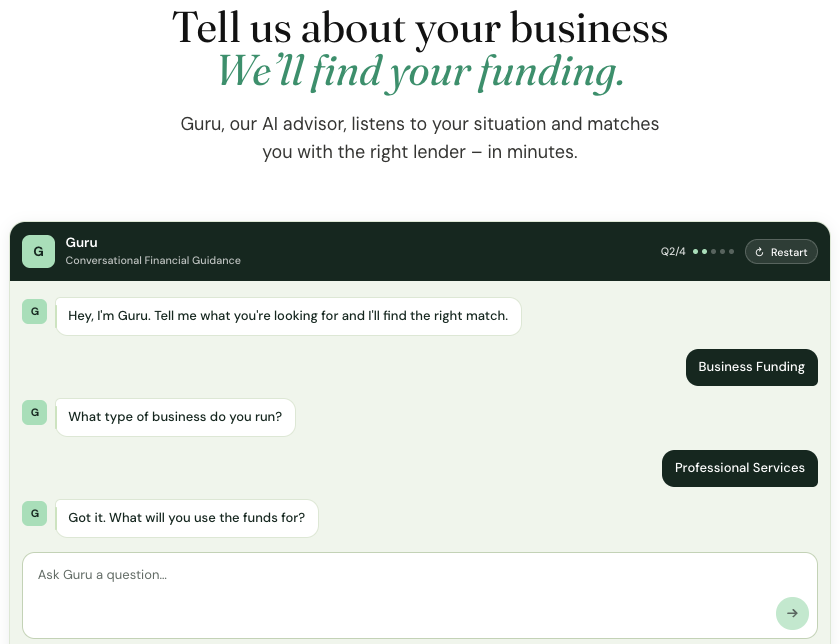
Tell Guru your monthly revenue, how long you’ve been in business, how much you need, and what you’ll use it for. Guru does the matching. You review the options and decide. There’s no obligation, no upfront cost, and no impact on your credit score at the matching stage.
Start your match now at Lending Gurus and see which lenders fit your business today.
Lending Gurus is a free matching service. All approvals, rates, terms, and funding amounts are determined solely by the matched lending partners. See our Terms & Conditions for full details.
Sources
Confirm program details directly on official pages before applying. Rules and eligibility thresholds change, and the primary source is always more reliable than a summary.
- Business funding: 2026 guide to get financing | QuickBooks Blog
- Loans – Small Business Administration
- How to start and fund your own business
- How To Get a Business Loan in 2026 | Financer
- Farm loan programs | FSA (USDA)
This article is general information, not a substitute for advice from a qualified financial advisor. Consult a qualified financial professional about your own circumstances before acting on anything here.
