
You can likely qualify for working capital financing if you can show consistent monthly revenue, positive cash flow, and at least several months of operating history. Get several months of your most recent bank statements ready, pull your most recent profit-and-loss statement, and run Guru at Lending Gurus to see which lenders match your profile.
Your first three steps:
- Pull 3–6 consecutive months of business bank statements
- Print or export a current year-to-date P&L and balance sheet
- Run Guru at Lending Gurus for lender matches without a hard credit pull
Lenders weight monthly revenue, time in business, and cash flow most heavily. Credit score matters, but it rarely determines approval on its own. A business with strong, consistent deposits and six or more months of operating history will often outperform a business with a higher credit score but uneven revenue.
Table of Contents
- What do working capital loan requirements actually look like?
- What documents do you need for a working capital loan?
- How do requirements change by loan type?
- When do lenders require collateral or a personal guarantee?
- How do lenders actually underwrite your application?
- What does the application process look like from start to funding?
- How can you improve your approval odds before applying?
- How Lending Gurus helps you find the right working capital lender
- Ready to find a lender? Start with Lending Gurus
- Sources
What do working capital loan requirements actually look like?
Working capital loan requirements vary by lender type and product, but every underwriter is checking the same core signals: can your business generate enough cash to repay what it borrows?
According to JPMorgan, lenders evaluate working capital through either a cash-flow approach or an asset-based approach. Cash-flow underwriting looks at your deposit history and revenue consistency. Asset-based underwriting looks at what you own — receivables, inventory, equipment — and lends against that value.
Here are the core criteria lenders check:
- Time in business: Online lenders often accept relatively short operating histories. Traditional banks typically want longer operational histories.
- Monthly and annual revenue: Most lenders set a minimum monthly revenue requirement. Higher revenue generally supports eligibility for larger loans.
- Cash flow consistency: Lenders scan for regular, predictable deposits. Gaps, spikes, or frequent overdrafts raise questions.
- Personal credit score: Relevant, especially for newer businesses with limited credit history, but rarely the deciding factor when revenue is strong.
- Business credit profile: Lenders may check your Dun & Bradstreet or Experian Business file, particularly for larger amounts.
- Industry risk: Some industries (restaurants, construction, retail) face tighter scrutiny because of historically higher default rates.
- Ownership documentation: Most lenders require proof of ownership and a government-issued ID for any owner holding 20% or more.
How lender types differ on minimums
Bankrate notes that online lenders often accept shorter operating histories and lower personal credit scores than traditional banks, making them more accessible for newer businesses that need funding quickly.
| Lender type | Typical time in business | Typical minimum monthly revenue | Personal credit score range |
|---|---|---|---|
| Online / alternative lender | Shorter operating history | Lower revenue threshold | More flexible |
| Community bank | Moderate operating history | Moderate revenue requirements | Moderate credit score |
| Traditional bank | Longer operating history | Higher revenue requirements | Higher credit score |
| SBA lender | Longer operating history | Varies by program | Moderate credit score |
Ranges are illustrative. Individual lenders set their own criteria and may deviate significantly. Source: Crestmont Capital, Bankrate.
Revenue and cash flow carry more weight than credit score alone. A business with two years of steady deposits and modest credit will often get approved where a business with a high score but erratic cash flow will not.
What documents do you need for a working capital loan?
CerebroCapital’s document checklist identifies the standard package lenders request for online applications. Having these ready before you apply cuts processing time and reduces back-and-forth.
Core document checklist:
- Business bank statements: Several consecutive months of recent bank statements. This is one of the most important documents in most applications.
- Business tax returns: Two years, often requested. Some online lenders may waive this for smaller or shorter-term products.
- Year-to-date P&L statement: Current, signed by the owner or accountant.
- Balance sheet: Current, showing assets, liabilities, and equity.
- Accounts receivable aging report: Required for invoice financing; useful for any application to show outstanding customer balances.
- Invoices: Relevant for invoice factoring or financing products.
- Business formation documents: Articles of incorporation, LLC operating agreement, or DBA registration.
- EIN confirmation letter: IRS-issued, confirms your federal tax ID.
- Government-issued ID: For each owner with 20% or more ownership.
- Voided business check: Confirms bank account details for funding.
Smaller online lenders may approve with just bank statements, a P&L, and an ID for amounts under a certain threshold. Larger requests and SBA products will require the full package.
File preparation tips: Save everything as a PDF with clear, consistent file names (e.g., “BusinessName_BankStatements_Jan–Jun2025.pdf”). Lenders process applications faster when documents are labeled and complete.
Pro Tip: Attach a one-page cover sheet to your document bundle that lists your business name, EIN, monthly revenue average, desired loan amount, and intended use. Crestmont Capital recommends this approach as a way to reduce underwriter questions and speed up the review.
How do requirements change by loan type?
Not all working capital products underwrite the same way. The product you choose shapes which documents matter most and how quickly you can get funded.
Term loans
Traditional term loans look at the full picture: time in business, credit score, revenue, and tax returns. Banks and SBA lenders use these most often. Expect a longer review process and more documentation.
Lines of credit
JPMorgan describes revolving lines of credit as a common working capital structure where interest is charged only on the amount drawn. Underwriting focuses on cash flow and creditworthiness. Banks typically require stronger credit profiles; online lenders are more flexible.
Merchant cash advances (MCAs)
MCAs underwrite on daily card volume, not credit score. If your business processes a consistent volume of credit and debit card transactions, you may qualify even with limited credit history. The cost structure is a fixed factor rate rather than an interest rate, so compare carefully.
Invoice financing and factoring
The quality of your receivables drives approval here. Lenders look at who owes you money, how old the invoices are, and whether your customers are creditworthy. Your own credit score matters less than your customers’ payment history.
SBA loans
SBA programs require longer time in business, full tax returns, and a more detailed application package. The SBA’s Export Working Capital Program provides standardized authorization templates and sample loan-agreement language for businesses pursuing export financing. SBA loans take longer to fund but typically carry lower rates.
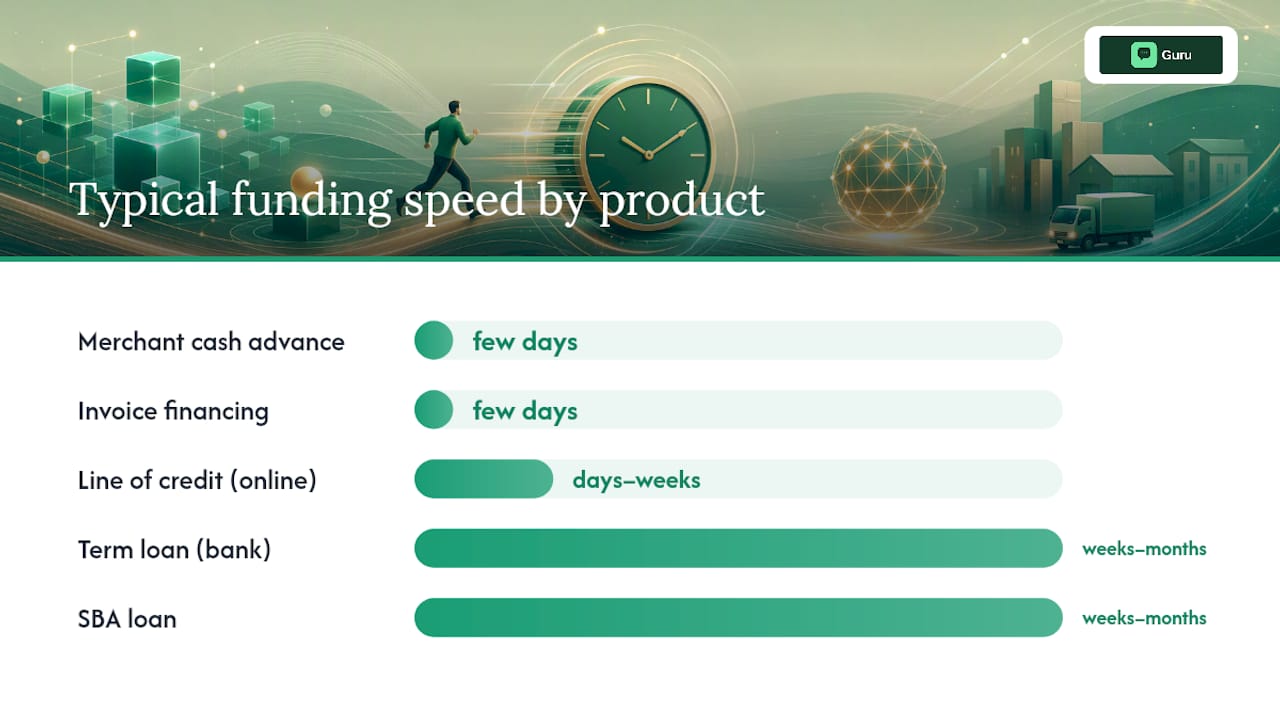
| Product | Key underwriting focus | Typical funding speed | Documentation intensity |
|---|---|---|---|
| Term loan (bank) | Full financials, credit, time in business | Several weeks to several months | High |
| Line of credit (online) | Cash flow, credit | Several days to several weeks | Moderate |
| Merchant cash advance | Card volume, daily deposits | A few business days | Low |
| Invoice financing | Receivables quality | A few business days | Moderate |
| SBA loan | Full financials, tax returns, business plan | Several weeks to several months | High |
Funding speeds are general ranges. Individual lenders vary. Source: Crestmont Capital.
Choosing the right product: If you need cash within a week and have strong card volume, an MCA or online line of credit fits better than an SBA loan. If you have outstanding invoices and need to bridge a gap, invoice financing is often the fastest path. For larger amounts with lower cost, a term loan or SBA product is worth the longer timeline.
When do lenders require collateral or a personal guarantee?
Working capital loans can be secured or unsecured, and the distinction affects both your risk and your approval odds.
Secured loans require you to pledge an asset. Common collateral types include:
- Accounts receivable (most common for asset-based lines)
- Inventory
- Equipment
- Commercial real estate
Unsecured loans rely on your creditworthiness and cash flow rather than a specific asset. Online lenders offer more unsecured products, but they often charge higher rates to offset the added risk.
Personal guarantees
Most small business lenders require a personal guarantee from any owner holding 20% or more of the business. A personal guarantee means you agree to repay the debt personally if the business cannot. This is standard practice, not a red flag.
Pro Tip: Before signing, ask whether the guarantee is limited or unlimited. A limited guarantee caps your personal exposure at a specific dollar amount or percentage. You can also ask for a release trigger, a provision that removes the personal guarantee once the loan balance drops below a set threshold. Not every lender will agree, but it is worth asking.
A few negotiation points worth knowing:
- Blanket liens (UCC filings) are common for business lines of credit. They give the lender a security interest in all business assets, not just one. Ask whether the lien can be limited to specific assets.
- If you are pledging real estate, confirm whether the lender requires a first or second lien position, as a second lien reduces your flexibility with future financing.
How do lenders actually underwrite your application?
Two metrics show up in nearly every underwriting review: the Debt Service Coverage Ratio (DSCR) and the Debt-to-Income ratio (DTI).
DSCR measures whether your business generates enough cash to cover its debt payments. The formula is straightforward: divide your net operating income by your total annual debt service. A DSCR above 1.0 means you earn more than you owe in payments. Many lenders look for a DSCR above 1.0 with some cushion to cover unexpected expenses.
DTI applies more to personal guarantee situations. It compares your total monthly debt obligations to your gross monthly income. A lower DTI signals less financial strain.
What lenders see in your bank statements
JPMorgan notes that lenders rely heavily on bank and processor data to confirm revenue and uncover risk. Underwriters are not just checking your average balance. They are looking at:
- Deposit frequency and consistency
- Whether deposits match the revenue you claimed
- NSF (non-sufficient funds) frequency
- Large one-off deposits that inflate the average
- Merchant processor data for card-based businesses
Red flags that slow or block approval
- Frequent NSFs: Even one or two per month signals cash flow stress.
- Inconsistent deposits: Gaps of two or more weeks with no activity raise questions about revenue continuity.
- High chargebacks: Common in retail and e-commerce; lenders treat this as a sign of customer disputes or fraud risk.
- Late or unfiled tax returns: Signals compliance risk and makes income verification harder.
- Large unexplained deposits: One-time transfers from personal accounts or loans can inflate your apparent revenue.
Remediation: Clean up your bank statements for 60–90 days before applying. Reduce unnecessary transfers, collect outstanding invoices, and resolve any NSF issues with your bank.
What does the application process look like from start to funding?
The sequence is fairly consistent across lenders, though the timeline varies significantly.
- Pre-application: Gather your document bundle (bank statements, P&L, ID, formation docs). Prepare your one-page cover sheet with key numbers.
- Application submission: Complete the lender’s online or paper application. Attach your full document package.
- Underwriting review: The lender verifies your documents, checks bank data, and calculates DSCR and DTI. This is where incomplete applications stall.
- Approval and offer: You receive a term sheet with the loan amount, rate or factor, repayment schedule, and any collateral or guarantee requirements.
- Acceptance and closing: Sign the agreement, complete any UCC filing or collateral documentation.
- Funding: Funds are deposited to your business bank account.
Typical timelines by lender type
Online lenders can move from application to funding in a few days when your documents are complete. Community banks typically take one to several weeks. Traditional banks and SBA lenders often take several weeks to a few months, sometimes longer for complex applications.
The single biggest delay in any application is missing or incomplete documents. A complete package submitted on day one moves faster than a partial package with follow-up requests stretching over days.
How can you improve your approval odds before applying?
A few targeted actions in the 60–90 days before you apply can meaningfully improve your position.
- Separate personal and business accounts if you have not already. Commingled accounts make cash flow analysis harder and raise compliance questions.
- Reduce unnecessary withdrawals and transfers. Lenders read your bank statements as a proxy for how you manage money. Frequent small transfers to personal accounts look like cash flow leakage.
- Collect outstanding invoices. Higher average monthly deposits directly improve your revenue picture. If collection is slow, invoice factoring can convert receivables to cash before you apply.
- Resolve NSF issues. Contact your bank to set up overdraft protection or a small line of credit to prevent NSF events from appearing in your statements.
- File any overdue tax returns. Late filings are a common denial reason. Lenders want to see that your business is current with the IRS.
- Build your business credit file. Open a net-30 trade account with a supplier that reports to Dun & Bradstreet or Experian Business. Even a few months of on-time payments adds positive history.
Pro Tip: If your bank statements are not yet strong enough for a traditional term loan, consider applying for a smaller MCA or invoice financing product first. Repaying it on time builds a track record that strengthens your next application.
When to wait versus when to apply now
Apply now if your revenue is consistent, your bank statements are clean, and you have at least six months of operating history. Wait and improve if you have multiple NSFs in the last 90 days, unfiled tax returns, or revenue that is declining month over month. Applying with a weak profile rarely helps and can result in a hard credit pull with no benefit.
How Lending Gurus helps you find the right working capital lender
Lending Gurus is a free matching platform. Guru, the platform’s conversational tool, listens to your financing needs and connects you with vetted lending partners without a hard credit pull. You describe your situation, and Guru identifies which partners are most likely to work with your profile.
What Lending Gurus does:
- Matches you to vetted lending partners based on your business profile
- Runs without a hard credit pull during the matching process
- Covers a range of products: working capital, lines of credit, equipment financing, invoice financing, and more
What Lending Gurus does not do:
- Approve loans or guarantee funding
- Set rates, terms, or loan amounts (partners decide those)
- Promise specific timelines for approval or disbursement
When a partner reaches out after a match, they will ask for the documents covered in this guide. Having your bank statements, P&L, and formation documents ready before you start the matching process means you can respond to a partner’s request the same day, which speeds up their review.
What the application process really comes down to
Most business owners spend more time worrying about their credit score than about their bank statements. That is the wrong priority. Lenders look at your bank statements first because they show what actually happened in your business, not what you reported. A credit score is a trailing indicator. Your deposit history is real-time evidence.
The owners who move through the process fastest are the ones who treat document preparation as a one-time project. Spend two hours organizing your files, labeling them clearly, and building that one-page cover sheet. You will use the same package for every lender you approach, and a clean, complete submission signals that you run a tight operation.
Ready to find a lender? Start with Lending Gurus
Sorting through lender options on your own takes time you probably do not have. Guru cuts that process down to minutes by matching your business profile to vetted lending partners without a hard credit pull.
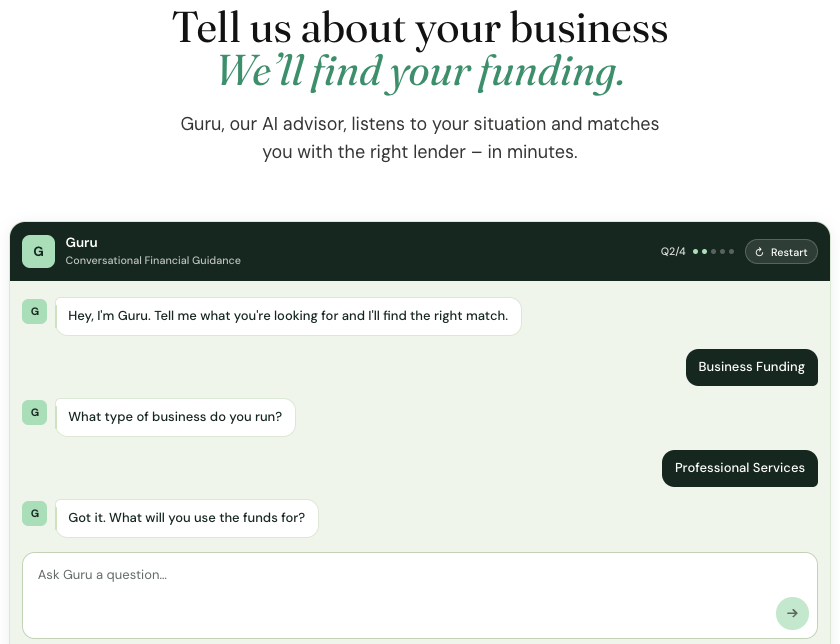
Start your match at Lending Gurus by answering a few questions about your business: monthly revenue, time in business, and what you need the funds for. Guru does the matching. Partners review your profile and reach out with options. No obligation, no hard inquiry on your credit.
Have these ready before you start:
- 3–6 months of business bank statements
- A current P&L or revenue summary
Partners set their own approval criteria, rates, and terms. Lending Gurus connects you to options; the lending decision belongs to the partner. Review the terms and conditions for full details on how the platform works.
Sources
The sources below back the facts and figures in this guide. Each one is worth bookmarking if you want to go deeper on a specific topic.
- Working Capital Loans: How They Work & Help Your Business
- Export Working Capital Authorization File Library | U.S. Small Business Administration
- What Is a Working Capital Loan And How Does It Work? | Bankrate
- Applying for a Working Capital Loan Online: Document Checklist
- Working Capital Loan Requirements: How to Qualify and Get Approved in 2026
This article is for general informational purposes only and does not constitute financial or legal advice. Confirm current requirements directly with your lender or a qualified financial professional before applying.
This article is general information, not a substitute for advice from a qualified financial advisor. Consult a qualified financial professional about your own circumstances before acting on anything here.
