
Yes, you can get a business loan using only your EIN, but the conditions matter. Most realistic options underwrite on business revenue, receivables, or collateral rather than your personal credit, and lenders still expect meaningful financial signals tied to that EIN before approving anything.

Your EIN is a tax identifier assigned by the IRS. It tells a lender who your business is legally, but it carries no repayment history on its own. Dun & Bradstreet, Experian Business, and Equifax Business are the bureaus that track what actually matters: your payment history, trade lines, and credit profile built under that EIN. The SBA and traditional banks almost always require a personal guarantee or personal credit check for younger businesses, so the realistic EIN-only paths tend to sit elsewhere.
The financing types most likely to underwrite on business metrics rather than your SSN:
- Merchant cash advances (MCAs): underwrite on daily or monthly card/bank revenue
- Invoice factoring and invoice financing: underwrite on the value of outstanding receivables
- Equipment loans: secured by the equipment itself, reducing the lender’s reliance on personal credit
- Some fintech revenue-based products: use bank statement analysis and cash flow modeling
One honest caution: most bank loans and SBA-backed products still expect a personal guarantee or a hard personal credit pull, especially if your business is under two years old.
Table of Contents
- Which loan products are most likely to accept an EIN-only application?
- What do EIN-friendly loan types actually look like side by side?
- What do lenders actually check beyond your EIN?
- What documents do you need when applying with an EIN?
- How do you apply for an EIN-only business loan, step by step?
- How do you build business credit so your EIN can stand on its own?
- What are the real trade-offs and red flags with EIN-only financing?
- Is an EIN-only loan realistic for your business right now?
- How Lending Gurus approaches EIN-friendly lender matching
- Finding EIN-friendly lenders without the guesswork
- Useful sources and next reads
Which loan products are most likely to accept an EIN-only application?
Merchant cash advances and invoice factoring are consistently the most accessible options for business owners trying to avoid personal credit reliance. That is because underwriters in those categories focus on what your business actually generates, not what your personal FICO score says.
Here is how the main lender categories break down:
| Lender / Product Type | Primary Underwriting Focus | Typical Trade-offs |
|---|---|---|
| MCA / Revenue-based lender | Daily card sales, bank deposits | Fast approval; higher effective cost; short repayment window |
| Invoice factoring firm | Accounts receivable quality and debtor creditworthiness | Tied to B2B invoices; factor fee reduces net proceeds |
| Equipment lender | Equipment value and asset condition | Collateral required; loan capped near equipment value |
| Online term lender / fintech | Bank statements, business credit score, time in business | More documentation; better rates than MCAs for qualified businesses |
| Vendor net-30 accounts | Payment history with that vendor | Small credit limits; builds trade lines over time |
The lender types that most often still require owner verification or a personal guarantee, despite marketing themselves as EIN-friendly: online term lenders and fintech working-capital products. They may skip a hard credit pull during prequalification, but most will ask for owner identity and may require a personal guarantee at closing, particularly for newer businesses.
What do EIN-friendly loan types actually look like side by side?
Scanning the options before you apply saves time. This table gives you the borrower profile most likely to qualify for each product, along with realistic expectations on speed, documentation, and cost.
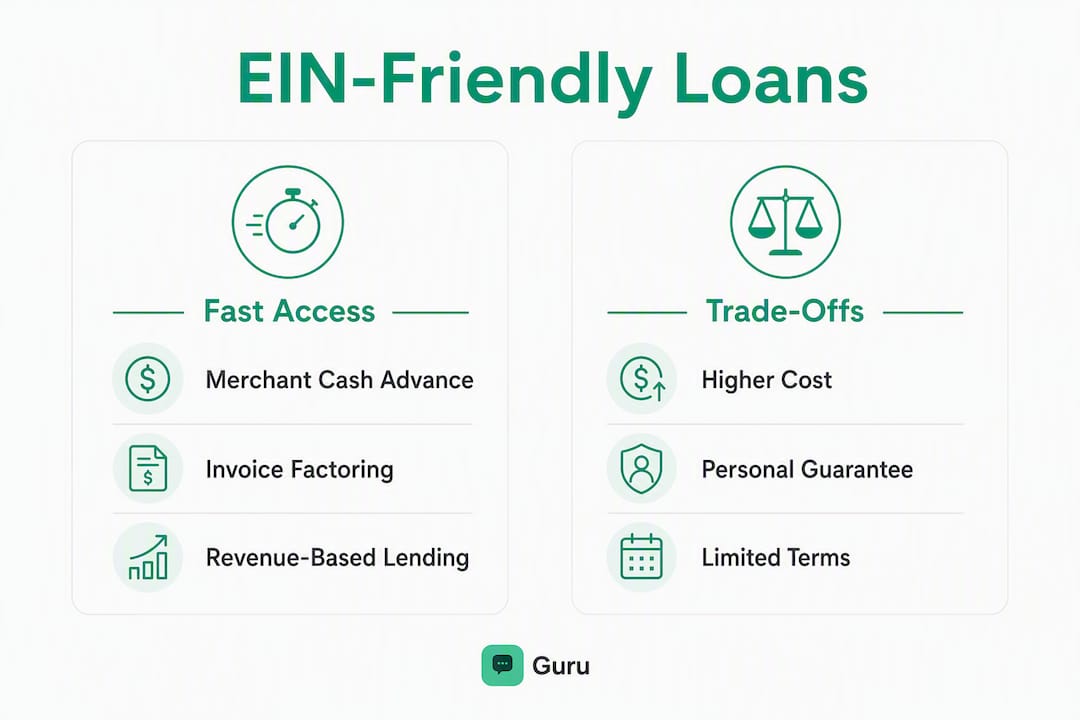
| Loan Type | Best-Fit Borrower | Speed | Key Docs | Cost / Term Trade-off |
|---|---|---|---|---|
| Merchant cash advance | Retail or service business with consistent daily card volume | Fast (days) | 3–6 months bank/card statements | Higher factor rate; daily or weekly repayment |
| Invoice factoring | B2B business with large, creditworthy receivables | Moderate (days to a week) | Invoices, debtor info, business registration | Factor fee (percentage of invoice); receivables tied up |
| Equipment financing | Established LLC or corporation buying identifiable equipment | Moderate | Equipment invoice, business formation docs, bank statements | Loan capped at asset value; longer terms possible |
| Business line of credit (online lender) | Business with 12+ months of history and growing revenue | Moderate to slow | 6–12 months bank statements, business credit report | Better rates; may require personal guarantee |
| Vendor net-30 accounts | Any registered business, even newer ones | Slow to build | EIN, business address, basic registration | Low cost; small limits; builds credit profile |
One point worth stating plainly: true “no SSN ever” products are rare. They tend to exist mainly for established corporate entities, often in the form of corporate charge cards or large-balance trade accounts where the business itself has a long, documented credit history. For most small business owners, some form of owner identity verification will come up during the process.
What do lenders actually check beyond your EIN?
Your EIN opens the door. What lenders find behind it determines whether you get funded. Even lenders that rely mostly on business metrics will pull bank statements, check time in business, and often ask for invoices or collateral documentation.
The primary underwriting inputs lenders use:
- Monthly revenue and deposit history: lenders want to see consistent, predictable cash flow, usually across 3–12 months of bank statements
- Time in business: most EIN-based underwriting requires at least 6 months of trading history; many lenders prefer 12–24 months
- Business bank statements: the cleaner and more consistent, the better; mixed personal/business transactions raise flags
- Customer invoices and accounts receivable: critical for invoice-based products; lenders assess debtor quality, not just invoice volume
- Business credit scores: Dun & Bradstreet PAYDEX, Experian Business, and Equifax Business scores all factor in when a business credit profile exists
- Collateral: for equipment loans and some term products, the asset value sets the ceiling on what you can borrow
On identity and compliance: lenders routinely verify owner identity for KYC purposes even when they avoid a hard personal credit pull. These checks are a legal compliance requirement, not a credit underwriting step, and they typically use soft or non-reporting methods. Expect to provide a government-issued ID and your ownership percentage regardless of the product type.
Pro Tip: Before submitting bank statements, review three months of deposits and make sure each one is clearly labeled. Lenders using automated underwriting models read deposit descriptions literally. Commingled personal transfers, vague “transfer” labels, or irregular deposit patterns can suppress the revenue figure the model assigns to your business, even when your actual revenue is strong. A separate business checking account with clean, consistent deposits is one of the fastest ways to present favorably.
What documents do you need when applying with an EIN?
Gathering your documents before you start an application cuts turnaround time significantly. Underwriters often issue conditional approvals quickly but then wait days for missing items. Having everything ready upfront keeps you in control of the timeline.
Core documents:
- EIN confirmation letter or IRS EIN assignment notice
- Business formation documents: articles of organization (LLC) or articles of incorporation (corporation)
- Business bank statements, typically 3–12 months depending on the product
- Recent customer invoices or signed contracts (required for invoice-based products)
- Equipment invoice or purchase agreement (for equipment financing)
- Basic financial statements or a simple profit-and-loss summary if available
Identity and KYC items (expected even without a hard SSN pull):
- Government-issued photo ID for each owner
- Ownership percentage for all principals
- Business address and contact information
Realistically, assembling these records takes one to three business days if your documents are organized. Underwriting turnaround for revenue-based products often runs one to five business days once a complete file is submitted. Traditional term products or lines of credit can take longer.
How do you apply for an EIN-only business loan, step by step?
A structured approach to your application reduces back-and-forth with underwriters and improves your chances of approval. Follow these steps in order:
- Confirm your EIN and entity registration. Verify that your EIN letter matches your business’s legal name exactly. Check your state’s business registry to confirm your entity is in good standing.
- Open a dedicated business bank account if you haven’t already. All business revenue should flow through this account. Lenders treat it as the primary evidence of your business’s financial health.
- Gather 3–12 months of business bank statements. The more history you have, the better. Organize them chronologically and label any large or unusual deposits.
- Pull your business credit reports. Check your Dun & Bradstreet PAYDEX score, Experian Business report, and Equifax Business report. Dispute any errors before applying.
- Choose the lender or product type that matches your profile. High daily card volume? Look at MCAs. Strong B2B receivables? Invoice factoring. Equipment purchase? Asset-secured financing. Established revenue history? Online term lender or line of credit.
- Submit a complete application with all supporting documentation. Include a one-page executive summary or P&L if your financials are strong but not obvious from bank statements alone.
- Respond to verification requests promptly. Underwriters often issue a conditional approval and then request additional items. Delays on your end extend the timeline.
A few presentation tips that matter:
- Consolidate bank statements into a single PDF, organized by month
- Label large deposits in a cover note so underwriters don’t have to guess
- Separate any personal transactions from business ones before submitting
Pro Tip: If you want to avoid a hard personal credit pull, ask the lender directly before submitting a full application. Request a soft-pull prequalification or a conditional offer first. Most revenue-based lenders and MCAs can give you a preliminary range without touching your personal credit report. Getting this in writing protects you if the lender later claims a hard pull was necessary.

How do you build business credit so your EIN can stand on its own?
Building a credit profile under your EIN takes time, but the steps are straightforward. Meaningful business credit profiles typically take 6–18 months to develop, and lenders generally want to see at least a few active trade lines before they’ll underwrite on business credit alone.
- Get your EIN and open a business checking account. This is the foundation. Every subsequent step builds on these two.
- Register for a D-U-N-S number through Dun & Bradstreet. It’s free and creates your business’s file in their system. Without it, your PAYDEX score can’t be calculated.
- Open 3–5 net-30 vendor accounts that report to business credit bureaus. Net-30 vendor accounts are often the easiest first trade lines because many vendors extend them to newer businesses without a personal credit check. Pay every invoice early or on time.
- Get a business credit card or small vendor line. Use it for regular business expenses and pay the balance in full each month. This creates a revolving trade line that reports monthly.
- Ask vendors to report your payment history. Not all vendors report automatically. A quick request to your account manager can get your on-time payments added to your business credit file.
- Monitor your PAYDEX, Experian Business, and Equifax Business scores regularly. Errors on business credit reports are more common than most owners realize, and disputing them is straightforward once you spot them.
Time expectations: you can open a D-U-N-S number and your first net-30 accounts within the first month. Lenders typically want to see at least three active trade lines and six months of payment history before treating your business credit profile as meaningful. A PAYDEX score of 80 or above (which reflects on-time payment) is a common threshold lenders reference.
Pro Tip: The fastest legitimate moves are opening net-30 accounts with vendors who report to business bureaus and paying them early, not just on time. PAYDEX rewards early payment with higher scores. Avoid any service promising to “boost” your business credit score instantly for a fee. Legitimate credit building takes months; any shortcut that promises otherwise is either ineffective or fraudulent.
What are the real trade-offs and red flags with EIN-only financing?
EIN-based financing is a real option, but it comes with genuine trade-offs. Understanding them upfront helps you decide whether the cost is worth it for your situation.
Realistic trade-offs:
- Higher effective cost: revenue-based products and MCAs carry higher effective costs than traditional term loans, often expressed as factor rates rather than APRs, which makes direct comparison harder
- Shorter repayment terms: MCAs and some invoice products repay in weeks or months, not years, which tightens cash flow
- Smaller credit limits for newer businesses: lenders cap exposure on businesses with limited history, so your first EIN-based facility may be modest
- Tighter covenants: some products restrict how you can use funds or require minimum monthly revenue to maintain the facility
Red flags that signal a predatory or fraudulent lender:
- Upfront fees required before any approval or funding: legitimate lenders deduct fees from proceeds, not before
- Pressure to accept terms immediately without time to review: any lender who won’t give you 24 hours to read the agreement is a warning sign
- Refusal to disclose the total cost of financing in writing: you have the right to see the full repayment amount before signing
- Unusual payment instructions: requests for wire transfers to personal accounts, cryptocurrency payments, or encrypted payment apps are fraud signals
- Guaranteed approval claims: no legitimate lender guarantees approval before reviewing your financials
On the legal side: a “no personal guarantee” claim means the lender’s recourse in a default is limited to business assets or collateral, not your personal property. In practice, many lenders include a personal guarantee clause in the fine print even when their marketing suggests otherwise. Read the agreement carefully before signing, and consider having an attorney review it if the amount is significant.
Is an EIN-only loan realistic for your business right now?
Use this checklist to assess where you stand before applying.
Apply now for revenue-based options if:
- Your business has been operating for at least 6 months with consistent monthly revenue
- You have 3+ months of clean business bank statements showing regular deposits
- You have outstanding invoices from creditworthy customers (for invoice-based products) or consistent card sales (for MCAs)
- You can tolerate higher effective costs in exchange for speed and no personal credit pull
Build credit and vendor lines first if:
- Your business is under 6 months old or has fewer than three trade lines reporting to business bureaus
- Your bank statements show irregular or low revenue
- You have no business credit score yet under your EIN
- Next step: open net-30 vendor accounts, register for a D-U-N-S number, and return to lenders in 6–12 months
Use a personal-guarantee product as a bridge if:
- You need capital now and your business credit profile isn’t strong enough for EIN-only underwriting
- Your personal credit is solid and you’re comfortable with the personal liability
- Next step: use the personal-guarantee loan to build business revenue and credit, then refinance into an EIN-based product when your business profile qualifies
Startups and day-one EINs with no trading history rarely qualify for true EIN-only loans. Setting realistic expectations about timing saves you from wasted applications and unnecessary hard pulls.
How Lending Gurus approaches EIN-friendly lender matching
From the publisher’s perspective, the most common mistake business owners make is applying to the wrong lender type for their current profile. A business with six months of revenue and no business credit score will not qualify for the same products as an established LLC with a PAYDEX score of 80 and three years of bank history. Matching the right product to the right profile is where the process either works or stalls.
Lending Gurus is a matching platform, not a lender. Guru, the free conversational tool on the platform, collects your business profile without a hard credit pull and surfaces vetted lending partners whose products align with your situation. The partners themselves decide approvals, set rates, and determine final terms. Lending Gurus does not guarantee approvals, promise specific amounts, or set timelines.
Before starting a match request through Guru, have your EIN confirmation letter, recent bank statements, and a rough sense of your monthly revenue ready. The more accurately you describe your business’s financial picture, the more relevant the matches will be.
This article is general information, not financial or legal advice. Confirm current lender requirements and eligibility rules directly with any lender or a qualified financial professional before applying.
Finding EIN-friendly lenders without the guesswork
Sorting through lender options on your own takes hours. Lending Gurus cuts that process down by matching your business profile to vetted partners who work with EIN-based applications, including revenue-based lenders, invoice financers, and equipment financing providers.
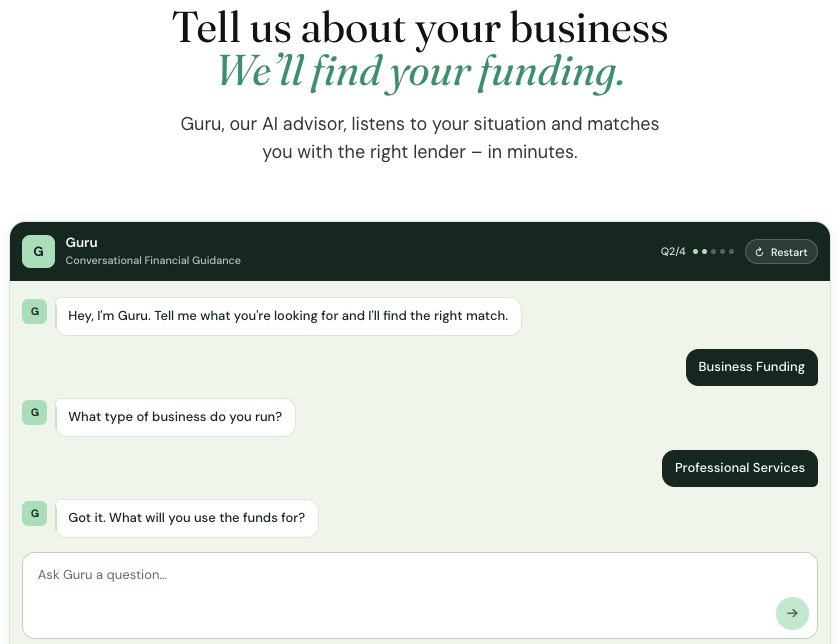
Guru is free to use, collects no payments from borrowers, and runs no hard credit pulls during the matching process. Before you start, have these ready:
- EIN confirmation letter or IRS notice
- 3–6 months of business bank statements
- Recent invoices or a summary of monthly revenue
- Basic business formation documents
Partners set all final terms. There are no guaranteed approvals and no promised rates. What you get is a faster path to lenders whose criteria actually match your business’s current profile. Visit Lending Gurus to start a match, or read through how the matching process works before you begin. Service terms and conditions are available on the site.
Useful sources and next reads
These are the primary sources used in this article. Each covers a distinct angle on EIN-based financing and is worth reading directly to verify lender-specific requirements.
- Shopify: Can You Get a Business Loan With Only an EIN? — Covers revenue-based products and MCAs as the most accessible EIN-friendly options, with practical context on cost trade-offs.
- Finder: Can I Get a Business Loan With an EIN Only? — Sets realistic time-in-business expectations and explains why startups with no trading history rarely qualify for true EIN-only products.
- Lending Gurus — The platform where you can start a free match to EIN-friendly lenders; use it after reviewing your bank statements and EIN documents.
When reading any lender’s marketing materials, watch for KYC and personal verification steps that may appear even when no hard SSN pull is advertised. Those steps are standard compliance requirements, not necessarily a sign that the lender will underwrite on your personal credit. For fintech accounting and documentation practices that can help you present cleaner financials to lenders, the Corphedge resource covers bookkeeping approaches relevant to regulated financial environments.
