
TL;DR:
- Most U.S. small and medium businesses prefer financing options that are processor-agnostic and flexible, removing platform lock-in while providing clearer cost comparisons. These include revenue-based financing, short-term loans, and lines of credit suited to different revenue models like SaaS, ecommerce, or invoicing, with funding speeds ranging from same-day to several weeks. Choosing the best option depends on your revenue flow, platform flexibility needs, and cost considerations, with tools like Lending Gurus simplifying comparisons without requiring hard credit pulls.
For most U.S. small and medium business owners, the most practical alternatives to Stripe Capital are processor-agnostic revenue-based financing and short-term term loans. These options remove processor lock-in, publish clearer cost terms, and are available whether you use Stripe or not.
Here is a quick shortlist by business type:
- Processor-agnostic revenue-based financing (Founderpath, Capchase, Clearco, Wayflyer, Lighter Capital): best for SaaS, subscription, and recurring-revenue businesses
- Merchant cash advances / embedded processor advances (PayPal Working Capital, Amazon Lending, QuickBooks Capital): best for businesses already on those platforms with consistent transaction volume
- Short-term term loans (OnDeck, BlueVine): best for general SMBs needing a lump sum with predictable fixed payments
- Lines of credit (BlueVine): best for businesses managing variable cash flow or seasonal gaps
- Invoice financing: best for B2B businesses with outstanding receivables
- SBA-backed loans and bank lines of credit: best for established businesses that can wait 2–6 weeks for lower-cost capital
To compare multiple options at once without a hard credit pull, use Lending Gurus to get matched to vetted lending partners. Partners set all approvals, rates, and terms.
| Category | Best For | Repayment | Speed | Processor Lock-in |
|---|---|---|---|---|
| Processor-agnostic RBF | SaaS, subscriptions | % of monthly revenue | 24–72 hours | None |
| Embedded processor advance | Platform sellers | % of daily sales sweep | Same day to 2 days | Yes |
| Merchant cash advance | Ecommerce, retail | % of daily card sales | 1–3 days | No |
| Short-term term loan | General SMB | Fixed daily or weekly | 1–5 days | No |
| Line of credit | Variable cash flow | Draw and repay | 1–3 days | No |
| Invoice financing | B2B with receivables | Invoice repayment | 1–3 days | No |
| SBA / bank loan | Established businesses | Fixed monthly | 2–6 weeks | No |
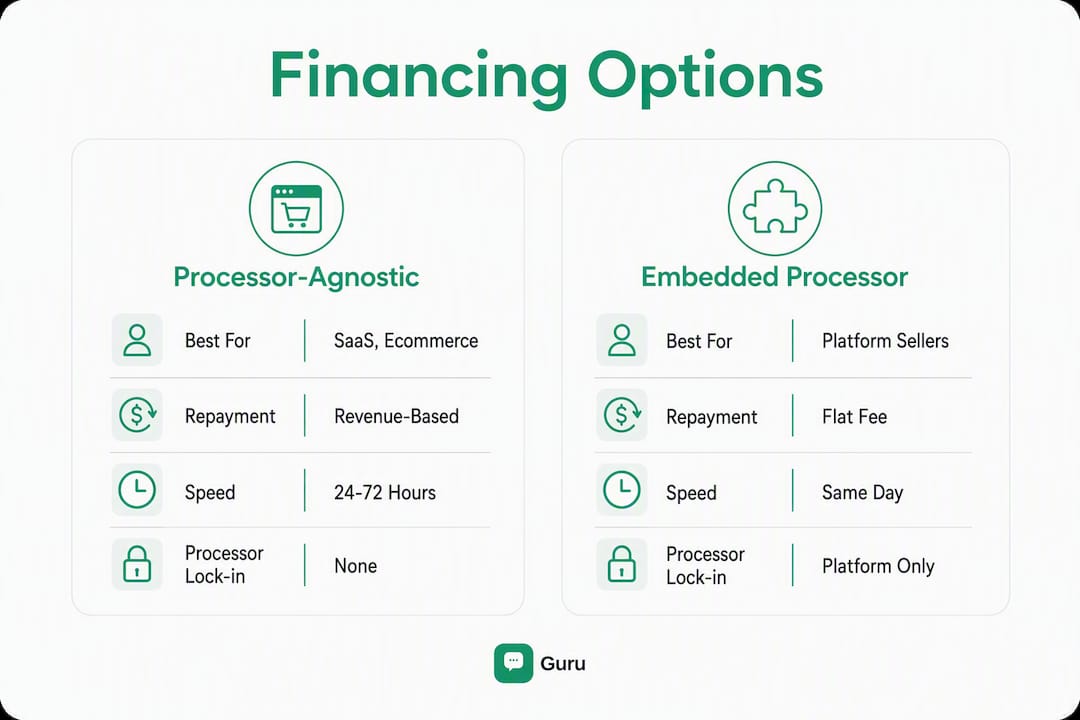
Table of Contents
- What are the best Stripe Capital alternatives for your business?
- How do these financing types actually work?
- How do these alternatives differ from processor-embedded advances?
- How do you choose the right financing option?
- How does Lending Gurus help you compare and apply?
- What is Stripe Capital and how does it work?
- Why do business owners look for Stripe Capital alternatives?
- What do these financing options actually cost?
- The real trade-off most founders miss
- Get matched to the right financing option today
- Useful sources
What are the best Stripe Capital alternatives for your business?
The right answer depends on one thing: how your revenue flows. Embedded advances like Stripe Capital are convenient if you already process through that platform, but they are invitation-only and tied to a single processor. Most business owners searching for alternatives want either more access or more flexibility.
The providers below cover the full range. Founderpath and Capchase focus on SaaS and subscription MRR. Clearco (formerly Clearbanc) and Wayflyer target ecommerce revenue. Lighter Capital is built for software companies with recurring revenue. OnDeck and BlueVine serve the broader SMB market with term loans and credit lines. PayPal Working Capital, Amazon Lending, and QuickBooks Capital are embedded advances for their respective platforms. Lending Gurus connects you to multiple options across categories without a hard credit pull to start.
Key rule of thumb: When comparing offers, convert every flat fee or factor rate into an approximate APR over your expected payback period. A flat fee that looks small can carry an effective APR well above what a term loan charges, especially for seasonal businesses with faster-than-expected repayment. Market-share analysis confirms that embedded advances hold a meaningful share of business lending but coexist with lower-cost traditional options — meaning you almost always have a cheaper alternative if you are willing to apply for it.
How do these financing types actually work?
Processor-agnostic revenue-based financing (Founderpath, Capchase, Clearco, Wayflyer, Lighter Capital)
What it is: The lender purchases a percentage of your future revenue in exchange for an upfront advance. Repayment comes as a fixed percentage of monthly or weekly revenue, not a daily processor sweep.
Pros:
- No processor lock-in; works across Stripe, Shopify, Braintree, or any stack
- Repayment flexes with revenue, so slow months cost less in absolute dollars
- Founderpath and Capchase specialize in SaaS MRR; Clearco and Wayflyer focus on ecommerce GMV
Cons:
- Underwriting is revenue-signal-heavy; low MRR or short track record limits access
- Cost is quoted as a flat fee or revenue share, not APR, which makes comparison harder
Best for: SaaS founders, subscription businesses, and multi-channel ecommerce sellers.
Speed: Typically 24–72 hours after approval, per lender guide data.

Embedded processor advances (PayPal Working Capital, Amazon Lending, QuickBooks Capital)
What it is: An advance tied to your existing payment or accounting platform. Repayment is swept automatically as a percentage of daily sales on that platform.
Pros:
- Near-instant access; offers often appear pre-approved in your dashboard
- No separate application in most cases
- Underwriting uses your existing platform data
Cons:
- Requires you to stay on that processor for the life of the advance
- Invitation-only; you cannot apply if you have not received an offer
- Cost transparency varies; factor rates are not always converted to APR
Best for: Sellers already generating consistent volume on PayPal, Amazon, or QuickBooks.
Speed: Same day to 2 days.

Merchant cash advances (general MCA providers)
What it is: A lump sum in exchange for a percentage of future card sales, repaid daily or weekly via a split of your merchant account.
Pros:
- Fast funding, often within 1–3 business days
- Approval based on card volume, not credit score alone
- No fixed monthly payment
Cons:
- Factor rates can translate to high effective APRs
- Daily sweeps can strain cash flow during slow periods
- Less regulated than term loans; contract terms vary widely
Best for: Retail and ecommerce businesses with high card-sale volume and short-term cash needs.
Short-term term loans (OnDeck, BlueVine)
What it is: A fixed lump sum repaid on a daily or weekly schedule over 3–24 months. Cost is quoted as an interest rate or factor rate.
Pros:
- Predictable payment schedule; easy to model in a cash-flow forecast
- Available to businesses that do not use a specific processor
- OnDeck and BlueVine both serve general SMBs with relatively fast underwriting
Cons:
- Fixed payments do not flex with revenue; a slow month still requires the same payment
- Shorter terms mean higher periodic payments than a bank loan
Best for: General SMBs needing a defined amount for a specific purpose (equipment, inventory, hiring).
Speed: Typically 1–5 business days.
Lines of credit (BlueVine)
What it is: A revolving credit facility you draw from as needed and repay over time. You pay interest only on what you draw.
Pros:
- Maximum flexibility; draw when you need cash, repay when you can
- Reusable without reapplying each time
- Good for managing seasonal gaps or unexpected expenses
Cons:
- Approval requires stronger credit and revenue history than an MCA
- Tempting to over-draw; discipline required
Best for: Businesses with variable or seasonal revenue that need a standing safety net.
Invoice financing
What it is: You sell or pledge outstanding invoices to a lender, who advances a percentage of the invoice value upfront. The lender collects from your customer and remits the balance minus fees.
Pros:
- Turns receivables into immediate cash without taking on new debt
- Approval is based on your customers’ creditworthiness, not just yours
- No processor dependency
Cons:
- Only works for B2B businesses with invoiced customers
- Fees add up if customers pay slowly
Best for: B2B service businesses, agencies, and wholesalers with net-30 or net-60 payment terms.
SBA-backed loans and bank lines of credit
SBA loan programs offer the lowest rates of any category here, with the 7(a) program allowing up to $5 million. Chase and similar banks offer SBA-partnered products alongside their own term loans and credit lines. The trade-off is time: underwriting takes weeks, and documentation requirements are substantial.
Best for: Established businesses with 2+ years of history, strong credit, and a cash need that is not urgent.
Pro Tip: If you need capital in under a week, SBA is not your path. But if you have 4–6 weeks and a strong file, the rate difference versus an MCA or RBF product can save you thousands of dollars over the life of the loan.
How do these alternatives differ from processor-embedded advances?
The structural differences between processor-embedded advances and the alternatives above come down to four things that directly affect your planning.
-
Processor lock-in. Embedded advances (Stripe Capital, PayPal Working Capital, Amazon Lending) require you to keep processing through that platform for the duration of repayment. Processor-agnostic revenue purchase agreements remove that constraint entirely, which matters if you use multiple sales channels or are considering switching processors.
-
Repayment predictability. Embedded advances sweep a percentage of daily sales, so your repayment amount changes every day with your volume. Term loans and lines of credit carry fixed payments you can model in a spreadsheet. Processor-agnostic RBF sits in between: payments flex monthly with revenue, but not daily.
-
Cost transparency. Embedded advances typically quote a flat fee or factor rate. Term loans quote an interest rate or APR. The two formats are not directly comparable without conversion. Converting a factor rate to an approximate APR over your expected payback period is the only way to make an apples-to-apples comparison, and market-share analysis confirms this step is consistently skipped by business owners who later feel surprised by total cost.
-
Eligibility access. Embedded advances are invitation-only. You either have an offer in your dashboard or you do not. Every alternative on this list has an application process you can initiate yourself, which means you are not waiting for a platform to decide you qualify.
-
Funding speed. Embedded advances fund fastest, often same-day. Specialized RBF lenders typically fund within 24–72 hours. Traditional bank and SBA products take weeks.
-
Product fit by revenue model. Stripe Capital and similar embedded products are built around transaction volume, which fits ecommerce and retail well. SaaS and subscription businesses often have lower transaction counts but high MRR, making processor-agnostic RBF lenders like Founderpath, Capchase, and Lighter Capital a structurally better fit.
Pro Tip: Ask any lender to quote you the total payback amount in dollars, not just the rate or fee. Then divide by the advance amount and subtract 1 to get your total cost as a percentage. That single number lets you compare any product type on the same scale.
How do you choose the right financing option?
Match the product category to your revenue model and your cash-flow plan. Here is a sequential checklist.
-
Define the cash need and timeline. How much do you need, and when do you need it? If the answer is “within 48 hours,” SBA is off the table. If the answer is “in 4–6 weeks and I want the lowest rate,” SBA moves to the top.
-
Identify your revenue model. SaaS or subscription MRR maps to processor-agnostic RBF. High card-sale volume maps to MCAs or embedded advances. B2B invoiced revenue maps to invoice financing. Mixed or general SMB revenue maps to term loans or lines of credit.
-
Run a simple cost comparison. Get the total payback amount from each offer. Divide by the advance amount. Subtract 1. That is your total cost percentage. For time-sensitive comparison, divide that percentage by the expected repayment period in months and multiply by 12 to approximate an annualized rate.
-
Check processor lock-in. If you plan to switch processors, add new sales channels, or are unsure about your platform, choose a processor-agnostic product.
-
Verify underwriting triggers. Most alternative lenders weight monthly revenue and time in business most heavily. Have 6–12 months of bank statements and transaction history ready before you apply.
-
Ask about prepayment. Some products charge a prepayment penalty; others offer a discount for early payoff. For seasonal businesses, early payoff flexibility can meaningfully reduce total cost.
Red flags to watch for:
- A lender who will not give you the total payback amount in dollars
- Contracts that require you to switch your primary processor
- Daily sweep rates that exceed your average daily margin
- No clear disclosure of fees beyond the factor rate
Questions to ask any lender:
- What is the total repayment amount in dollars?
- Is there a prepayment discount or penalty?
- Does this product require me to process payments through your platform?
- What happens if my revenue drops 30% in a given month?
Typical documents required: 3–6 months of business bank statements, recent profit and loss statement, basic business information (EIN, time in business, monthly revenue), and sometimes a voided check or bank login for verification.
Timeline to funding: Embedded advances fund same-day to 2 days. Fintech RBF and MCA lenders typically fund within 1–5 business days. Bank and SBA-backed products take 2–6 weeks depending on loan size and documentation completeness.
How does Lending Gurus help you compare and apply?
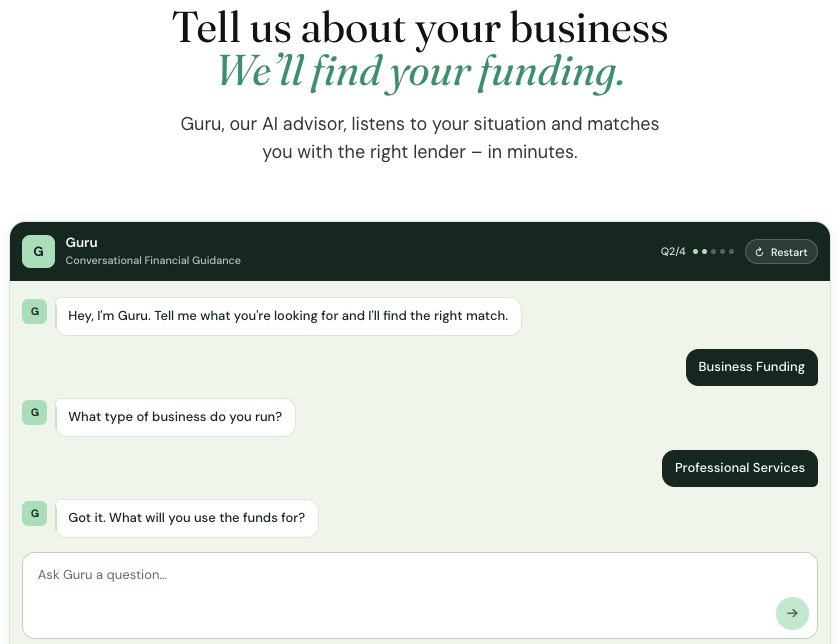
Lending Gurus matches you to vetted lending partners without a hard credit pull to start. Partners conduct their own underwriting and set all approvals, rates, and terms. Lending Gurus does not lend, broker, or guarantee any outcome.
Here is what the matching process looks like:
- Quick profile capture: Guru, Lending Gurus’ conversational advisor, asks about your business type, monthly revenue, time in business, and funding need.
- Soft match to partner products: Based on your profile, Guru identifies lending partners whose products fit your situation.
- Connection to partner application: You are connected to matched partners to complete their application and underwriting process.
- Educational resources: Lending Gurus provides guides and comparisons to help you evaluate offers before you commit.
Pro Tip: Before you start a match, pull together 6–12 months of bank statements and your most recent monthly revenue figure. Lenders weight monthly revenue and time in business most heavily, and having those numbers ready speeds up the partner application process significantly.
Lending Gurus does not underwrite or guarantee approvals, rates, or funding amounts. All final decisions rest with the matched lending partners.
What is Stripe Capital and how does it work?
Stripe Capital is an embedded financing product built into the Stripe payment processing platform. It offers cash advances and loans to eligible Stripe merchants, with repayment automatically swept as a percentage of daily Stripe sales until the advance is repaid.
A few key mechanics define how it works:
- Invitation-only access. Stripe Capital offers appear in the Stripe dashboard for merchants Stripe has pre-selected based on processing history. You cannot apply cold; if there is no offer in your dashboard, you are not eligible at that time.
- Processor sweep repayment. Repayment is automatic. Stripe deducts a fixed percentage of each day’s sales until the total repayment amount is reached. On slow days, you repay less; on strong days, more.
- Cost as a flat fee. Stripe Capital charges a single flat fee added to the advance amount. There is no interest rate in the traditional sense, and the fee does not change based on how quickly you repay.
- Funding limits tied to processing volume. Offer amounts are based on your Stripe transaction history. Businesses with lower or newer processing volume receive smaller offers or none at all.
- Platform dependency. Because repayment is swept from Stripe sales, you need to keep processing through Stripe for the duration of the advance.
Stripe Capital launched in 2019 and has expanded its product set since then. For merchants already embedded in the Stripe ecosystem with consistent volume, it is a genuinely fast and frictionless option. The limitations show up when you want to compare it to other offers, switch processors, or access capital without waiting for an invitation.
Why do business owners look for Stripe Capital alternatives?
Four friction points drive most searches for alternatives.
Invitation-only access. The most common reason is simple: no offer in the dashboard. Stripe decides who is eligible based on processing history, and many active merchants never receive an offer. That leaves a meaningful share of Stripe users locked out entirely.
Processor lock-in. Repayment is tied to Stripe sales. If you want to add Shopify, switch to Square, or move to a different processor, the advance complicates that decision. Businesses that use multiple sales channels or are growing beyond a single platform find this constraint increasingly limiting.
Pricing clarity. Stripe Capital’s flat-fee model is not quoted as an APR, which makes it difficult to compare against a term loan or line of credit. Founders who want to run a true cost comparison have to do the conversion themselves, and many do not realize the effective cost until after they have accepted an offer.
Product fit by revenue model. Stripe Capital is built around card transaction volume. SaaS businesses with high MRR but relatively low transaction counts often receive smaller offers than their revenue would justify, because the underwriting model weights daily sales rather than monthly recurring revenue. Subscription businesses, agencies, and software companies tend to find better-structured products with lenders who underwrite against MRR directly, such as Founderpath, Capchase, or Lighter Capital.
Funding limits. Offer amounts are capped by processing history. A fast-growing business that needs more capital than its current Stripe volume supports has no way to negotiate a larger offer within the platform.
What do these financing options actually cost?
Cost structures vary significantly across product types, and the format in which cost is quoted affects how easy it is to compare.
Processor-agnostic RBF (Founderpath, Capchase, Clearco, Wayflyer, Lighter Capital): These products typically quote cost as a flat fee or a revenue share percentage. A common structure is a flat fee of 6–12% of the advance amount, though specific rates are not publicly listed for most providers and depend on your revenue profile and term. Total repayment equals the advance plus the flat fee.
Embedded processor advances (PayPal Working Capital, Amazon Lending, QuickBooks Capital, Stripe Capital): Cost is a flat fee added to the advance. The effective APR depends entirely on how quickly you repay. Faster repayment means a higher annualized cost for the same flat fee. Slower repayment lowers the annualized cost but extends the period your cash flow is being swept.
Merchant cash advances: MCAs quote a factor rate, typically in the range of 1.1 to 1.5 (meaning you repay $1.10–$1.50 for every $1.00 advanced). Converting a factor rate to an approximate APR requires knowing your expected repayment period. A 1.3 factor rate repaid over 6 months carries a very different annualized cost than the same rate repaid over 18 months.
Short-term term loans (OnDeck, BlueVine): These products quote an interest rate or APR, which makes comparison straightforward. Rates vary based on credit profile, revenue, and term length. Shorter terms carry higher periodic payments but lower total interest.
Lines of credit (BlueVine): Interest accrues only on the drawn balance. Rates vary by provider and credit profile. The flexibility to draw and repay repeatedly makes this the most cost-efficient option for businesses that do not need a lump sum.
SBA 7(a) loans: The SBA 7(a) program sets maximum interest rates that lenders may charge, making these the lowest-cost option in this comparison for qualifying businesses. Maximum loan amounts reach $5 million. The trade-off is documentation, time, and eligibility requirements that exclude newer or lower-revenue businesses.
Invoice financing: Fees are typically quoted as a percentage of the invoice value per week or month the invoice remains outstanding. A 2% weekly fee on a net-30 invoice translates to a high annualized cost if customers pay late.
The single most useful habit when comparing offers is to ask every lender for the total repayment amount in dollars. That number, divided by the advance amount, gives you total cost as a percentage regardless of how the lender chooses to quote it.
The real trade-off most founders miss
The financing decision most business owners frame as “which lender should I pick?” is actually a structural question: predictability versus convenience.
Embedded advances win on convenience. The offer is already in your dashboard, the application takes minutes, and the money arrives fast. But convenience has a price: you are locked to one processor, cost is quoted in a format that discourages comparison, and eligibility is entirely at the platform’s discretion.
Processor-agnostic alternatives require more effort upfront. You have to apply, submit documents, and wait for underwriting. In exchange, you get portability, clearer cost terms, and access to products built for your specific revenue model rather than your transaction volume.
The businesses that consistently get better financing terms are the ones that treat the application process as a negotiation, not a transaction. They come in with 12 months of clean bank statements, a clear use-of-funds statement, and at least two competing offers. That preparation shifts the dynamic from “take it or leave it” to a genuine conversation about terms.
Get matched to the right financing option today
If you want to compare multiple processor-agnostic alternatives quickly, Lending Gurus is built for exactly that. Guru, the platform’s free conversational advisor, captures your business profile without a hard credit pull and matches you to vetted lending partners across term loans, revenue-based financing, lines of credit, and more.
Here is what to expect:
- No hard credit pull to start the matching process
- Matches across multiple product categories and lenders
- Partners conduct their own underwriting and set all final terms, rates, and amounts
- Free to use; Lending Gurus earns a referral fee from partners only when a loan is funded
Ready to see which options fit your business? Start your match at Lending Gurus and get connected to lending partners in minutes.
This article is general information, not financial advice. Confirm current program details and eligibility with the relevant lender or a qualified financial professional before applying.
Useful sources
- Loans — U.S. Small Business Administration: Official SBA loan program overview, eligibility requirements, and lender directory.
- 7(a) Loans — U.S. Small Business Administration: Detailed terms, maximum amounts, and rate caps for the SBA’s primary business loan program.
- Stripe Capital Market Share — 6sense: Market-share analysis of embedded advances within the broader business lending category.
- Business Loans Made Simple — Lending Gurus: Overview of Lending Gurus’ matching platform and the financing products available through its partner network.
