
What can a line of credit be used for?
A line of credit is a revolving loan that gives you access to funds up to a set limit, and you only pay interest on what you actually draw. That flexibility makes it one of the most practical financing tools available for both personal and business needs.
Common line of credit uses include:
- Home improvement projects where final costs are uncertain
- Debt consolidation to replace higher-interest balances
- Emergency expenses like unexpected medical bills or urgent repairs
- Irregular income gaps for freelancers, contractors, or seasonal workers
- Business operating expenses such as payroll, supplies, and inventory
- Cash flow management during slow revenue periods
Unlike a personal loan with a fixed disbursement, a line of credit lets you borrow, repay, and borrow again within your limit. Interest rates are generally lower than credit cards, which makes it a cost-effective option when you need ongoing or unpredictable access to funds.
Table of Contents
- How a line of credit works
- What types of lines of credit are available?
- Pros and cons of a line of credit
- Is a line of credit right for you?
- Frequently asked questions about lines of credit
- Managing irregular income and emergencies with a line of credit
- Tax implications of different types of lines of credit
- Steps to apply and qualify for a line of credit
- How lines of credit compare to other financing options
- Lending Gurus connects you to the right line of credit faster
- Key Takeaways
How a line of credit works
A line of credit operates as revolving credit. Your lender sets a maximum credit limit, and you can draw funds at any time up to that ceiling.
Key mechanics to understand:
- Interest accrues from day one of a withdrawal, not from when the account was opened
- You only pay interest on the amount drawn, not the full credit limit
- Repayments replenish your available credit, so you can borrow again without reapplying
- Secured lines use collateral (like your home or equipment) and typically carry lower rates
- Unsecured lines require no collateral but usually come with higher rates and stricter credit requirements
- Variable interest rates are standard, meaning your rate can shift with market benchmarks
- Fees may apply, including monthly maintenance fees, per-transaction fees, and inactivity fees if you leave the account dormant
Personal lines of credit typically have draw periods lasting several years before entering repayment phase. Once the draw period ends, the account moves into a repayment phase and no further borrowing is allowed. Knowing this timeline matters when you are planning for longer-term needs.
What types of lines of credit are available?
Not every line of credit works the same way. The right type depends on your financial profile, what you need the funds for, and how much collateral you can offer.
- Personal line of credit: Unsecured and flexible, used for expenses ranging from home repairs to medical bills. Rates are higher than secured options but lower than most credit cards.
- Home equity line of credit (HELOC): Secured by your home, offering higher credit limits and lower interest rates. Best for large, ongoing projects like renovations. The trade-off is that your home is at risk if you default.
- Business line of credit: Available in both secured and unsecured forms. Secured business lines may require collateral such as equipment or receivables. Used primarily for payroll, inventory, and managing uneven cash flow.
- Student line of credit: Designed specifically for post-secondary education costs, covering tuition, books, and housing.
The distinction between revolving and non-revolving also matters. Most lines of credit are revolving, meaning repaid funds become available again. A non-revolving line works more like a loan: once you draw the funds, the limit does not replenish.
Pros and cons of a line of credit

A line of credit offers real advantages, but it also carries risks worth understanding before you apply.
Pros:
- Borrow only what you need, when you need it
- Pay interest only on drawn amounts, not the full limit
- Lower rates than most credit cards
- Revolving access means you do not need to reapply after repayment
- Responsible use can improve your credit score, since activity is reported to credit bureaus
Cons:
- Variable rates can increase your costs if market rates rise
- Maintenance, transaction, and inactivity fees add up
- Overspending without a structured repayment plan leads to long-term financial strain
- Unsecured lines are harder to qualify for with a limited or damaged credit history
- Secured lines like HELOCs put your collateral at risk if you miss payments
Compared to a fixed-term loan, a line of credit offers less predictability. You know your loan payment to the dollar each month; with a line of credit, your payment fluctuates based on how much you have drawn and the current rate.
Is a line of credit right for you?
The answer depends on a few honest questions about your financial situation.
- Do you need flexible, recurring access to funds? A line of credit fits better than a lump-sum loan for expenses that unfold over time.
- Is your credit score strong enough to qualify? Borrowers with poor credit often face higher rates or outright denials on unsecured products.
- Can you handle a variable rate? If rates rise, your borrowing costs rise with them.
- Do you have the discipline to repay consistently? Paying only the monthly interest minimum means the principal balance never shrinks.
- Is a one-time purchase involved? A line of credit is not ideal for single large purchases like a car or a home, where a fixed loan or mortgage is a better fit.
If you are weighing a line of credit against a personal loan or credit card, the core trade-off is flexibility versus predictability. A personal loan gives you a fixed rate and a fixed payoff date. A credit card is more accessible but typically carries higher rates. A line of credit sits between the two.
Frequently asked questions about lines of credit
What is the best use for a personal line of credit?
Personal lines of credit work best for expenses with uncertain or variable costs, such as home improvement projects, medical bills, or bridging income gaps. They are less suited to one-time purchases with a known price.
How is a line of credit different from a credit card?
Both are revolving credit products, but a line of credit typically carries a lower interest rate and a higher credit limit. Credit cards also offer rewards and purchase protections that lines of credit generally do not.
What do lenders look for when you apply?
Lenders evaluate your credit score, income, debt-to-income ratio, and, for secured lines, the value of your collateral. Unsecured lines require stronger credit profiles.
When does interest start on a line of credit?
Interest begins accruing the day you draw funds, not when the account is opened or approved.
What are the main risks?
Variable rates, potential fees, and the ease of repeated borrowing can lead to debt accumulation if you do not have a clear repayment plan. For secured lines, defaulting puts your collateral at risk.
Managing irregular income and emergencies with a line of credit
Freelancers, contractors, and small business owners with uneven revenue cycles get particular value from a line of credit. Rather than taking out a new loan every time cash flow dips, you draw what you need and repay when income arrives.
Practical tactics for using a line of credit effectively:
- Draw only enough to cover the specific gap, not the full available limit
- Set a repayment target beyond the minimum interest payment to reduce principal
- Track your outstanding balance monthly so interest costs stay visible
- Review your account terms annually; inactivity fees can apply even when you have not borrowed
- Use it for genuine emergencies, not discretionary spending, to avoid debt creep
For small business owners, a line of credit can cover payroll during a slow month or fund a bulk inventory purchase before a busy season, without locking you into a fixed repayment schedule. Responsible cash flow management using a line of credit also builds your credit profile over time, which can open access to better rates later.
Pro Tip: Set a personal draw limit below your actual credit limit. If your limit is $20,000, commit to drawing no more than $12,000. That buffer protects you from maxing out the account and keeps your credit utilization ratio healthy.

Tax implications of different types of lines of credit
The tax treatment of a line of credit depends on how you use the funds, not just the product type.

For personal lines of credit, interest is generally not tax-deductible. The IRS does not allow deductions for personal interest expenses.
HELOC interest follows different rules. If you use the funds to buy, build, or substantially improve the home that secures the loan, the interest may be deductible under IRS guidelines, subject to applicable limits. If you use HELOC funds for personal expenses unrelated to the home, that interest is not deductible.
For business lines of credit, interest paid on funds used for legitimate business expenses is typically deductible as a business expense. The key is documentation: you need to show the funds were used for business purposes. Mixing personal and business draws on the same line complicates this, which is one reason keeping business and personal credit separate is worth the effort.
Consult a tax professional for guidance specific to your situation, since deductibility rules can change and depend on your entity type and how you use the funds.
Steps to apply and qualify for a line of credit
Applying for a line of credit follows a predictable process, but preparation makes a real difference in the outcome.
- Check your credit score. Most lenders want a score of at least 670 for unsecured personal lines. Business lines and HELOCs have their own thresholds.
- Calculate your debt-to-income ratio. Lenders use this to assess whether you can manage additional debt. A lower ratio strengthens your application.
- Gather documentation. Expect to provide proof of income, recent tax returns, bank statements, and, for business lines, financial statements.
- Identify the right type. Decide whether a personal, home equity, or business line fits your need before you apply, since each product has different qualification criteria.
- Compare lenders. Rates, fees, credit limits, and draw period lengths vary. Review the full cost, not just the advertised rate.
- Submit your application. Many lenders now offer online applications. Some, like Lending Gurus, use a conversational process with no hard credit pull during the matching stage.
- Review the terms before signing. Confirm the rate type (variable or fixed), any maintenance or transaction fees, and the draw period length.
How lines of credit compare to other financing options
| Feature | Line of Credit | Credit Card | Personal Loan |
|---|---|---|---|
| Structure | Revolving | Revolving | Fixed term |
| Interest rate | Variable, typically lower | Variable, typically higher | Fixed or variable |
| Access to funds | Draw as needed | Swipe/tap as needed | Lump sum upfront |
| Best for | Ongoing or uncertain costs | Small, everyday purchases | One-time known expenses |
| Repayment | Flexible, interest on drawn amount | Minimum monthly payment | Fixed monthly installment |
| Collateral | Optional (secured or unsecured) | None | Usually none |
A personal loan is the better choice when you know exactly how much you need and want a predictable payoff schedule. A credit card works for smaller, frequent purchases where you can pay the balance monthly. A line of credit fills the gap for situations where costs are ongoing, variable, or not yet fully known.
Lending Gurus connects you to the right line of credit faster
Finding the right line of credit means comparing lenders, rates, terms, and qualification requirements across multiple products. That process takes time most people do not have.
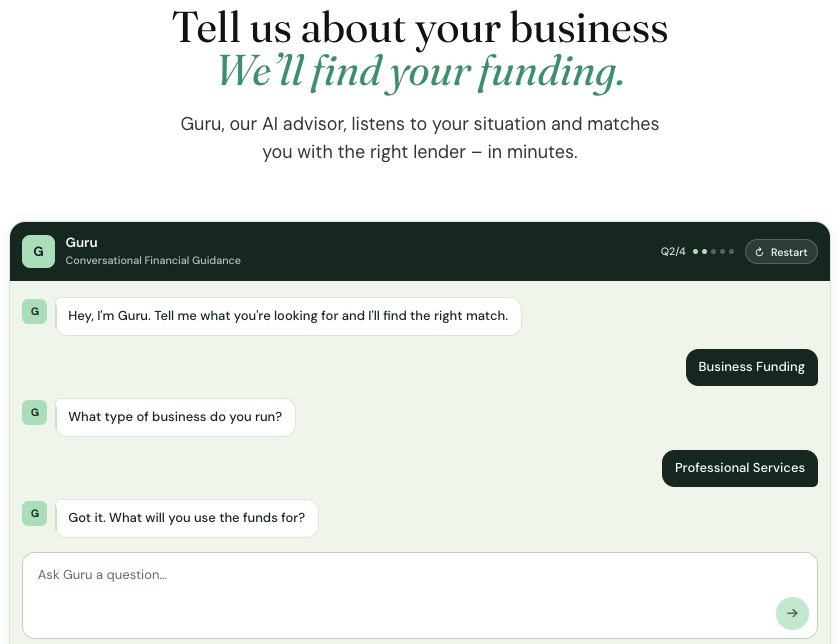
Lending Gurus cuts through that process with an AI-powered platform that matches you to suitable lenders in minutes, covering personal lines of credit, business lines of credit, and a range of other financing products. The conversational AI advisor, Guru, listens to your specific situation without a hard credit pull, so you can explore your options without affecting your credit score. There is no obligation and no red tape. Whether you are a small business owner managing cash flow or an individual planning a home renovation, you get matched to lenders whose terms fit your actual profile. See how it works and get started today.
Key Takeaways
A line of credit is most valuable when your funding needs are ongoing, variable, or uncertain, making flexible revolving access more practical than a fixed lump-sum loan.
| Point | Details |
|---|---|
| Best for variable costs | Lines of credit suit ongoing or unpredictable expenses better than one-time fixed purchases. |
| Interest on drawn amounts only | You pay interest only on what you borrow, not the full credit limit. |
| Draw periods matter | Personal lines typically have draw periods of 2–5 years before entering repayment phase. |
| Tax deductibility varies | HELOC interest may be deductible if funds improve the secured home; personal line interest generally is not. |
| Lending Gurus | Matches you to personal and business line of credit lenders in minutes, with no hard credit pull. |
