
Invoice factoring typically costs 1% to 5% of invoice face value per 30 days, with most factors clustering around a 2.5% monthly rate. That headline number rarely tells the whole story. Once you layer in advance rate mechanics, ancillary fees, and how long your customer takes to pay, your real cost often lands well above the quoted rate.
Here’s what actually determines what you pay:
- The advance rate (usually 70% to 90% of invoice value) determines how much cash you get today versus what sits in reserve.
- Ancillary fees like setup charges, wire fees, and monthly minimums stack on top of the discount rate.
- Invoice aging matters. Tiered pricing models charge more the longer a customer takes to pay.
Before signing anything, ask for a complete written fee schedule and calculate the annualized effective APR. That’s the only way to compare a factoring offer against a bank line of credit or another funding source on equal terms. The math for doing that is below.
Table of Contents
- What Determines Invoice Factoring Costs?
- How Do Factoring Fee Models Compare?
- What Hidden Fees Increase Factoring Costs?
- How Do You Calculate the True Cost of Invoice Factoring?
- Recourse vs. Non-Recourse: Which Costs More?
- Is Invoice Factoring Right for Your Business?
- How Are Factoring Fees Treated for Tax and Accounting Purposes?
- How Do Late-Paying Customers Affect Factoring Costs?
- What Contract Terms Affect Your Factoring Costs?
- Does Your Customer’s Credit Affect Your Factoring Rate?
- What I Tell Business Owners Before They Sign
- Get Faster, Clearer Financing Quotes With Lending Gurus
- Sources
What Determines Invoice Factoring Costs?
Invoice factoring pricing comes down to three moving parts: how much cash you get upfront, how much sits in reserve, and whose credit the factor is actually underwriting. Understanding these mechanics is the difference between reading a quote and understanding what you’ll actually pay.
Here’s how the structure typically works:
- The advance rate sets your immediate cash. Most factors advance 70% to 90% of the invoice’s face value the day you submit it. A lower advance rate (say, 70%) means less working capital today, even if the quoted fee looks attractive.
- The reserve holds the difference. The remaining 10% to 30% doesn’t disappear. It’s held back until your customer pays in full, then released to you minus the factoring fee.
- Your customer’s credit drives the price, not yours. Factoring is a sale of receivables, so factors price based on the creditworthiness of the business paying the invoice, not your own financials. A factor lending against invoices from a Fortune 500 customer will typically quote a better rate than one financing invoices from a newer, thinner-file client.
- Volume affects everything. Factors who process a high dollar volume of your invoices each month tend to offer better pricing than one-off arrangements, since steady volume reduces their underwriting overhead per invoice.
These mechanics interact directly with your effective cost. A high advance rate with a low headline fee can still cost more per dollar of actual cash received than a lower advance rate with a slightly higher fee, depending on how the numbers shake out. That’s why cost comparisons should always calculate cost per dollar advanced, not cost per dollar of invoice face value.
How Do Factoring Fee Models Compare?
Factors typically price their services using one of three structures, and the same nominal rate can produce very different real costs depending on which model you’re signed into.
- Flat fee. You pay a single percentage of invoice value regardless of how long it takes your customer to pay, as long as payment arrives within an agreed window. Simple to understand, but it can penalize you if your customer usually pays fast, since you’re not rewarded for speed.
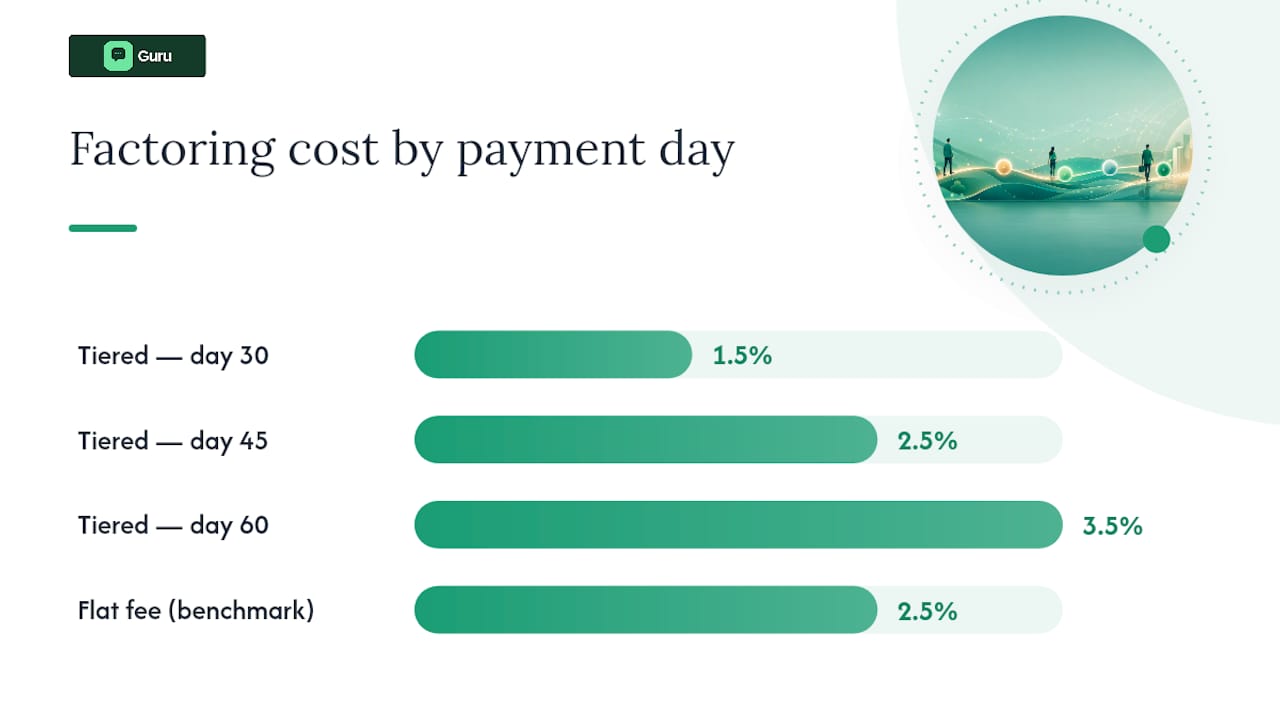
- Tiered fee. The rate increases in steps the longer the invoice stays unpaid. For example, 1.5% for the first 30 days, another 1% for days 31 to 45, and another 1% for every 15 days after that. This model punishes slow-paying customers hard, and the cost compounds fast if your buyer routinely stretches payment terms.
- Spread or prime-plus. Pricing is tied to a benchmark rate, often the prime rate, plus a spread that reflects your risk profile. This model behaves more like a traditional loan and can shift with interest rate cycles.
Rate ranges tend to cluster. Across most industry sources, the per-30-day discount rate lands between 1% and 5%, with roughly 2.5% as a common monthly benchmark for standard contract factoring. Where you land in that range depends on your industry, your customers’ credit profiles, your monthly volume, and the length of your contract commitment.
Tiered pricing deserves extra scrutiny. If your customers routinely pay on day 50 instead of day 30, a tiered schedule that looked cheap at first glance can end up costing more than a flat fee with a slightly higher headline number. Always ask the factor to run your actual historical payment timelines against their tiered structure before you sign.
What Hidden Fees Increase Factoring Costs?
The discount rate is just the headline. Real factoring contracts often carry a stack of ancillary charges that push your total cost meaningfully higher, and these rarely show up in the marketing pitch.
Watch for these:
- One-time setup or due diligence fees, often ranging from $500 to $2,500 depending on the factor and the complexity of your receivables.
- Per-transaction charges for wire transfers or ACH payments, typically $15 to $50 per transfer.
- Monthly minimum fees that kick in if your factored volume falls short of a set threshold, sometimes running $100 to $500 a month.
- Lockbox and audit fees, charged for the account infrastructure some factors require to collect customer payments directly.
- Early-termination penalties, which can be calculated as a percentage of your remaining contract value or a multiple of average monthly volume.
Pro Tip: Ask every prospective factor for a sample invoice worked all the way through, from face value to advance to fee to final remittance, using your actual numbers. If they hesitate to put it in writing, treat that as a warning sign.
Because these charges are often only 50% to 70% of the real total cost when the headline rate is taken alone, request a complete fee schedule before comparing any two offers.
How Do You Calculate the True Cost of Invoice Factoring?
Converting a quoted discount rate into a real number requires basic math, but almost nobody does it before signing. Here’s how to walk through it.
Step 2: Convert to cost per dollar advanced. You received $8,500 upfront and paid $300 in fees, so your real cost is $300 divided by $8,500, or about 3.5% of the cash you actually had access to, not 3% of the invoice.
Step 3: Annualize it. A 3% fee charged every 30 days, if you continuously factor invoices all year, compounds toward a substantial annualized rate. Corpay’s analysis notes that even a 2% monthly discount rate can approximate roughly a 24% annualized cost under continuous use, which puts factoring in a very different light next to a bank line of credit quoted as an annual rate.
- Take your per-30-day fee percentage.
- Multiply by (365 ÷ average days to collect).
- Compare that annualized figure directly against other financing options.
Run this against your slowest-paying customer, not your average one. A single invoice that drags from 30 to 60 days can double your effective rate under a tiered model, and most calculators recommend measuring cost per dollar of cash advanced rather than face value for an apples-to-apples comparison. Model a full 12-month volume projection with every fee included before you commit.
Recourse vs. Non-Recourse: Which Costs More?
Recourse factoring means you buy back any invoice your customer fails to pay. Non-recourse factoring means the factor absorbs that loss instead, within the terms of the agreement.
That risk transfer is why non-recourse factoring almost always carries a higher fee. The factor is underwriting genuine credit risk on your customer, not just providing working capital against a receivable you still guarantee.
- Recourse factoring typically costs less and suits businesses with reliable, creditworthy customers who rarely default.
- Non-recourse factoring costs more but protects you if a major customer goes under or simply refuses to pay, which matters most when you’re concentrated in a few large accounts.
- Ask specifically what triggers non-recourse protection. Many contracts only cover insolvency or bankruptcy, not a slow-paying or disputing customer, so the protection may be narrower than it sounds.
Before signing either type, get the exact default and dispute triggers in writing. A “non-recourse” label that only covers bankruptcy still leaves you exposed to the far more common scenario of a customer disputing an invoice or simply going dark.
Is Invoice Factoring Right for Your Business?
Factoring works best when speed matters more than the lowest possible rate, when your own credit history is thin, and when your customers are creditworthy even if your business is young. If a bank has already turned you down because you lack collateral or years of financials, factoring can bridge that gap since it prices off your customer’s credit, not yours.
Compare it against these alternatives before committing — including options for grow light financing that can help equipment-heavy businesses access capital with flexible terms:
- A bank line of credit usually costs less over time and doesn’t require you to sell receivables, but it demands stronger financials, more collateral, and a slower approval process.
- Trade credit insurance protects you against customer non-payment without giving up your invoices, but it doesn’t solve a cash-flow timing problem the way factoring does.
- Spot factoring (factoring a single invoice instead of a full contract) offers flexibility with no long-term commitment, but per-invoice fees run 25% to 50% higher than contract rates because the factor loses the benefit of steady volume.
- Ask yourself: Do I need cash in days, not weeks? Are my customers more creditworthy than my own balance sheet? If both are true, factoring deserves serious consideration.
How Are Factoring Fees Treated for Tax and Accounting Purposes?
Factoring fees are generally treated as a deductible business expense, recorded as a financing or operating cost rather than interest, since factoring is structured as a sale of receivables rather than a loan. That distinction matters for your bookkeeping.
Because you’re selling an asset (the invoice) rather than borrowing against it, the transaction typically hits your books differently than a bank loan would. The discount fee and any ancillary charges usually get recorded as factoring expense on your income statement. The reserve amount isn’t your money yet, so it shouldn’t be booked as revenue until the factor releases it.
Recourse factoring can complicate things further. Since you retain the risk of nonpayment, some accountants treat recourse arrangements as a secured borrowing rather than a true sale for financial reporting purposes, which changes how the receivable and the advance appear on your balance sheet. Non-recourse factoring, where the risk fully transfers to the factor, more cleanly qualifies as a sale.
This is not a place to guess. Factoring fee treatment can affect your reported revenue, your balance sheet, and how lenders read your financials if you later apply for other credit. Work with a qualified accountant or tax professional to confirm how your specific factoring agreement should be booked and whether any state or federal reporting nuances apply to your structure. Getting this wrong doesn’t just cost you at tax time. It can distort your financial statements in ways that make future financing harder to secure.
How Do Late-Paying Customers Affect Factoring Costs?
Delinquent invoices are where factoring costs quietly spiral. Under a tiered fee structure, every extra block of days your customer takes to pay adds another fee layer, and that compounding effect is rarely obvious when you first sign the contract.
Multiply that across a customer who habitually pays late, and your effective annualized cost on that account can run far higher than your blended average.
Outright defaults carry a different consequence depending on your contract type. Under recourse factoring, you’re on the hook to buy back the unpaid invoice, which means you’ve paid factoring fees on cash you ultimately have to return. Under non-recourse factoring, the factor absorbs the loss, but only within whatever narrow default definition the contract specifies, which is why verifying those trigger terms matters as much as the fee itself.

Chronic delinquency from your customer base can also affect your standing with the factor going forward. A factor that sees a pattern of late payers in your receivables portfolio may raise your rate at renewal, tighten your advance rate, or decline to renew the contract altogether. Reliable, prompt-paying customers aren’t just good for your business. They’re the single biggest lever you have for keeping factoring costs low over time.
What Contract Terms Affect Your Factoring Costs?
The rate on the term sheet isn’t the only number that determines your cost. The contract structure around that rate often matters just as much.
Minimum contract length is standard in the industry, often running six months to a year or longer. Shorter commitments typically come with a rate premium, since the factor has less time to recoup its underwriting costs. Longer commitments can unlock better pricing, but they also lock you into a relationship that’s expensive to exit early.
Volume commitments work similarly. Factors often quote better rates in exchange for a guaranteed minimum monthly factoring volume. Fall short of that volume, and you may trigger a monthly minimum fee that effectively raises your real rate, even though your quoted discount percentage never changed.
Exclusivity clauses matter too. Some contracts require you to factor all of your invoices, or all invoices from a certain customer, through that single factor. That limits your flexibility to shop a specific account elsewhere for a better rate, and it’s worth negotiating around if you have customers whose invoices would qualify for stronger pricing from a different factor.
Early-termination penalties tie all of this together. If you sign a 12-month minimum and want out at month six, expect a penalty calculated either as a percentage of your remaining committed volume or a multiple of your recent monthly factoring activity. Read this clause before you sign, not after you decide to leave, since it’s often the single most expensive line in the entire agreement.
Does Your Customer’s Credit Affect Your Factoring Rate?
Your customer’s credit profile, not yours, is the primary variable a factor underwrites, since factoring is fundamentally a purchase of your customer’s payment obligation. This is the single biggest structural difference between factoring and a traditional business loan.
A factor evaluating your application will pull credit and payment history on the businesses that owe you money, not just your own company file. Invoices from large, established, consistently-paying customers typically factor at the lower end of the standard rate range. Invoices from newer, smaller, or higher-risk customers push your rate toward the upper end, or may get declined for factoring altogether even if your own business credit is strong.
This cuts both ways for business owners. If you’re a newer company with limited credit history but you sell to blue-chip customers, factoring can get you meaningfully better pricing than a bank loan ever would, since the bank is stuck evaluating your thin file while the factor is pricing off your customer’s strength. Flip that scenario, and a well-established business selling to a portfolio of small, unproven customers may find factoring costs more than expected, because the factor is pricing the risk it’s actually taking on.
Concentration matters here too. If one customer represents a large share of your factored receivables, a factor will scrutinize that single credit relationship closely, and any deterioration in that customer’s payment behavior can move your entire rate at renewal. Diversifying which customers you factor, when possible, tends to produce more stable pricing over time than betting the arrangement on one or two large accounts.
What I Tell Business Owners Before They Sign
The most common mistake I see is business owners comparing headline discount rates without asking about advance rate, tiering, or termination penalties. Always negotiate the advance rate and per-invoice fees together, not separately, since factors have room to move on both.
Lending Gurus helps you collect quotes from vetted lending partners faster through Guru, our free matching tool. Partners still set their own rates, terms, and approvals. Get every fee schedule in writing before you compare.
— Chris
Get Faster, Clearer Financing Quotes With Lending Gurus
Comparing factoring offers by hand means chasing multiple providers, decoding different fee structures, and hoping you’re not missing a hidden charge buried in the fine print. Lending Gurus gives you a faster starting point: our free matching tool, Guru, listens to your business situation through a simple conversation, with no hard credit pull, and connects you with vetted lending partners suited to your revenue, time in business, and and cash flow.
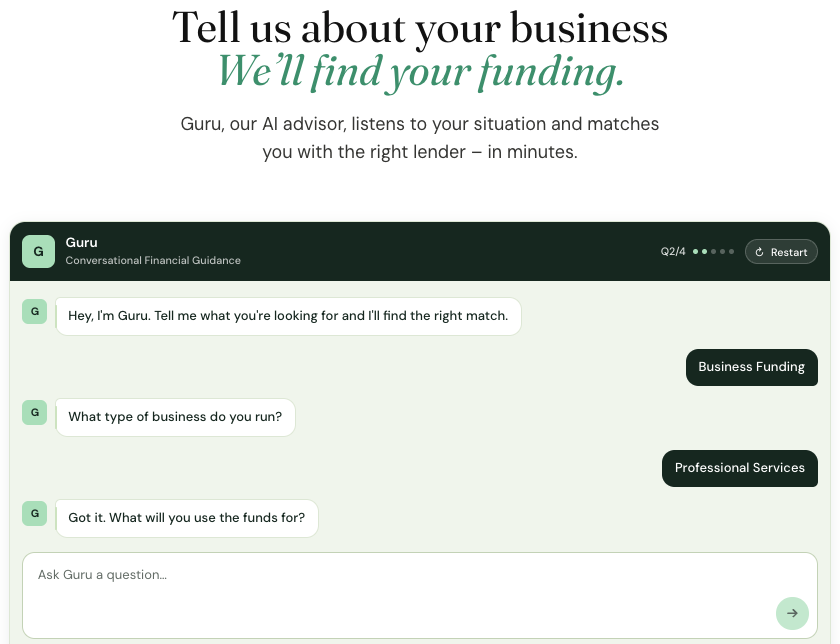
Guru doesn’t set rates or approve funding. Lending Gurus matches you to partners; those partners decide your actual terms, advance rates, and pricing. What Guru does is cut the legwork of tracking down multiple quotes yourself, so you can get written fee schedules in front of you faster and compare them the way this article just showed you, side by side, with the real math behind each offer.
If working capital gaps have you weighing factoring against a line of credit or another funding path, see how the matching process works and start a conversation with Guru today.
This article is general information, not a substitute for advice from a qualified financial advisor. Consult a qualified financial professional about your own circumstances before acting on anything here.
