
A working capital line of credit is a revolving credit facility that gives your business on-demand access to funds for short-term operational expenses, with interest charged only on the amount you draw. Unlike a term loan, this credit line replenishes as you repay, making it one of the most flexible short-term financing options available to small business owners. Credit limits range from $5,000 to $500,000, with commercial facilities reaching $5 million for larger operations. The SBA recognizes revolving credit facilities as a core tool for managing operational cash flow, and lenders across the country have built products specifically around this need.
How does a working capital line of credit work for small businesses?
A working capital line of credit operates on a revolving basis, which separates it fundamentally from a term loan. With a term loan, you receive a lump sum upfront and repay it over a fixed schedule. With a revolving credit line, you draw what you need, repay it, and the available balance restores automatically.

Repayment terms typically run 6–24 months for short-term facilities, while some long-term lines extend to five years. Repayments are usually scheduled weekly or monthly, depending on the lender. Each payment you make frees up that portion of your credit limit again, so you are not locked out of funds after your first draw.
Speed is a major advantage of the modern credit line. Online lenders approve applications in as little as 3 hours and can fund the same day. Traditional banks, by contrast, may take several weeks to process an application. For a business owner facing a payroll gap or an unexpected supplier invoice, that difference is significant.
Here is how the draw-and-repay cycle works in practice:
- You open a $100,000 credit line but draw only $30,000 to cover a slow month’s payroll.
- Interest accrues only on the $30,000 drawn, not the full $100,000 limit.
- You repay $30,000 over the next 60 days, restoring your full $100,000 availability.
- The following quarter, you draw $50,000 for inventory ahead of a busy season.
Pro Tip: Set a calendar reminder to review your outstanding draw balance monthly. Letting small draws accumulate without repayment is the fastest way to erode your available credit when you need it most.
What are the typical qualification criteria for a working capital line of credit?
Lenders evaluate several factors before approving a business line of credit. Meeting the minimums gets you in the door. Meeting the preferred thresholds gets you the best rates.
A minimum personal credit score of 600 is the baseline most lenders require, along with at least 6–12 months in business and annual revenue starting at $150,000. Those are the floor numbers. In practice, a credit score of 680 or higher is what lenders prefer when offering their most competitive products, and consistent cash flow carries as much weight as the score itself.
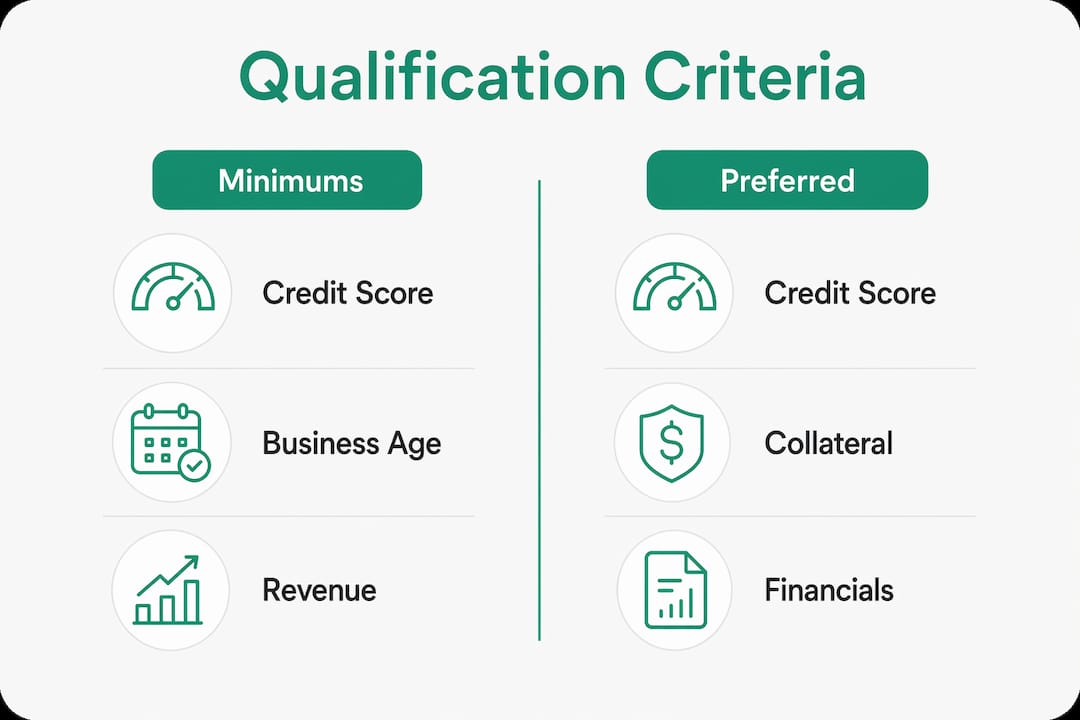
Traditional banks typically require two or more years in business and stronger financials overall. Online lenders are more flexible on tenure but still scrutinize revenue trends and bank statement history. The type of line you qualify for, secured or unsecured, also shapes your limit and rate.
| Qualification Factor | Minimum Threshold | Preferred Threshold |
|---|---|---|
| Personal credit score | 600+ | 680+ |
| Time in business | 6–12 months | 2+ years |
| Annual revenue | $150,000+ | $250,000+ |
| Credit limit range | $5,000–$100,000 | $100,000–$500,000+ |
| Collateral required | Unsecured available | Secured for higher limits |
Secured lines of credit require collateral, such as accounts receivable, inventory, or equipment. In exchange, lenders offer higher limits and lower rates. Unsecured lines carry no collateral requirement but come with tighter limits and higher interest rates to offset lender risk.
Pro Tip: Pull your business bank statements for the past 12 months before applying. Lenders weight average daily balance and deposit consistency heavily. A strong statement history can offset a borderline credit score.
What are the advantages and pitfalls of a working capital line of credit?
The core advantage of a credit line for businesses is cost efficiency. You pay interest only on what you draw, not on the full credit limit. If you have a $200,000 line but only need $40,000 this month, your interest cost reflects $40,000. A term loan for $200,000 charges interest on the entire balance from day one.
Renewability gives your business operational agility for recurring or unpredictable expenses. Seasonal businesses, contractors, and retailers all benefit from a credit line that resets as they repay. The funds are there when revenue dips and costs spike, without requiring a new application each time.
That said, misuse is common and costly. The most frequent mistakes business owners make with a working capital LOC include:
- Using the line to fund long-term assets like equipment or real estate, which creates a repayment mismatch.
- Over-borrowing during good months, leaving no available credit when cash flow tightens.
- Ignoring draw fees. Some lenders charge a transaction fee on each draw, which makes frequent small draws significantly more expensive than the stated APR suggests.
- Failing to verify whether the line is truly revolving. Some products marketed as “lines” are non-revolving, meaning once you draw and repay, the credit does not restore. Always confirm revolving status in the contract before signing.
A working capital line of credit works best as a bridge for recurring operational gaps, not as a substitute for permanent capital. Businesses that treat it as a cash flow buffer tied to their operating cycle stay out of debt traps. Those that use it to fund growth without a repayment plan often find themselves rolling over balances indefinitely.
How does a working capital line of credit compare to other short-term financing options?
Choosing between a revolving credit line, a working capital loan, and a business term loan comes down to what your expense looks like. Recurring and variable costs favor a line of credit. One-time, defined purchases favor a loan.
Lines of credit suit ongoing needs with unpredictable timing. Working capital loans deliver a lump sum upfront with a fixed repayment schedule, making them better for a specific known expense like a bulk inventory purchase or a bridge between receivables. Term loans work best for large capital expenditures with a clear ROI timeline.
| Feature | Working capital line of credit | Working capital loan | Business term loan |
|---|---|---|---|
| Disbursement | Draw as needed | Lump sum upfront | Lump sum upfront |
| Repayment structure | Revolving, restores on repayment | Fixed schedule | Fixed schedule |
| Interest charged on | Drawn balance only | Full loan amount | Full loan amount |
| Best use case | Payroll, inventory, recurring gaps | Defined short-term expense | Equipment, expansion |
| Approval speed | Hours (online lenders) | 1–3 days | Days to weeks |
| Qualification flexibility | Moderate | Moderate | Stricter |
The cost difference between a line and a loan is most visible when your needs are variable. A business that draws $20,000 one month and $80,000 the next pays interest proportionally on a line. The same business with a $100,000 term loan pays interest on the full balance every month, regardless of how much it actually needed.
Digital-first lenders are the better choice when speed matters. If you need funds within 24 hours, an online lender with digital underwriting is the practical path. If rate minimization is the priority and you can wait, a bank or credit union line typically offers lower APRs for well-qualified borrowers.
Key Takeaways
A working capital line of credit is the most cost-efficient short-term financing option for small businesses with recurring or variable cash flow needs, because you pay interest only on what you draw.
| Point | Details |
|---|---|
| Revolving structure saves money | Interest accrues only on drawn funds, not the full credit limit. |
| Qualification starts at 600 credit score | A score of 680+ and $150,000+ in annual revenue unlocks the best rates and limits. |
| Online lenders fund faster | Digital underwriting can approve and fund in as little as 3 hours versus weeks at a bank. |
| Verify revolving status in writing | Some “lines” are non-revolving draws. Confirm the contract before signing. |
| Match the tool to the expense | Use a credit line for recurring gaps and a term loan for one-time defined purchases. |
What I’ve learned about using working capital credit lines wisely
Most business owners I’ve spoken with make the same mistake: they open a credit line during a strong revenue period, then draw heavily during the first slow month without a repayment plan. By month three, the line is maxed and the slow period is still ongoing. The credit line becomes a liability instead of a buffer.
The businesses that use these tools well treat the draw amount as a decision, not a reflex. They calculate the specific gap they need to cover, draw that amount, and build repayment into their cash flow projection for the next 30–60 days. That discipline keeps the line available for the next cycle.
One thing most articles skip: your relationship with the lender matters more than you think. Lenders who see consistent, responsible draw-and-repay behavior often increase your credit limit proactively. That increase costs you nothing and gives you more capacity when a real opportunity or emergency arrives. Building that track record early, even with small draws you do not strictly need, is a legitimate strategy.
If your credit score sits below 680, do not wait for a crisis to apply. Work on your score, get 12 months of clean bank statements, and apply when you are in a position of strength. Applying under pressure with weak financials is the fastest way to get a high-rate product that costs more than it helps.
— Chris
How Lendinggurus can match you with the right credit line
Finding the right business line of credit means comparing lenders across rate, limit, and repayment terms simultaneously. That process takes time most small business owners do not have.

Lendinggurus uses an AI advisor named Guru to match your business with suitable lenders in minutes, without a hard credit pull. You describe your funding needs, and Guru surfaces options that fit your revenue, credit profile, and timeline. The application process at Lendinggurus is built for speed, connecting you to lenders who specialize in working capital solutions for small businesses. Whether you need $20,000 for payroll or $250,000 for a seasonal inventory push, you can find flexible business funding matched to your specific situation with no obligation to proceed.
FAQ
What is a working capital line of credit?
A working capital line of credit is a revolving credit facility that lets businesses draw funds up to a set limit for short-term operational expenses, paying interest only on the amount drawn.
How much can I borrow with a business line of credit?
Credit limits typically range from $5,000 to $500,000 for small businesses, with commercial lines reaching $5 million for larger operations.
What credit score do I need to qualify?
Most lenders require a minimum personal credit score of 600, but a score of 680 or higher is preferred for the best rates and highest credit limits.
How fast can I get approved for a working capital LOC?
Online lenders using digital underwriting can approve and fund a line of credit in as little as 3 hours. Traditional banks typically take several weeks.
Is a working capital line of credit the same as a working capital loan?
No. A working capital loan delivers a lump sum with a fixed repayment schedule. A working capital line of credit is revolving, meaning your available balance restores as you repay, and you draw only what you need when you need it.
