
You can open a business bank account as soon as your business is formed and you have an EIN, or your Social Security number if you’re a sole proprietor. Most banks let you apply online in under 20 minutes, though LLCs, corporations, and partnerships sometimes need a branch visit for identity verification. Before you apply, pick your account type, gather your documents, and decide whether you’re going online or in person.
Table of Contents
- How to Open a Business Bank Account Online or In-Branch
- What Documents Do You Need to Open a Business Account?
- Which Business Bank Account Type Should You Choose?
- How Much Do Business Bank Accounts Cost?
- Is My Business Bank Account FDIC Insured?
- What Will Banks Ask About Your Business’s Owners?
- Can You Open a Business Bank Account Online?
- The Real Reason Most Owners Wait Too Long to Open an Account
- Ready to Explore Financing Once Your Account Is Open?
- Sources
- FAQ
How to Open a Business Bank Account Online or In-Branch
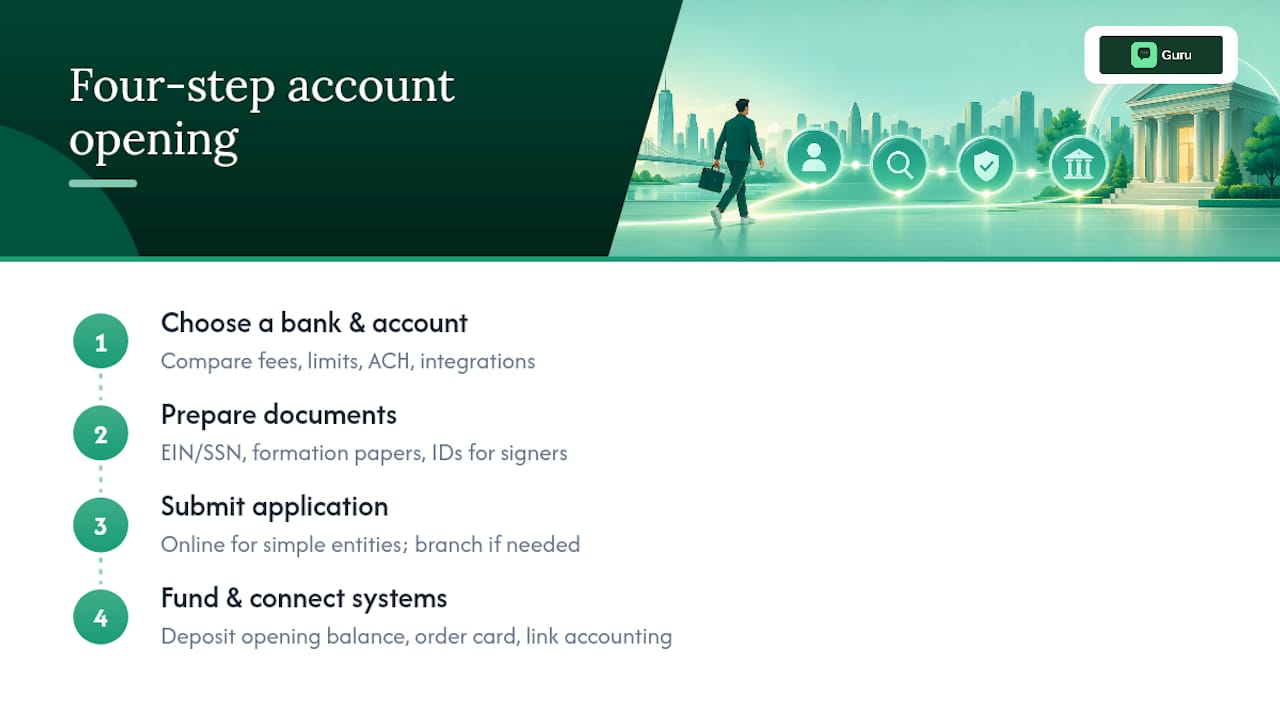
The fastest path to a funded account has four moving parts: pick the right bank and account type, prepare your paperwork, submit the application, then fund and connect the account to your other tools. Rushing any one of these steps is how owners end up stuck in verification limbo for two weeks.
1. Evaluate banks on fees, tools, and access, not just the sign-up bonus. A checking account with no monthly fee sounds great until you realize the bank charges $0.50 per transaction after 100 free ones and you process 400 transactions a month. Compare monthly maintenance fees, transaction limits, ACH capabilities, mobile deposit caps, and whether the bank integrates with accounting software like QuickBooks or Xero. If you handle cash, ask about deposit fees and daily cash-handling limits before you fall in love with a sign-up offer.
2. Gather your documents before you start the application. This is the step that trips up the most owners. You’ll need your EIN confirmation letter (or SSN if you’re a sole proprietor with no employees), formation documents, and identification for every signer. Consumer finance guides consistently point to the same four-step opening process: choose the account, gather documents, submit the application, then fund and integrate. Skipping the prep step is the single biggest cause of delayed approvals.
3. Apply online or walk into a branch, depending on your entity type. Sole proprietors and single-member LLCs with straightforward ownership can usually complete the entire process online. Multi-member LLCs, corporations, and partnerships often trigger a request for notarized documents or an in-person identity check, because the bank has to verify every beneficial owner under federal rules. Expect the bank to ask follow-up questions if your formation documents and application don’t match exactly. A dedicated business account also keeps your business finances legally separate from day one, which matters the moment you apply for financing or file taxes.
4. Fund the account and connect your systems immediately. Once approved, deposit your opening balance, order a debit card, and set up direct deposit for payroll if you have employees. Link the account to your accounting software the same week you open it. Waiting means reconciling weeks of transactions by hand later, and that’s a headache no one budgets time for.
Pro Tip: Apply for your EIN online through the IRS at least a few business days before you plan to open your account. The confirmation letter downloads instantly, and having it ready removes the single most common bottleneck in the entire process.
What Documents Do You Need to Open a Business Account?
Banks ask for a predictable set of documents, and having them scanned and ready before you start the application can cut your approval time from days to hours. Here’s what to have on hand:
- EIN confirmation letter or your SSN. You can use your EIN immediately after the IRS issues it by filing Form SS-4, and most banks accept the confirmation letter as proof. Sole proprietors without employees can often use their SSN instead.
- Formation documents. Articles of organization for an LLC, articles of incorporation for a corporation, or a DBA (doing business as) certificate if you’re operating under a trade name.
- Partnership or operating agreements. Multi-member LLCs and partnerships need to show how ownership and control are divided among the owners.
- Government-issued ID for every signer. A driver’s license or passport for each person who will have signing authority on the account.
- Beneficial ownership information. Full legal names, dates of birth, home addresses, and Social Security numbers or ITINs for anyone who owns 25% or more of the business, plus one person who controls day-to-day operations.
- Business license, if your state or city requires one. Retailers, restaurants, and contractors are commonly asked to show this.
- Proof of business address. A lease agreement or a recent utility bill in the business name usually satisfies this.
The IRS also requires every EIN application to name a real, identifiable “responsible party,” not a nominee, and that designation has to be updated within 60 days if it changes. Skipping this or listing an outdated responsible party is a quiet way applications get flagged for extra review. If your business is cash-heavy (think restaurants, salons, or contractors who take cash payments), expect the bank to ask about your anticipated deposit volume too. That’s not an inconvenience. It’s part of how banks manage risk on accounts that move a lot of physical cash.
Which Business Bank Account Type Should You Choose?
Most small businesses need at least a checking account, and many benefit from adding a savings account and merchant services once volume picks up.
Business checking is your daily operating account. This is where payroll, vendor payments, and revenue deposits flow, and it’s the account you’ll want linked to your accounting software from day one.
Business savings holds reserve funds, tax set-asides, or money earmarked for equipment purchases. Keeping this separate from your operating account makes it much harder to accidentally spend your quarterly tax payment on inventory.
Merchant services let you accept credit and debit card payments, whether in person or online. If you sell anything beyond cash or check, you’ll need this tied to your checking account.
Business credit cards aren’t a bank account, but most owners open one alongside their checking account to separate expense categories and start building a business credit profile independent of personal credit.
When comparing accounts, run through this checklist:
- Online and mobile banking with real-time balance and transaction alerts
- Direct integration with accounting platforms like QuickBooks, Xero, or Wave
- Mobile check deposit limits that match your typical deposit size
- Fraud monitoring and the ability to freeze a card instantly from the app
- Cash deposit limits and fees if your business handles physical currency
Many owners keep two accounts at the same bank: one operating account for daily transactions and one reserve account for taxes or emergencies. Beyond the bookkeeping clarity, this also matters for deposit insurance coverage, which we’ll get into next.
How Much Do Business Bank Accounts Cost?
Business accounts rarely advertise their true cost upfront, and that’s by design. The sign-up bonus is the headline; the fee schedule is where the real cost lives.
Watch for these common fees:
- Monthly maintenance fees, often waived if you keep a minimum daily balance or hit a monthly transaction threshold
- Per-transaction fees once you exceed a bank’s free transaction limit, sometimes as low as 100 to 200 transactions a month
- ACH and wire transfer fees, which vary depending on whether the transfer is domestic or international
- Returned-item and overdraft fees, which stack up fast if you’re running tight cash flow
- Cash deposit fees, typically charged once you exceed a set dollar amount in cash deposits per month
Opening minimum deposits vary widely across banks and account tiers, and the waiver conditions matter more than the sticker minimum. A bank might advertise a low opening deposit but require a much higher average balance to waive the monthly fee.
The smartest way to compare banks isn’t to read the marketing page. Pull up the actual fee schedule (usually a PDF buried in the disclosures section) and run your real numbers against it: your expected monthly transaction count, your average balance, and your typical cash deposit volume. Then check whether you clear the waiver thresholds.
Pro Tip: Call the bank’s small business line and ask directly, “What would my monthly fee be based on [your average balance] and [your transaction volume]?” Reps will often give you a straight answer that the fee schedule alone doesn’t make obvious.
Is My Business Bank Account FDIC Insured?
Yes, and the coverage amount depends on how your account is titled, not just which bank you use. The FDIC insures deposits up to $250,000 per depositor, per insured bank, per ownership category.
Ownership category is the part most owners overlook. If you’re a sole proprietor, your business deposits are combined with your personal single accounts at the same bank for insurance purposes. That means if you have $150,000 in personal savings and $150,000 in a sole-proprietorship business account at the same institution, you’re sitting at $300,000 combined, which exceeds the $250,000 limit and leaves part of that money uninsured.
Corporations, LLCs, and partnerships get treated differently. When the account is titled in the legal business name, it’s insured separately from the owners’ personal accounts, as its own ownership category. This is one of the practical reasons to form an LLC or corporation instead of operating indefinitely as a sole proprietor: it isolates your deposit insurance the same way it isolates your liability.
If your business regularly holds more than $250,000 in cash reserves, spreading deposits across FDIC-insured banks, or opening accounts under different ownership categories, keeps your full balance protected instead of leaving a chunk exposed at a single institution.
What Will Banks Ask About Your Business’s Owners?
Banks aren’t being nosy when they ask for personal details on every owner. They’re required to under federal law. The Customer Due Diligence Rule from FinCEN requires banks to identify and verify the identity of beneficial owners for any legal-entity customer, meaning anyone who owns 25% or more of the business, plus at least one person who controls its operations.
Expect the bank to collect, for each qualifying owner:
- Full legal name and date of birth
- Home address
- Social Security number or ITIN
- Government-issued photo ID
The most common reason this step drags out isn’t the requirement itself. It’s mismatched paperwork. If your operating agreement lists ownership percentages that don’t match what you tell the bank, or your state filings haven’t been updated since a partner bought in or sold out, the bank will flag the discrepancy and pause your application until it’s resolved. Before you apply, pull your most recent state filing and operating agreement and confirm they match what you’re about to tell the bank. That ten-minute check can save you a week of back-and-forth.
Can You Open a Business Bank Account Online?
It depends on your entity type and how complicated your ownership structure is. Sole proprietors and single-member LLCs with one clear owner can usually complete the entire process online, from application to funding, without ever visiting a branch.
Multi-member LLCs, corporations, partnerships, and businesses with foreign owners tend to need a branch visit or at least a video verification call. Here’s when that’s likely:
- Your business has multiple owners or a layered ownership structure. Banks need to verify identity for each beneficial owner, and that’s harder to automate reliably online.
- A signer or owner is a foreign national without a U.S. Social Security number. Nonresident owners can often still open accounts, but banks typically require in-person verification and an ITIN or passport, and the process takes longer than a same-day online application.
- Your formation documents need notarization or certified copies. Some states or bank policies require certified formation paperwork that’s easier to verify face-to-face.
- Your business handles high cash volume. Banks may want an in-person conversation about your deposit patterns before opening a merchant or cash-management relationship.
If a branch visit is required, bring physical copies of every document from your checklist, not just digital scans, plus a second form of ID for each signer. Walking in prepared turns a potential two-visit process into one.
The Real Reason Most Owners Wait Too Long to Open an Account
Most owners treat the business bank account as an afterthought, something to handle once revenue starts coming in. That’s backwards. The account isn’t a formality you check off after the business gets going. It’s the foundation that makes everything after it easier, including the paperwork you’ll eventually deal with when raising financing.
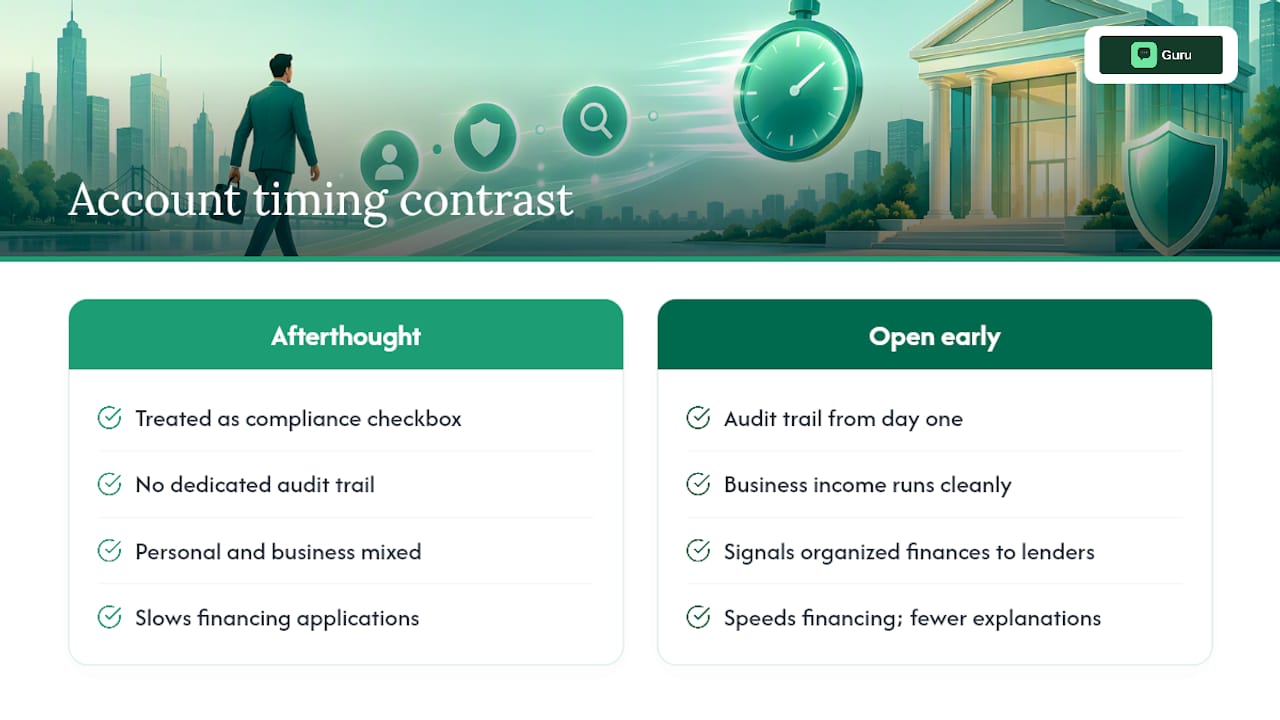
A clean, properly titled business account does two things banks and lenders both care about. It gives you an audit trail from day one, so tax season doesn’t turn into a forensic reconstruction of which Venmo payment was personal and which was business. And it signals to any lender reviewing your application later that your finances are organized, which matters more than most owners realize when it comes to how quickly a financing application moves.
Here’s what conventional advice gets wrong: it treats opening an account as a compliance checkbox instead of a financing strategy. Lenders weigh monthly revenue, time in business, and cash flow more heavily than almost anything else on a business loan application. None of that is visible unless your business income runs cleanly through a dedicated account instead of your personal checking. Open the account early, keep it clean, and you’ll spend less time explaining your finances later and more time getting funded. A properly set up account can help streamline the process when you are ready to look for financing through matching platforms that connect you with lending partners.
— Chris
Ready to Explore Financing Once Your Account Is Open?
Once your business account is up and running, the next question most owners face is how to fund growth: covering payroll during a slow month, restocking inventory before a busy season, or financing a piece of equipment that pays for itself in six months. That’s a different problem than opening a bank account, and it deserves a different tool.
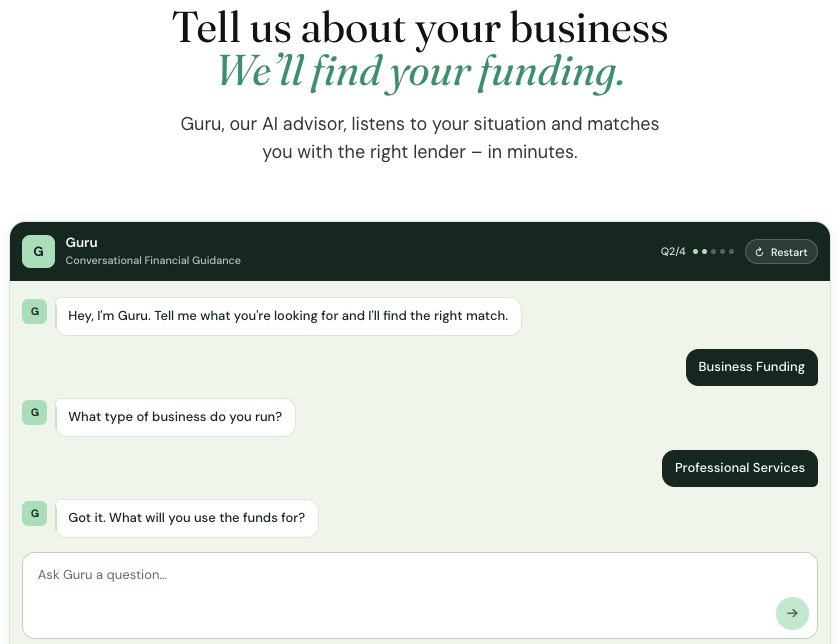
Lending Gurus is not a lender. It’s a free matching platform that connects you with vetted lending partners based on your actual financial picture, not a rigid credit score cutoff. The conversational advisor, Guru, asks about your revenue, time in business, and cash flow without a hard credit pull, then surfaces lending partners suited to your situation. Partners decide final approval, rates, and terms, so nothing here is guaranteed or instant. If you’re weighing working capital, a line of credit, or equipment financing once your account is set up, start a conversation with Guru on the Lending Gurus homepage to see which partners might fit your business.
This article is general information, not a substitute for advice from a qualified financial advisor. Consult a qualified financial professional about your own circumstances before acting on anything here.
Sources
- SBA — Open a business bank account
- FDIC — Your insured deposits (ownership categories)
- IRS — Instructions for Form SS-4
- FinCEN — Customer due diligence (CDD) rule
- CNBC Select — How To Open A Business Bank Account In 4 Simple Steps (2024)
FAQ
Can I Open a Business Bank Account Online in the U.S.?
Yes, most banks let sole proprietors and single-member LLCs open an account fully online. Multi-member LLCs, corporations, and businesses with more complex ownership often need a branch visit or video call to verify beneficial owners under federal Customer Due Diligence rules.
What Documents Do I Need to Open a Business Bank Account?
You’ll typically need your EIN confirmation letter or SSN, formation documents like articles of organization, a government-issued ID for each signer, and beneficial ownership details for anyone owning 25% or more of the business. The SBA’s document checklist covers the full list banks commonly request.
How Much Money Do I Need to Open a Business Account?
Opening minimums vary by bank and account type, and there’s no single figure that applies everywhere. Rather than focusing on the minimum deposit alone, check the bank’s fee schedule for the average balance required to waive monthly maintenance fees, since that number often matters more than the opening deposit.
Can a Foreign Owner Open a U.S. Business Bank Account?
Yes, but it usually requires an in-person visit or video verification, along with a passport, ITIN, and documentation proving the business is legally formed in the U.S. Banks apply the same beneficial ownership verification rules to foreign owners as they do to U.S. citizens, which typically extends the timeline.
How Long Does It Take to Open a Business Bank Account?
A simple sole proprietorship or single-member LLC with documents ready can often open an account the same day online. Accounts with multiple owners, foreign owners, or incomplete paperwork can take several days to a few weeks while the bank verifies beneficial ownership information.
