
An early payoff penalty, also called a prepayment penalty, is a fee some lenders charge when you pay off all or part of a loan ahead of schedule. Not every loan has one, and they are less common than they used to be, but they still show up on some mortgages and older or subprime personal loans. Before you send extra money to a lender, check your Truth in Lending disclosure and promissory note, or call and ask for a written payoff quote.
Table of Contents
- What a prepayment penalty is and the common types you’ll see
- How penalties are calculated: worked examples you can reuse
- When penalties apply and common triggers to watch for
- What the law says about prepayment penalties
- How to check your loan paperwork and get an exact payoff quote
- How to avoid or reduce an early payoff penalty
- A compact decision framework: run the numbers before you pay off
- How Lending Gurus helps you sort through your options
- Compare lenders and confirm payoff terms before you commit
- Where to find more on prepayment penalties
- Sources
- FAQ
What a prepayment penalty is and the common types you’ll see
Lenders write prepayment penalties in two main styles. A hard penalty applies no matter why you pay off the loan, whether you sell the home, refinance, or just pay in full. A soft penalty only kicks in for a refinance or sale, and usually leaves you free to make extra principal payments without a fee.
The fee itself takes a few common forms:
- Percentage of balance: a flat percentage, often 1% to 3%, applied to what you still owe.
- Months of interest: a charge equal to a set number of months of interest payments.
- Flat fee: a fixed dollar amount stated in the note, regardless of balance.
- Sliding scale: a fee that steps down each year, often written as 3/2/1, meaning 3% in year one, 2% in year two, and 1% in year three.
Mortgages carry these clauses most often, along with some secured personal loans. Most unsecured personal loans skip them entirely, according to SoFi’s guidance on personal loan terms.
How penalties are calculated: worked examples you can reuse
The math behind these fees is simple once you know which formula your lender uses.
- Percentage-based: a $200,000 remaining balance with a 2% penalty costs $4,000.
- Months-of-interest: if your monthly interest comes to $600, a six-month penalty costs $3,600.
- Sliding scale (3/2/1): on a $150,000 balance, paying off in year one at 3% costs $4,500, year two at 2% costs $3,000, and year three at 1% costs $1,500.
Fees can sometimes run up to a few percent of your outstanding principal balance, according to Experian’s consumer guidance on prepayment penalties. On a large mortgage balance, that percentage adds up fast, which is exactly why it pays to know your number before you pay off the loan.
When penalties apply and common triggers to watch for
Most prepayment penalties only apply during an early window, commonly the first three to five years of the loan, according to the Consumer Financial Protection Bureau. Outside that window, you can typically pay off the balance without owing anything extra.
The trigger matters as much as the timing. A full payoff from a home sale or refinance is the most common trigger, while routine extra principal payments usually are not, unless your note sets a specific threshold. Read the exact wording in your contract: some define the penalty around “full payoff,” others around any prepayment above a stated percentage of the balance in a given year.
What the law says about prepayment penalties
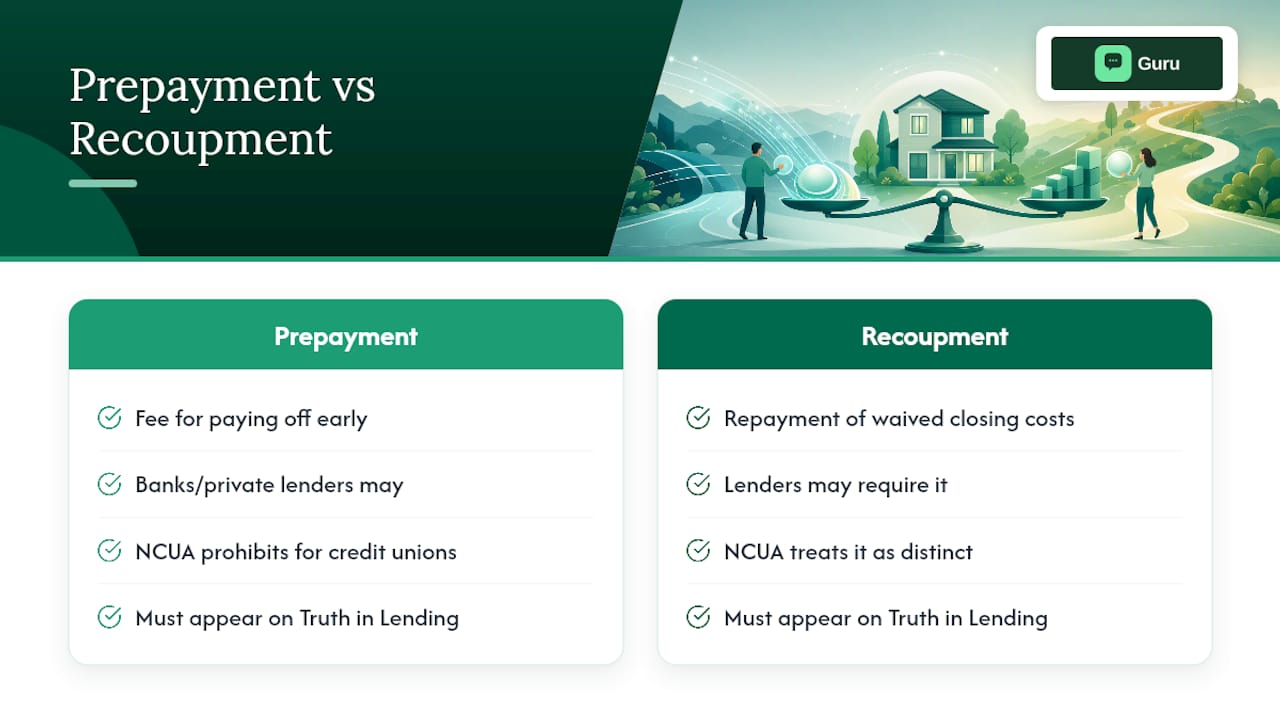
Federal rules limit where these fees can appear. Under NCUA rules, federal credit unions cannot charge prepayment penalties on consumer loans. That protection does not extend to every lender, so a bank or private lender can still write one into your note.
There is a related but different practice called recoupment. A lender may waive certain closing costs upfront, then require you to repay those waived costs if you pay off the loan within a short window. NCUA guidance treats recoupment as legally distinct from a prepayment penalty, since it recovers a specific waived cost rather than charging a new fee. Your Truth in Lending disclosure is required to spell out whether either applies to your loan, which makes it the first document worth reading closely.
How to check your loan paperwork and get an exact payoff quote
Confirming whether you owe a penalty takes a few concrete steps, not guesswork.
- Pull your Truth in Lending disclosure and read the section on prepayment.
- Read your promissory note in full, including any payoff addendum attached to it, since penalty language often sits in an addendum rather than the main note, per CFPB guidance on prepayment.
- Search digital copies of your documents for the terms “prepayment,” “early payoff,” and “recoupment.”
- Call your lender and request a written payoff statement that itemizes any early payoff fees, not just the remaining balance.
- If your lender agrees to waive a fee, get that waiver in writing before you send payment.
A verbal promise from a representative will not hold up later if the fee shows up anyway.
How to avoid or reduce an early payoff penalty
You have more control over this than most borrowers realize, especially before you sign anything.
- Ask directly about prepayment penalties while shopping for a loan, and choose an offer without one when terms are otherwise comparable.
- If your current loan has a penalty, check the exact date the window closes and time your payoff for after that date when your finances allow it.
- Ask your lender to waive or reduce the fee, particularly if you’re refinancing with the same institution.
- Make extra payments below any stated annual threshold instead of paying the full balance at once, since many lenders permit limited partial prepayments without triggering the fee, per Experian.
Pro Tip: Call your lender before you pay, not after, and ask them to confirm in writing exactly which payoff scenario avoids the fee.
A compact decision framework: run the numbers before you pay off
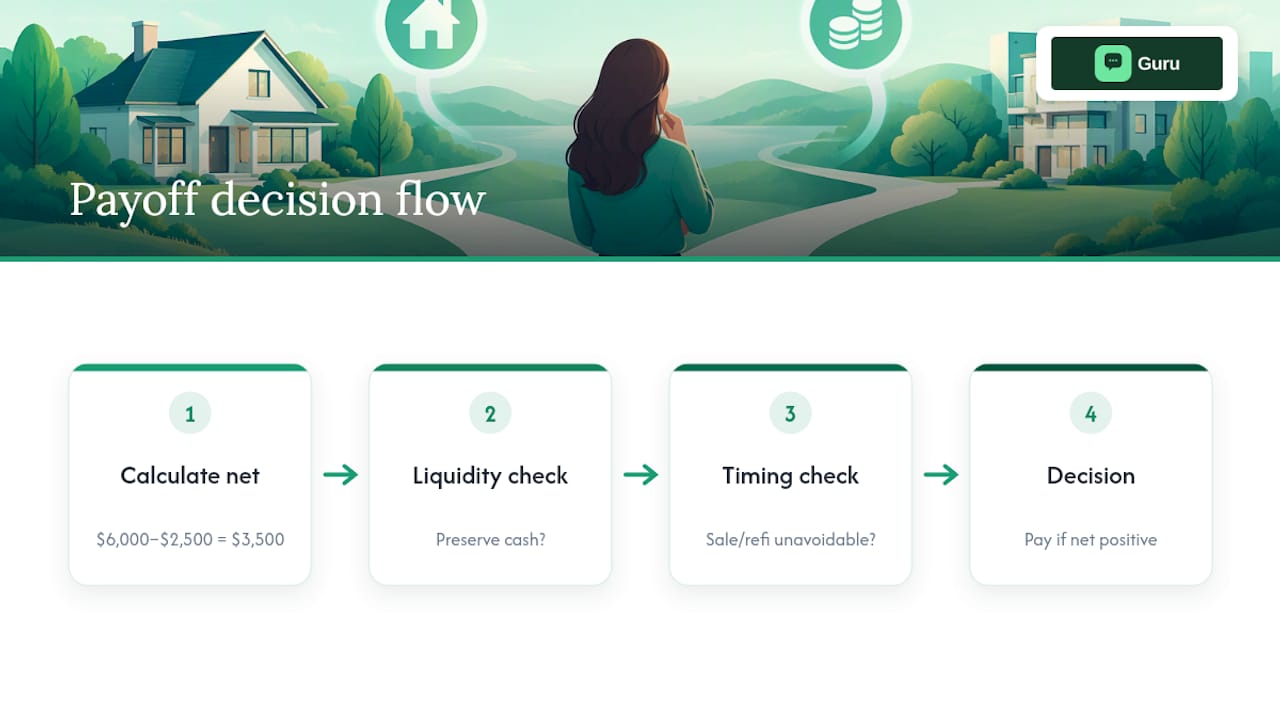
Before you pay off a loan early, subtract the penalty from what you’d actually save in interest. If refinancing at a lower rate would save $6,000 in interest over the life of the loan and the penalty costs $2,500, you still come out ahead by $3,500.
Factor in more than the math, though. Consider how the payoff affects your cash on hand, whether you need that liquidity elsewhere, and whether a looming sale or refinance makes the penalty unavoidable anyway. If you’re behind on payments and facing a forced sale, resources on handling missed mortgage payments can help you weigh your options.
A penalty is often worth paying when the rate drop is substantial or the sale can’t wait. It’s rarely worth paying just to feel done with a loan a few months sooner.
How Lending Gurus helps you sort through your options
A lead aggregation platform offers a free conversational tool that matches you to vetted lending partners without a hard credit pull, with those partners deciding approvals, rates, terms, and amounts. If you’re weighing a refinance or a new loan without a prepayment penalty, Guru can help surface options worth comparing. Nothing here guarantees approval, a rate, or a timeline.
Compare lenders and confirm payoff terms before you commit
Reading a promissory note is only half the job. Comparing what’s actually available to you is the other half, and that’s where Lending Gurus comes in.
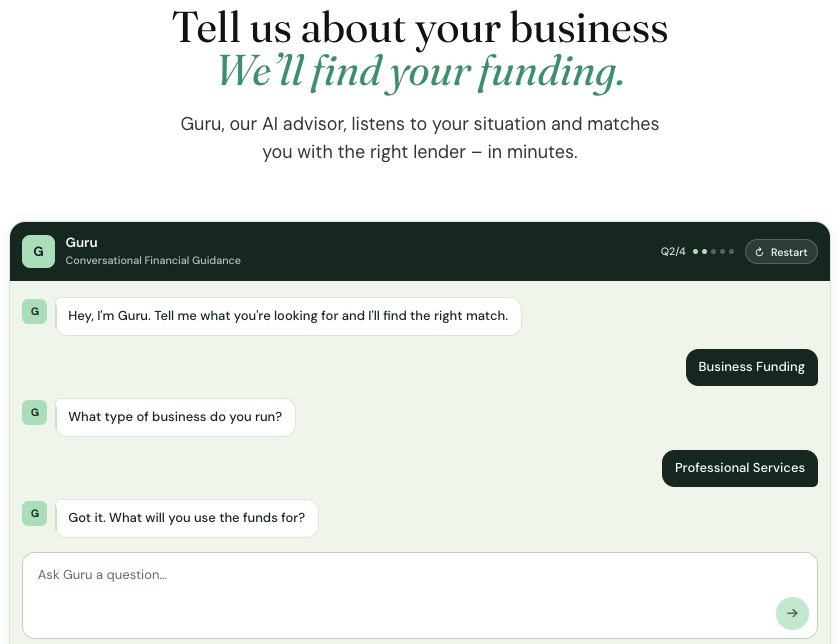
Guru asks a few questions about your situation and matches you to lending partners across working capital, lines of credit, equipment financing, and more, with no hard credit pull and no obligation to proceed. Once you’re matched, ask each partner for a written payoff quote and confirm directly whether their loan carries a prepayment penalty. Partners set their own rates, terms, and fees, so the specifics come from them, not from us. Start a conversation with Guru at Lendinggurus and get a clearer picture of what’s out there before you decide.
Where to find more on prepayment penalties
For more detail beyond this guide, the CFPB’s explainer on prepayment penalties covers disclosure basics, Experian’s breakdown of penalty types and costs walks through fee structures, and NCUA’s legal opinions explain credit union rules and recoupment. Your own Truth in Lending disclosure and payoff statement remain the most reliable sources for your specific loan.
This article is general information, not a substitute for advice from a qualified financial advisor. Consult a qualified financial professional about your own circumstances before acting on anything here.
Sources
- What are prepayment penalties? | Experian
- What is a prepayment penalty? | CFPB
- Prepayment penalty — member business loans (NCUA legal opinion) | NCUA
- Do personal loans have a prepayment penalty? | SoFi
FAQ
Is it smart to pay off a car loan early?
It depends on whether your loan has a prepayment penalty and how much interest you’d save. Most modern auto and personal loans skip prepayment fees, so check your note first, then compare the interest saved against any remaining fee before deciding.
What happens if I pay an extra $100 a month on my mortgage?
Extra principal payments typically shorten your loan term and reduce total interest paid, since more of each payment goes toward the balance instead of interest. Confirm first that your loan doesn’t cap penalty-free extra payments at a specific annual threshold.
Does paying off a loan early hurt your credit?
Paying off an installment loan early doesn’t directly damage your credit, though closing the account can slightly affect your credit mix and average account age. The bigger financial question is usually the prepayment penalty, not the credit impact.
Will I get penalized for paying off my mortgage early?
Only if your loan document includes a prepayment penalty clause, which is now less common but still exists on some mortgages, especially within the first three to five years, according to the CFPB. Check your Truth in Lending disclosure and promissory note, or ask your lender for a written payoff statement to confirm.
