
A merchant cash advance can rescue a business with an urgent, short-term cash gap and predictable card sales, but for most small business owners it’s an expensive fix, not a financing strategy. If your revenue is stable, your credit is workable, or you can wait even two weeks for approval, cheaper options almost always beat an MCA. The math only favors an MCA when speed matters more than cost and you’ve already run the numbers.
Table of Contents
- What Is a Merchant Cash Advance and How Does It Work?
- What Are the Pros of a Merchant Cash Advance?
- What Are the Cons and Risks of a Merchant Cash Advance?
- How Do You Calculate the True Cost of an MCA?
- What Alternatives Should You Consider Before an MCA?
- What Contract Red Flags Should You Check Before Signing?
- Is a Merchant Cash Advance Right for Your Business?
- An Editorial Take on MCAs from Someone Who’s Studied the Fine Print
- Compare Funding Options Before You Commit to an MCA
- Sources
- FAQ
What Is a Merchant Cash Advance and How Does It Work?
A merchant cash advance isn’t a loan. It’s a sale. You’re selling a slice of your future revenue at a discount, and the provider hands you cash today in exchange for the right to collect against sales you haven’t made yet.
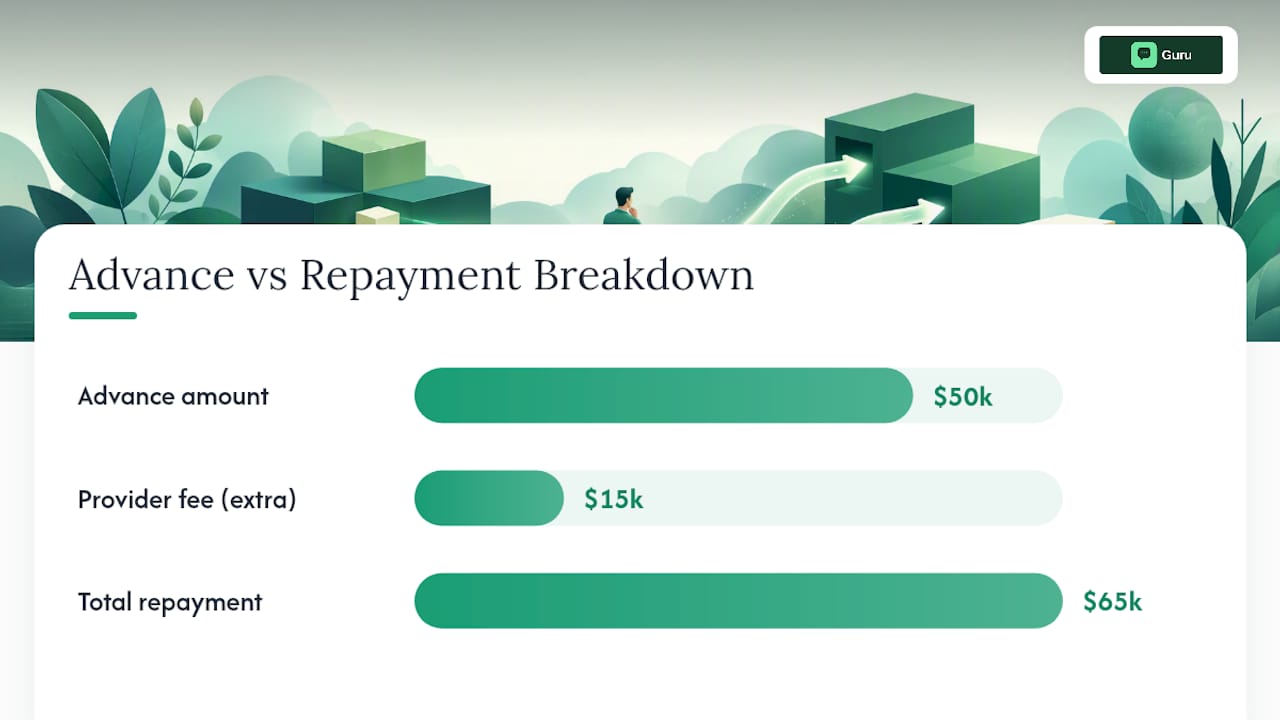
That distinction matters legally and financially. Merchant cash advances are purchases of future receivables, which is why providers use a factor rate instead of an interest rate. A factor rate of 1.3 on a $50,000 advance means you owe $65,000 total, regardless of how long repayment takes.
Repayment happens automatically, and the mechanics matter more than the headline number:
- Holdback percentage: the share of your daily or weekly card sales the provider takes, typically debited straight from your merchant processor.
- Fixed ACH withdrawals: some providers skip the percentage model and pull a set dollar amount from your bank account daily or weekly, regardless of how sales perform.
- Factor rate: the multiplier applied to your advance amount that determines total repayment, unrelated to time elapsed.
- Payback period: usually three to eighteen months, far shorter than a term loan.
Qualification looks nothing like a bank loan application. Providers care about your monthly card processing volume and bank statements far more than your credit score. Most want to see consistent monthly sales, and many will approve businesses with subprime credit that a bank would reject outright. Credit still factors into pricing and approval odds, but it’s rarely the deciding variable the way it is with a conventional term loan.
What Are the Pros of a Merchant Cash Advance?
Speed is the entire pitch, and it’s real. Understanding the practical upside helps you judge whether that speed is worth what you’ll pay for it.
- Fast funding. Many providers approve and fund within 24 to 48 hours of receiving your bank and processing statements, compared to weeks for a bank term loan or months for an SBA loan.
- Lenient underwriting. Approval leans on sales history and cash flow, not a credit score threshold. A business with a rough credit history but strong monthly card volume can still qualify.
- No collateral requirement. You’re not pledging equipment, real estate, or inventory. The advance is secured against future sales, not physical assets.
- Revenue-tied repayment. If you’re on a percentage holdback structure rather than fixed ACH, a slow sales week means a smaller payment, which can reduce strain compared to a fixed loan installment.
- No restrictions on use of funds. Payroll, inventory, an unexpected repair. Most providers don’t dictate how you spend the advance.
Pro Tip: Ask every provider whether your structure is percentage-of-sales or fixed daily ACH before you sign anything. Those two structures behave completely differently in a slow month, and the paperwork doesn’t always make the difference obvious.
What Are the Cons and Risks of a Merchant Cash Advance?
The upside is speed and access. The downside is cost, and it’s steep enough that it deserves its own section rather than a footnote.
Factor rates disguise the real cost. A 1.3 factor rate sounds modest until you annualize it against a six-month repayment term, at which point the effective APR can land in the triple digits. Compare that to a bank line of credit or SBA loan, where annual rates rarely approach that range even for borrowers with weaker credit.
The incentive is backwards. Because MCA cost is fixed once you sign, faster repayment doesn’t save you money the way it does with an interest-based loan. It just concentrates the same total cost into fewer weeks, straining cash flow harder. The lender loses nothing by pushing quick repayment; you absorb all the risk.
Beyond cost, watch for these operational and contractual risks:
- Cash-flow squeeze. Daily or weekly withdrawals, especially fixed ACH ones, can trigger overdrafts if a slow stretch coincides with a big expense.
- Personal guarantees. Many contracts require you to personally guarantee repayment, putting personal assets at risk even though the business, not you, took the advance.
- Confessions of judgment. Some contracts include a clause letting the provider obtain a judgment against you without a court hearing if you default, a legal shortcut that strips away your usual defense rights.
- Processor lock-in. Providers often require you to route all card processing through a specific processor, making it harder to switch systems or negotiate better processing rates later.
- Stacking risk. Taking a second MCA to cover payments on the first is a common trap that compounds effective cost fast and rarely ends well.
- No credit-building benefit. Most MCA providers don’t report to business credit bureaus, so timely repayment does nothing to strengthen your credit profile the way a term loan or line of credit would.
How Do You Calculate the True Cost of an MCA?
Factor rates hide the real number until you convert them into an annualized figure you can actually compare against a loan quote. Here’s the method:
- Find your factor rate and advance amount. Say you’re advanced $40,000 at a 1.35 factor rate. Total repayment is $54,000, meaning $14,000 in cost.
- Estimate your repayment period in months. Base this on your average daily card volume and the holdback percentage, not the provider’s optimistic estimate. Assume six months.
- Annualize the cost. Divide the $14,000 cost by the $40,000 advanced to get a 35% cost ratio, then annualize it over the six-month term. Doing that math consistently shows why effective APRs on MCAs can run far higher than the factor rate alone suggests, often landing well above what a bank or SBA loan would charge for the same dollar amount.
- Add every extra fee. Origination fees, underwriting fees, and ACH processing fees all add to your real cost and rarely appear in the headline factor rate.
Run this math with your own conservative repayment timeline, not the provider’s best-case projection. If your sales dip and repayment stretches from six months to nine, your daily cash-flow hit stays the same dollar amount, but you’re now paying that same $14,000 cost over a longer, harder stretch.
What Alternatives Should You Consider Before an MCA?
An MCA is rarely your only option, even when you feel boxed in. Match your situation against these before you sign anything.
- SBA and bank term loans: the lowest cost by far, but expect weeks to months for approval and stricter credit and revenue requirements. Best when you have time and a clean financial history.
- Business line of credit: revolving access you draw only when needed, with interest charged solely on what you use. A strong fit if your cash need is recurring rather than a one-time gap.
- Business credit cards: useful for smaller, short-term gaps, especially with a 0% introductory APR window, though limits are usually lower than an MCA advance.
- Invoice factoring: sells unpaid invoices rather than future sales, a better match if your cash gap comes from slow-paying customers rather than overall revenue.
- Equipment financing: ties repayment to a specific asset purchase, often at a lower cost than an MCA because the equipment itself secures the loan.
If your credit and time horizon allow it, cheaper capital is almost always sitting one application away. Lending Gurus’s breakdown of loan types walks through how each of these compares before you commit to anything.
What Contract Red Flags Should You Check Before Signing?
Before you sign anything, run this checklist against the actual contract, not the sales pitch.
- Search for a confession of judgment clause. If it’s there, understand exactly what rights you’re giving up in a default scenario.
- Check for a personal guarantee. Know precisely what personal assets are exposed if the business can’t repay.
- Confirm the withdrawal structure. Ask directly whether payments are a percentage of sales or a fixed daily ACH amount, and get it in writing.
- Demand the total dollar cost upfront. Not just the factor rate. The exact total repayment figure and a sample repayment schedule based on realistic sales.
- Ask about processor requirements and stacking restrictions. Some contracts bar you from taking a second advance; others don’t, which is itself a warning sign.
Pro Tip: Request 24 to 48 hours to review any contract before signing, and if the provider pressures you to sign same-day, treat that as a red flag itself. Legitimate providers, per guidance from Stripe, expect you to understand total cost before committing.
Is a Merchant Cash Advance Right for Your Business?
An MCA can make sense when three things line up: you need cash within days, you can repay it within a short window without straining daily operations, and the advance funds something with a clear return, like inventory for a confirmed order or a repair blocking revenue.
- Good fit: a restaurant covering a walk-in freezer repair ahead of a busy weekend, where the cost of staying closed exceeds the advance’s cost.
- Bad fit: covering a recurring payroll shortfall, which signals a deeper cash-flow problem an MCA will only make worse.
- Walk away if: you’d need to stack a second advance to repay the first, or the contract includes a confession of judgment you don’t fully understand.
An Editorial Take on MCAs from Someone Who’s Studied the Fine Print
Most MCA criticism misses the real point: the product isn’t inherently predatory, but it’s priced for emergencies and marketed for everyday use. That mismatch is where businesses get hurt. Lending Gurus works as a matchmaking platform that connects you with vetted lending partners, including options beyond MCAs, and Guru, its conversational advisor, asks about your situation without a hard credit pull. The partners you’re matched with set final approval, rates, and terms, not Lending Gurus. Bring a real cash-flow forecast to any negotiation. It’s the single best leverage point you have against a rushed sales pitch.
— Chris
Compare Funding Options Before You Commit to an MCA
If you’ve read this far, you already know an MCA isn’t your only path, and it’s rarely your cheapest one. The harder problem is figuring out which alternative actually fits your revenue pattern and timeline without spending weeks filling out applications for products you don’t qualify for.
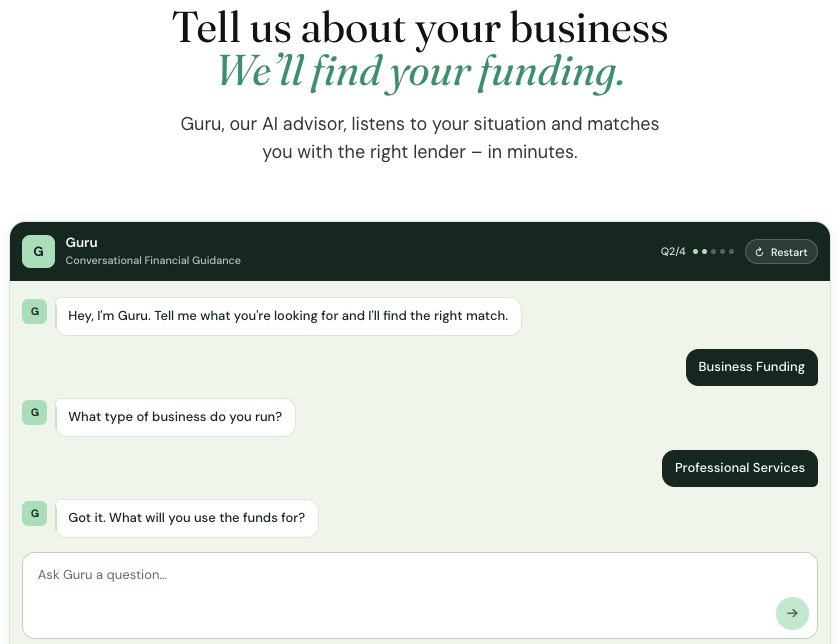
Lending Gurus built Guru specifically for that problem. Tell Guru about your monthly revenue, time in business, and what you need the funds for, and it matches you to vetted lending partners without a hard credit pull, whether that turns out to be a line of credit, invoice financing, equipment financing, or something else entirely. There’s no obligation and no cost to see what you qualify for. Start a conversation with Guru and see your real options before you sign anything with an MCA provider.
Sources
- Pros and Cons of Merchant Cash Advance Loans
- Merchant cash advance loan (Investopedia)
- Merchant Cash Advance: Pros, Cons, and Alternatives (Shopify)
- How a merchant cash advance works | Stripe
This article is general information, not a substitute for advice from a qualified financial advisor. Consult a qualified financial professional about your own circumstances before acting on anything here.
FAQ
What Are the Main Risks of a Merchant Cash Advance?
The biggest risks are a very high effective cost once the factor rate is annualized, daily or weekly withdrawals that strain cash flow, and contract terms like personal guarantees or a confession of judgment that expose you legally beyond the business itself.
What Happens if You Can’t Pay Back a Merchant Cash Advance?
Default can trigger legal action, and if your contract includes a confession of judgment, the provider may be able to obtain a judgment against you quickly without a standard court hearing, making it critical to understand that clause before signing.
What Are the Downsides of Using a Cash Advance?
The core downsides are cost (effective APRs that can run far higher than a bank loan), the operational strain of frequent automatic withdrawals, and limited consumer-style protections compared with regulated loan products.
How Do You Get Out of a Merchant Cash Advance?
Renegotiating directly with the provider, consolidating the advance into a lower-cost loan if you now qualify, or working with an attorney on the contract terms are the main paths; taking a second advance to cover the first only compounds the problem. A platform like Lending Gurus can help you check whether you now qualify for a lower-cost alternative to pay it off.
Is a Merchant Cash Advance Worth It Compared to a Loan?
For most businesses with time to wait and workable credit, a conventional loan or line of credit costs meaningfully less than an MCA; an MCA is generally only worth it when speed and lenient underwriting outweigh the added cost for a short, clearly justified need.
