
An origination fee is a one-time administrative charge your lender collects to process, underwrite, and fund your loan. Every major lender charges some version of it, and federal student loans carry a fixed statutory rate set by law. Don’t fixate on that single number, though. Compare the APR and Loan Estimate across offers, because a low fee paired with a high rate can cost you more over time than a higher fee with a better rate.
Table of Contents
- What Does a Loan Origination Fee Cover?
- How Much Do Origination Fees Typically Cost?
- Origination Fee vs. Discount Points: What’s the Difference?
- Where Do Origination Fees Show Up on Your Loan Documents?
- Are Origination Fees Negotiable?
- What Does a Fee Actually Cost You in Real Numbers?
- What Should You Ask Lenders Before You Sign?
- How Lending Gurus Helps You Compare Fee Disclosures
- Compare Your Loan Offers Before You Commit
- Where to Verify These Fee Rules Yourself
- Sources
- FAQ
What Does a Loan Origination Fee Cover?
Your loan origination fee pays for the paperwork and labor behind getting your loan approved and funded. It’s not one task. It’s several, usually bundled into a single line item on your paperwork.
- Processing: collecting your application, income documents, and verifications
- Underwriting: the lender’s review of your risk, income, and collateral
- Document preparation: drafting the note, disclosures, and closing paperwork
- Funding: wiring or disbursing the loan proceeds once everything clears
Some lenders itemize these as separate charges. Others fold them into one flat fee labeled simply “origination charge.” You’ll pay it one of three ways: in cash at closing, deducted directly from your loan proceeds before you receive them, or rolled into your loan balance and repaid over time with interest.
How Much Do Origination Fees Typically Cost?
Origination fees range from under 1% to as much as 8% of the loan amount, and the type of loan drives most of that spread.
Always ask what you’ll actually receive, not just the loan amount you’re approved for.*
- Mortgages: typically 0.5% to 1% of the loan amount, sometimes bundled with other lender fees
- Personal loans: commonly 0.5% to 8%, depending on your credit profile and the lender’s underwriting model
- Federal student loans: set by statute. For loans first disbursed on or after October 1, 2020, Direct Subsidized and Unsubsidized loans carry a 1.057% fee, and PLUS loans carry 4.228%
Smaller loans often carry higher percentage fees. The underwriting work is nearly identical whether a lender processes a $5,000 loan or a $50,000 loan, so lenders spread that fixed cost across a smaller balance, and the percentage climbs as a result.
Origination Fee vs. Discount Points: What’s the Difference?
An origination fee pays for administrative work. Both show up on your Loan Estimate, and both factor into your APR.
- Origination fees are close to mandatory. You’ll rarely find a lender that skips this charge entirely.
- Discount points are a choice. You decide whether the upfront cost is worth the rate reduction.
- Both raise your APR above your stated interest rate, since APR folds in fees along with the rate itself.
Pro Tip: Buying points only makes sense if you plan to keep the loan long enough to hit your breakeven point, the number of months it takes for your monthly savings to offset what you paid upfront. Ask your lender to calculate this exact figure for your loan before you decide.
Where Do Origination Fees Show Up on Your Loan Documents?
- Loan Estimate, Section A (page 2): origination charges are listed here, itemized by category, within three business days of your mortgage application under TRID rules.
- Closing Disclosure: the final version of those same charges, which should closely match your Loan Estimate. Large, unexplained increases are a red flag.
- Payment timing: most fees are collected at closing or subtracted from loan proceeds, though some lenders let you roll the fee into your balance and pay it off over the life of the loan.
TRID rules limit how much these charges can increase between your Loan Estimate and closing, with exceptions for things like a changed loan program or new information about your finances.
Are Origination Fees Negotiable?
Yes, in many cases, particularly on mortgages and larger personal loans where lenders compete hard for your business.
- Ask for an itemized breakdown. If a lender lumps several charges into one number, request the detail. Overlapping processing and underwriting charges sometimes hide in a single line.
- Collect at least two Loan Estimates. Competing offers give you real leverage to ask for a reduction or a waiver.
- Ask directly about a no-fee option. Some lenders will waive the origination charge in exchange for a higher rate. Ask them to show you the APR difference so you can judge the tradeoff yourself.
- Watch for relabeled fees. A “no origination fee” loan can still carry a “processing fee” or “administrative fee” that does the same job under a different name.
Pro Tip: When a lender refuses to waive or reduce a fee, ask for a written explanation. Lenders who can’t justify a charge in writing often reconsider it.
Marketing language around “zero fee” loans deserves scrutiny. Lenders sometimes offset a waived origination fee with a higher interest rate, so the fee didn’t disappear. It just moved into your rate.
What Does a Fee Actually Cost You in Real Numbers?
- Mortgage example: On a $300,000 mortgage with a 0.75% origination fee, you’d owe $2,250 at closing, on top of your down payment and other closing costs.
- Personal loan example: On a $15,000 personal loan with a 3% origination fee rolled into the balance, you’d repay $15,450 plus interest, not $15,000, even though you only received the reduced net proceeds upfront.
- The real comparison point: APR captures both the fee and the rate together, which is why two loans with identical origination fees can still have very different total costs.
A lower fee with a higher rate can easily cost more over a five or ten year term than a higher fee paired with a meaningfully lower rate. Run the APR comparison before you sign anything.
What Should You Ask Lenders Before You Sign?
Ask every lender the same set of questions so you can compare answers side by side.
- “Can you give me an itemized breakdown of every origination charge?”
- “Do you offer a no-origination-fee option, and what does that do to my rate?”
- “Why did this charge change between my Loan Estimate and Closing Disclosure?”
Red flags worth walking away from: vague charge names like “admin fee” with no explanation, a Closing Disclosure that doesn’t match your Loan Estimate, or an APR that’s far higher than the stated interest rate would suggest. When something doesn’t add up, ask for a written Loan Estimate before you commit to anything.
How Lending Gurus Helps You Compare Fee Disclosures
Lending Gurus is a free matching tool, not a lender. Guru connects you to vetted lending partners who set their own rates, fees, and terms. Lending Gurus doesn’t approve loans, guarantee terms, or promise a specific rate or timeline. Those decisions belong entirely to the partner lender.
What Guru does is speed up the comparison step. It listens to your situation through a conversational interface, with no hard credit pull, and surfaces matches so you can start reviewing fee structures side by side sooner. For business financing, Guru weighs monthly revenue, time in business, and cash flow more heavily than credit score alone, since that’s how most business lenders actually evaluate applications.
Compare Your Loan Offers Before You Commit
Every lender structures its origination fee differently, and the only way to know if you’re getting a fair deal is to see more than one offer side by side. That’s the gap Lending Gurus is built to close.
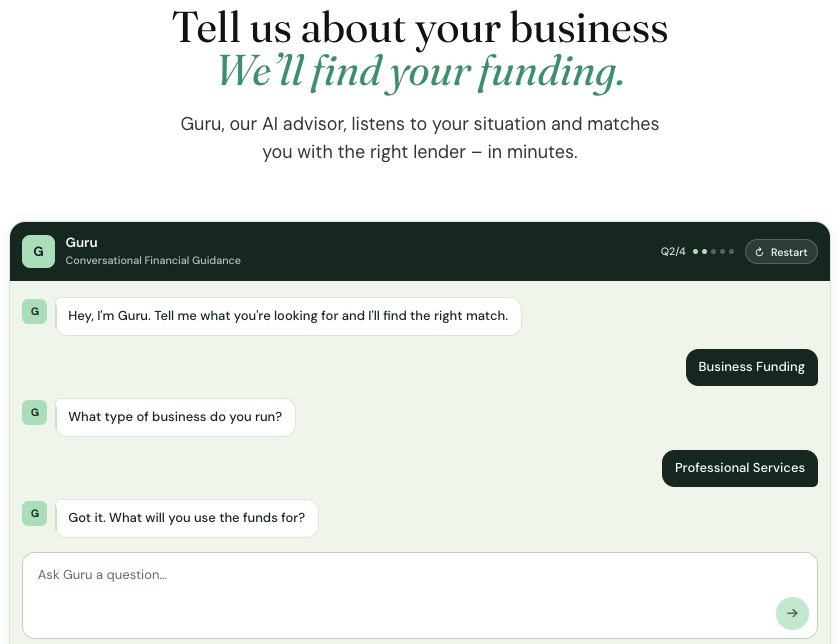
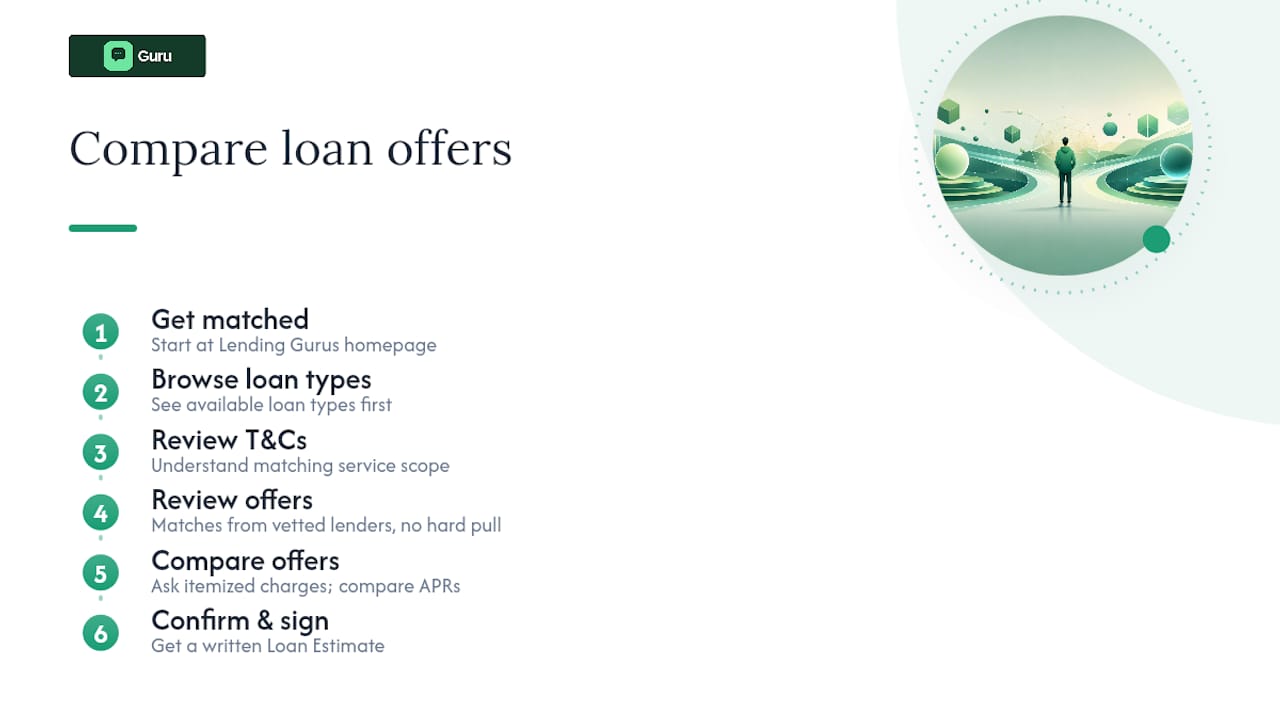
Guru asks a few questions about your situation, business or personal, and surfaces matches from vetted lending partners without a hard credit pull. You’ll see different fee structures and loan types without filling out five separate applications. Once you have offers in hand, use the checklist above: ask for itemized charges, compare APRs side by side, and confirm your written Loan Estimate before you sign anything.
Start at the Lending Gurus homepage to get matched, or browse the loan types Guru covers first if you want to see what’s available before you begin. Review the terms and conditions to understand exactly how the matching service works and what it doesn’t guarantee.
Where to Verify These Fee Rules Yourself
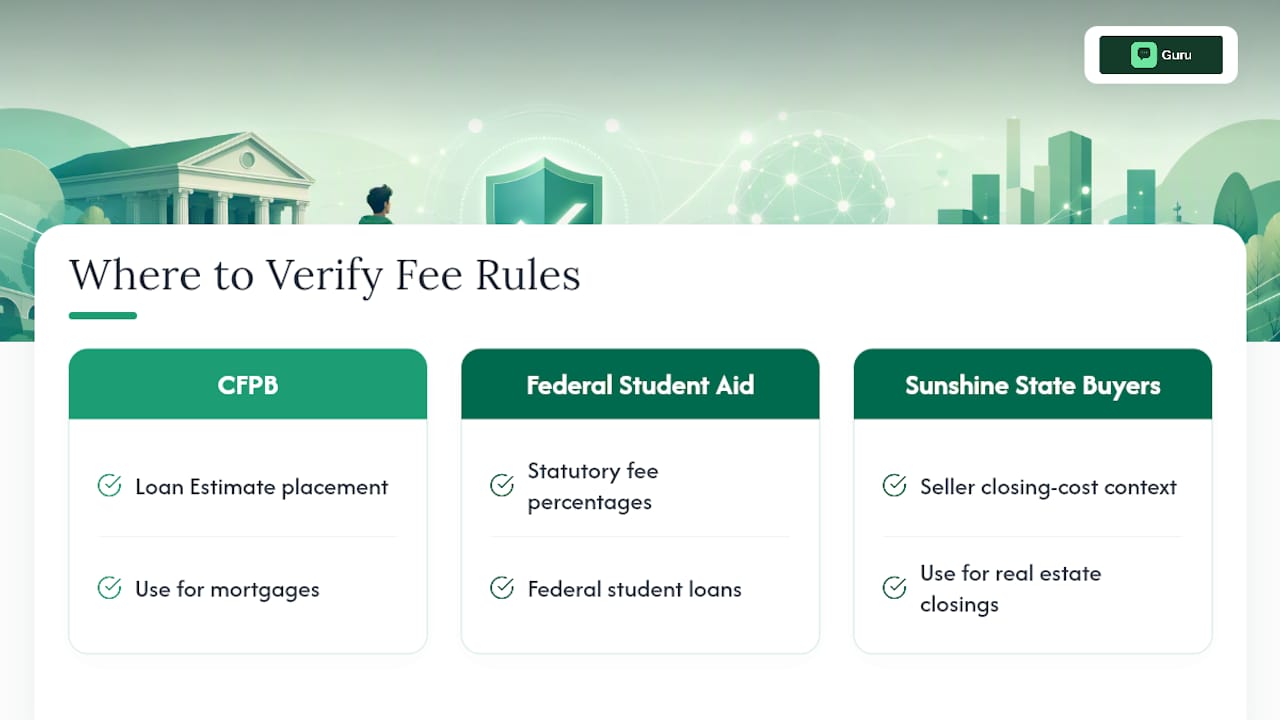
The CFPB’s guide to mortgage origination fees explains exactly where charges must appear on your Loan Estimate. Federal Student Aid confirms the statutory fee percentages on federal student loans directly from the source. For real estate closings specifically, Sunshine State Buyers’ breakdown of seller closing costs offers useful context on how origination charges fit into the broader closing cost picture.
This article is general information, not a substitute for advice from a qualified financial advisor. Consult a qualified financial professional about your own circumstances before acting on anything here.
Sources
- FY-26 sequester required changes — Federal Student Aid (ED)
- CFPB: What is the difference between a loan interest rate and the APR?
- Investopedia: Origination fee
- Experian: What is an origination fee?
FAQ
Should I Pay a Loan Origination Fee?
In most cases, yes, since nearly every lender charges some version of this fee. The better question is whether the APR on that offer beats a competing offer with a different fee and rate combination.
Is a 2% Origination Fee High?
Whether it’s high for your situation depends on the rate attached to it. Compare the full APR against other offers before judging the fee alone.
How Do I Avoid Loan Origination Fees?
Ask lenders directly for a no-origination-fee option, but expect a rate increase in exchange, since lenders often shift that cost into the interest rate rather than absorbing it. Shopping multiple Loan Estimates and negotiating with your preferred lender also gives you real leverage to reduce or waive the charge.
How Much Are Closing Costs on a $400,000 Loan?
Closing costs typically run a few percentage points of the loan amount and include the origination fee alongside appraisal, credit report, title, and underwriting charges. Your Loan Estimate and Closing Disclosure will itemize the exact dollar amounts for your specific loan, so review those documents rather than relying on a rough percentage.
Does Lending Gurus Charge an Origination Fee?
The matching service does not charge fees to use its platform. Any origination fee you may pay comes from the lending partner you are matched with, based on that partner’s own pricing and underwriting.
