
Loan approval time ranges from minutes to several weeks, and funding is a separate clock that adds more days on top. Online personal loans and auto financing move fastest, often approved same day; mortgages and SBA loans move slowest, often taking 30 to 90 days. The sections below break down each loan type and show you how to shave real time off your own timeline.
Table of Contents
- How Long Does Loan Approval Take by Loan Type?
- What Are the Steps in the Loan Approval Process?
- What Factors Affect Loan Approval Time?
- How Can You Speed Up Loan Approval?
- What Happens After You Submit a Loan Application?
- How Does a Lending Gurus Match Speed Up the Process?
- Speed Versus Cost: What Actually Matters When Choosing a Lender
- Find a Lender Match Without the Guesswork
- Where to Verify Loan Timelines Yourself
- Sources
- FAQ
How Long Does Loan Approval Take by Loan Type?
Loan processing time depends almost entirely on who you borrow from and what the lender needs to verify. A personal loan from an online lender and a mortgage from a bank are not on the same planet timewise, even though both involve “approval.”
- Personal loans, online lenders: Approval often lands in minutes to 24 hours, with funding arriving the same day or next day.
- Personal loans, banks and credit unions: Approval usually takes 1 to 7 business days, and funding adds another 1 to 5 business days once you’re approved.
- Mortgages: Full approval through closing commonly runs 30 to 45 days, driven by appraisal, title work, and mandatory disclosure windows.
- Private student loans: Approval typically takes days to a couple of weeks, and many lenders time disbursement to line up with your school’s billing cycle.
- Federal student loans: Timing follows your school’s own disbursement schedule rather than a lender decision, so the calendar is largely out of your hands.
- Auto and dealer financing: Approval can happen in hours, and dealerships routinely close financing the same day you sign for the car.
- SBA and larger business loans: Standard SBA 7(a) loans often take 30 to 90 days because of the added federal guarantee steps, while SBA Express aims for a faster initial decision, though full underwriting still applies.
Some banks add their own wrinkles. Citi, for example, can offer same-day funds for its own deposit account holders once approved, but non-Citi direct deposits can take up to two business days. That kind of detail rarely shows up until you’re already deep in an application, so it pays to ask upfront.
What Are the Steps in the Loan Approval Process?
Every loan moves through the same basic stages. What changes is how long each one takes.
- Prequalification or preapproval. A soft credit pull gives you a rough eligibility read without touching your credit score, and it’s the fastest way to rule out lenders who won’t work for your situation.
- Application submission. You provide income, identity, employment, and (for secured loans) asset information. Online applications usually take minutes to complete.
- Document verification. The lender checks your ID, pay stubs, bank statements, and tax returns against what you claimed. This is where incomplete paperwork causes the most friction.
- Underwriting. Automated decisioning can clear a straightforward file in minutes to hours. Manual underwriting, required for more complex or borderline profiles, can add days.
- Final decision and funding initiation. You get an approval, a conditional approval, or a denial. Once approved, funding starts, though the money in your account is a separate timeline from the approval itself.
What Factors Affect Loan Approval Time?
Two applicants with identical loan amounts can have wildly different approval timelines. Here’s what actually moves the needle.
- Document completeness. Missing pay stubs, unsigned forms, or mismatched addresses are the single most common reason approval stalls, and applicant error remains a leading cause of multi-day delays.
- Underwriting model. Automated systems clear simple files fast. Manual review, triggered by inconsistencies or unusual income, adds real time.
- Loan complexity. Collateral, appraisals, and title searches (common in mortgages and some business loans) introduce third-party steps a lender can’t control.
- Borrower complexity. Self-employment income, a recent job change, high debt-to-income ratio, or a thin credit file all tend to push a file into manual review.
- External timing. Appraisers, title companies, and closing agents work on their own schedules, and weekends or bank holidays freeze the clock entirely.
Pro Tip: If you’re self-employed, upload two years of tax returns and a profit-and-loss statement before the lender asks. Waiting for that request to arrive is one of the most common reasons self-employed borrowers lose a week they didn’t need to lose.
How Can You Speed Up Loan Approval?
Most borrowers can shave real time off their timeline without changing lenders, just by changing the order they do things in.
- Prequalify with soft-pull tools first. This narrows your lender list before you commit to a hard credit inquiry, which saves you from applying somewhere that was never going to fit your file.
- Gather documents before you apply. ID, recent pay stubs, bank statements, and tax returns should be scanned and ready, not requested one at a time.
- Favor lenders with automated underwriting when speed matters most. A straightforward file clears faster through an automated system than a manual queue.
- Respond to lender requests same day. Secure upload portals exist for a reason. A same-day reply can be the difference between funding this week and next.
- Submit early in the week. Applications filed Friday afternoon often sit until Monday, and funding cutoffs near bank holidays can push deposits back further than borrowers expect.
Typical application-to-funds windows run anywhere from the same day to about a week for personal loans, and the fastest path there is almost always full documentation submitted on the first try. Tools that speed up document signing and submission can shave real time off this stage too, since a signature delay is just as costly as a missing bank statement.
What Happens After You Submit a Loan Application?
Once you hit submit, most lenders send an initial status update within a day or two, sometimes within minutes for automated decisions.
- Expect an email or portal notification confirming receipt, followed by either a decision or a document request.
- If the lender asks for additional documents, respond within 24 hours whenever possible. Slow responses are the most avoidable source of delay in the entire process.
- A conditional approval means the lender will fund the loan once you satisfy specific remaining requirements, such as a verified pay stub or an updated bank statement. It is not a final approval, and it’s not a guarantee.
- Once final approval is issued, funding is initiated, but the deposit itself can still take 1 to 5 business days to land depending on your bank and the lender’s own disbursement schedule.
How Does a Lending Gurus Match Speed Up the Process?
Lending Gurus doesn’t approve loans. Partner lenders decide approvals, set rates, and set terms, and Lending Gurus never promises a specific outcome or timeline.
What Guru does is shorten the search phase that eats up time before you ever reach underwriting. Instead of applying to five lenders separately, you talk to Guru, a conversational tool that asks about your situation without a hard credit pull, then matches you to vetted partners suited to your profile.
Faster lender matching means fewer wasted applications. Skipping a hard credit pull at the shopping stage means you can compare options without the pulls stacking up on your credit report. Getting document guidance upfront means you walk into underwriting with a cleaner file the first time.
The time Guru saves is in the matching and preparation stage, not in underwriting itself. Partners still control how long their own review takes.
Speed Versus Cost: What Actually Matters When Choosing a Lender
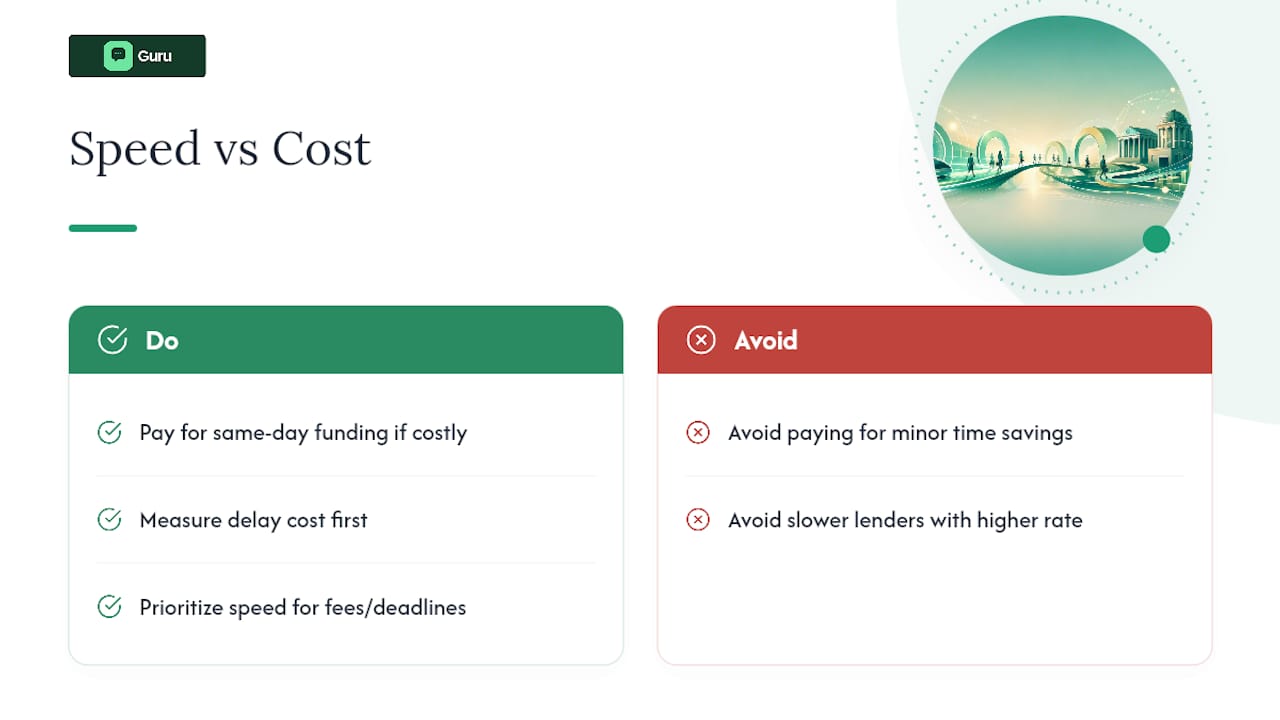
Same-day funding can be worth considering when a delay might cost you something concrete, like a late fee, a missed deposit, or a deal that expires. Outside of that, a slightly slower lender with a lower rate almost always wins over the life of the loan.
A simple rule: if the cost of waiting a few extra days is measurable, pay for speed. If it isn’t, don’t.
— Chris
Find a Lender Match Without the Guesswork
Comparing lenders one application at a time is slow, and every hard credit pull along the way can ding your score before you’ve even picked a lender. Lending Gurus is built for exactly that bottleneck: you talk to Guru, our free conversational tool, about your situation once, and get matched to vetted lending partners without a hard credit pull slowing you down.

Guru doesn’t approve loans or set rates. The partner lender you’re matched with makes that call, and terms, amounts, and timelines are theirs to decide. What Lending Gurus controls is the front end: faster matching, no repeated applications, and no obligation to accept anything you’re offered. If you want to see exactly how the matching process works before you commit to anything, read through how Lending Gurus works, then start the conversation with Guru when you’re ready to see which partners fit your situation.
Where to Verify Loan Timelines Yourself
A few consumer-facing pages are worth bookmarking if you want to check timelines directly from the source rather than take an aggregator’s word for it.
- Experian’s guide to personal loan timing breaks down online lender versus bank timelines.
- Chase’s mortgage approval timeline page explains what drives the 30 to 45 day mortgage window.
- Lending Gurus’s terms and conditions cover how matching and data use work on the platform itself.
This article is general information, not a substitute for advice from a qualified financial advisor. Consult a qualified financial professional about your own circumstances before acting on anything here.
Sources
- How long does it take to get a personal loan? — Experian
- How long do mortgage loan approvals take? — Chase
- How long does it take to get a personal loan? — Bankrate
FAQ
How long does it usually take to get a loan approved?
It depends heavily on the loan type. Online personal loans and auto financing can be approved in minutes to 24 hours, while mortgages typically take 30 to 45 days from application to closing.
What credit score do you need to get a $30,000 loan?
Credit score requirements vary by lender and loan type, and no single cutoff applies universally. Lenders also weigh income, existing debt, and (for business loans) cash flow and time in business alongside credit history, so a strong score alone doesn’t guarantee approval or a specific rate.
Can a loan be denied after approval?
Yes. A conditional approval requires you to meet specific remaining conditions, such as verified income or updated bank statements, before funding, and failing to satisfy those conditions can result in denial even after initial approval.
How quickly can you get a loan approved?
The fastest personal loan approvals happen in minutes through online lenders using automated underwriting, while banks and credit unions typically need 1 to 7 business days because of manual review steps. Complex loans like mortgages or SBA financing take weeks to months regardless of lender type.
