
Working capital is the difference between your current assets and your current liabilities. It tells you, at a glance, how much short-term financial cushion your business actually has. Current assets include cash, accounts receivable, inventory, and prepaid expenses. Current liabilities cover accounts payable, short-term debt, accrued expenses, and unearned revenue. The gap between those two numbers is what keeps your business running day to day.
Two versions of this metric matter:
- Gross working capital: The total value of all current assets, before any liabilities are subtracted.
- Net working capital (NWC): Current assets minus current liabilities. This is the number most financial managers and lenders focus on, because it shows whether you can actually cover your near-term obligations.
Think of net working capital as a snapshot. It reflects your liquidity at a specific moment in time, not over a period. That distinction separates it from cash flow, which tracks money moving in and out over weeks or months.
How to calculate working capital using the formula
The formula is straightforward:
Working Capital = Current Assets – Current Liabilities
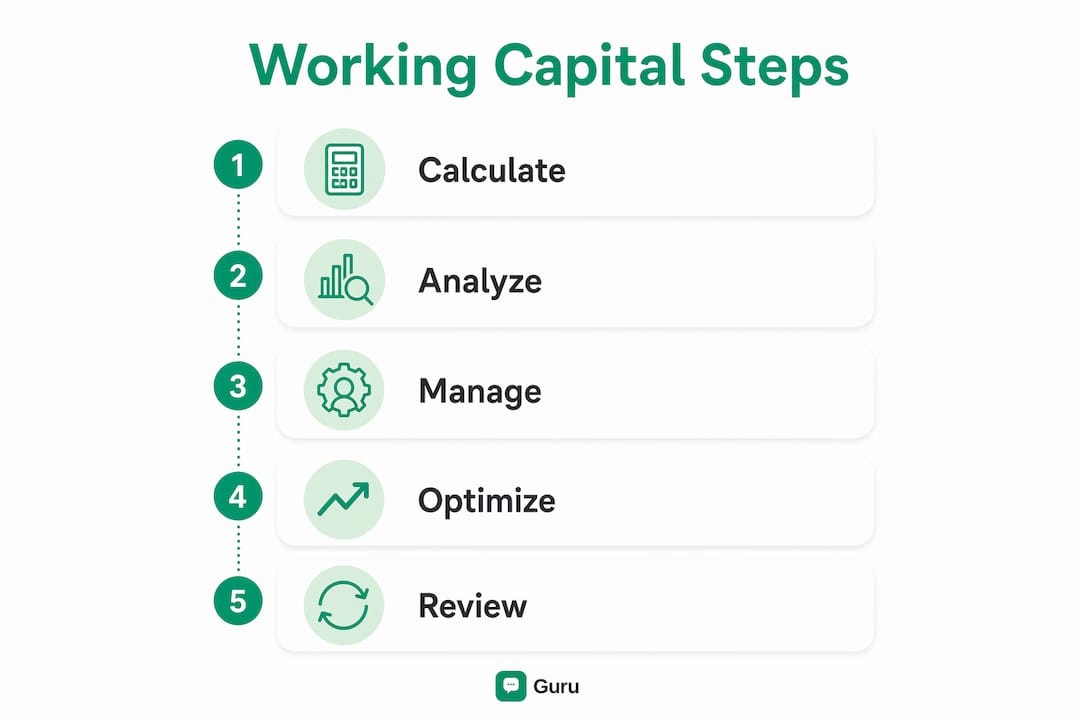
Getting to that number takes a few deliberate steps.
- Pull your balance sheet. Your current assets and current liabilities both live there. You need the most recent version for an accurate picture.
- Add up current assets. Include cash, accounts receivable, inventory, marketable securities, and prepaid expenses. Only count items you expect to convert to cash within 12 months.
- Add up current liabilities. Include accounts payable, accrued wages, taxes owed, short-term loans, and unearned revenue. One detail many business owners miss: the current portion of long-term debt due within the next year belongs here too.
- Subtract. Current assets minus current liabilities equals your net working capital.
Here is a simple example:
| Item | Amount |
|---|---|
| Cash | — |
| Accounts receivable | — |
| Inventory | — |
| Total current assets | — |
| Accounts payable | — |
| Short-term debt | — |
| Accrued expenses | — |
| Total current liabilities | — |
| Net working capital | $48,000 |

A positive result like $48,000 means you have more than enough short-term assets to cover your near-term obligations. A negative result means the opposite: your liabilities outpace your liquid assets, and that gap needs attention. A result near zero is technically balanced, but it leaves no buffer for unexpected expenses.
Why working capital matters for your business health
Working capital funds the essentials: payroll, inventory purchases, supplier payments, and customer order fulfillment. Even a profitable company can face serious trouble if its cash is tied up in slow-moving inventory or unpaid invoices. Profit on paper does not pay your employees on Friday.
The benefits of keeping working capital healthy go beyond just staying solvent:
- Operational continuity: You can meet payroll and pay suppliers on time, which protects vendor relationships and employee morale.
- Growth capacity: Positive working capital gives you the flexibility to take on new orders, invest in equipment, or expand without waiting on a loan.
- Reduced financing costs: When you are not scrambling for emergency credit, you avoid high-interest short-term borrowing.
- Resilience during downturns: Businesses with strong liquidity weather slow seasons and economic shifts far better than those running on thin margins.
Common challenges include slow accounts receivable, seasonal revenue swings, and rapid growth that consumes cash faster than sales can replenish it. Seasonal businesses face a particular version of this: their working capital needs in peak months look nothing like their off-season reality.
Pro Tip: A high working capital ratio is not always a good sign. If too much capital sits in slow-moving inventory or aging receivables rather than liquid cash, you may be missing opportunities to put that money to work. According to J.P. Morgan, effective working capital management reduces financing costs and improves operational flexibility.

Real-world working capital examples
Seeing the numbers in context makes the concept click faster than any definition.
Example 1: Retail business with positive working capital
A clothing retailer has current assets and current liabilities such that the net working capital is positive. The business can restock for the holiday season, pay its suppliers on time, and still have a buffer for unexpected costs.
Example 2: Restaurant with negative working capital
A restaurant has current assets that are less than its current liabilities, including unpaid food supplier invoices and a short-term equipment loan. The owner needs to either accelerate revenue, negotiate extended payment terms with suppliers, or secure short-term financing before the gap widens.
Working capital is the lifeblood of a business’s operational success. A company can be profitable on paper and still face insolvency if its assets cannot be converted to cash fast enough to meet obligations. The difference between a business that survives a slow quarter and one that does not often comes down to how well it managed its working capital before the slowdown hit.
Gross vs. net in practice:
A manufacturing company might report $200,000 in gross working capital (total current assets). But once you subtract $160,000 in current liabilities, the net working capital drops to $40,000. That narrower figure is what lenders and financial analysts actually use to assess short-term risk.
Seasonal businesses should measure working capital at both peak and off-peak periods. A landscaping company flush with cash in july may look very different on its balance sheet in january, and planning for that gap is what separates businesses that survive the winter from those that do not.
Working capital management strategies that actually work
Managing working capital well means more than watching your bank balance. It involves strategic handling of receivables, payables, and inventory together.
Accelerate accounts receivable. Send invoices immediately after delivery. Offer small early-payment discounts to incentivize faster payment. Review your collections process and follow up on overdue accounts within a defined window, not whenever someone remembers.
Manage payables strategically. Pay suppliers on the last day terms allow, not early. Negotiate longer payment windows when you have the leverage. Extending payables by even 15 days can meaningfully improve your cash position without damaging supplier relationships.
Tighten inventory management. Excess inventory ties up cash that could be working elsewhere. Use demand forecasting to order closer to actual need, and identify slow-moving stock before it becomes a write-off.
Use a line of credit as a buffer, not a crutch. A revolving line of credit gives you flexibility during seasonal dips or unexpected expenses without forcing you to liquidate assets. The key is drawing on it for short-term gaps, not ongoing operating losses.
Review your working capital cycle regularly. The cash conversion cycle, which measures the time between spending cash on inventory and collecting cash from customers, is one of the most useful operational metrics you can track. Shortening it by even a few days compounds over time. Business owners looking to strengthen their financial position can also explore scaling their operations with better liquidity practices built in from the start.
Key Takeaways
Working capital, calculated as current assets minus current liabilities, is the single most direct measure of your business’s ability to meet short-term obligations and fund daily operations.
| Point | Details |
|---|---|
| Core formula | Net working capital equals current assets minus current liabilities, drawn from your balance sheet. |
| Positive vs. negative | Positive working capital means you can cover obligations and invest in growth; negative signals a liquidity gap. |
| Include all liabilities | The current portion of long-term debt due within 12 months must be counted in current liabilities for an accurate result. |
| Management goes beyond cash | Optimizing receivables, payables, and inventory together is what drives lasting improvement in working capital. |
| Seasonal planning matters | Measuring working capital at both peak and off-peak periods helps businesses prepare for predictable cash gaps. |
Need working capital financing? Lending Gurus can help

If your working capital calculation reveals a gap, the right financing can close it without the red tape of traditional lending. Lending Gurus uses AI to match business owners with lenders suited to their specific situation, including working capital loans, lines of credit, and invoice financing, all without a hard credit pull. The process takes minutes, not weeks. If you are ready to see your options, learn how it works and get matched today.
