
To qualify for most lines of credit, you need to show lenders three things: creditworthiness, verifiable income or business cash flow, and the right documentation. Secured products, like a HELOC, add a fourth requirement: collateral that a lender can value and legally claim if you default.
Every lender weighs these factors a little differently, and the product you’re applying for changes the checklist. A personal line of credit leans on your individual credit report and income. A business line looks harder at your company’s revenue and time in business. A home equity line of credit needs an appraisal before anyone talks numbers.
Here’s what almost every lender checks before approving a line of credit:
- Credit report and score — payment history, derogatories, and recent inquiries
- Verifiable income or cash flow — pay stubs, tax returns, or bank deposits, depending on whether you’re an employee, self-employed, or a business owner
- Supporting documents — identification, tax ID, bank statements, and (for businesses) financial statements
- Collateral, if the line is secured — home equity, a certificate of deposit, or an investment account, verified through appraisal or account statements
Requirements vary by lender and by product, and most lenders let you check your likely terms with a soft credit pull before you commit to a hard inquiry. Lending Gurus doesn’t set any of these requirements. Guru matches you to lending partners, and those partners make the final call on approval, rates, and terms.
Table of Contents
- Line of Credit Requirements by Product Type
- What Do Lenders Check on Your Credit and Income?
- Secured vs. Unsecured Lines: What Collateral Changes
- How Long Does the Line of Credit Application Take?
- How Do Lenders Actually Weigh Your Application?
- Minimum Time in Business for a Line of Credit
- Lender-Specific Criteria You Should Expect to See
- Typical Minimum and Maximum Credit Limits
- Does Having Other Credit Lines Hurt Your Application?
- How Bankruptcies and Collections Affect Your Approval
- Our Take: Requirements Are a Starting Point, Not a Verdict
- How to Use Guru to Find Lenders That Fit Your Profile
- Sources
Line of Credit Requirements by Product Type
The word “requirements” means something different depending on which line of credit you’re asking about. Lumping personal lines, HELOCs, and business lines together is how a lot of applicants waste time gathering the wrong paperwork.
Personal lines of credit center on you as an individual. Lenders look at your personal credit score, your income (job or otherwise), and your existing debt load. Because a personal line of credit is a revolving account approved based on your overall creditworthiness, there’s no business financials to dig through, no appraisal, and usually no collateral unless you’re applying for a secured version.
HELOCs work differently because your home backs the line. Lenders need a current appraisal to establish your home’s value, your existing mortgage statement to calculate remaining equity, proof of homeowners insurance, and standard income documentation. The CFPB’s HELOC guidance notes that home-equity products carry extra disclosure requirements under Regulation Z, precisely because your house is on the line if payments stop.
Business lines of credit flip the emphasis. Personal credit still matters, especially for newer businesses without an established business credit file, but lenders weight revenue, cash flow, and time in business more heavily. The SBA notes that business lines of credit are often used for seasonal cash flow gaps or working capital, and lenders evaluating them want to see:
- Two to three years of business tax returns
- Profit and loss statements and a balance sheet
- Business bank statements (often three to twelve months)
- Personal tax returns and credit report, particularly for owner-guaranteed lines
If your business is young or has thin credit history, expect your personal credit and personal guarantee to carry more weight. That’s normal, not a red flag on your application.
What Do Lenders Check on Your Credit and Income?
Lenders build their decision around four data points: your credit report, your income, your debt-to-income ratio, and the documents that prove all three are accurate. Understanding each one helps you prequalify without surprises.
Prequalification versus hard pull. Most lenders let you check estimated terms through a soft credit inquiry, which doesn’t affect your score. Once you submit a full application, expect a hard inquiry as part of formal underwriting. Prequalify first wherever that option exists. It costs you nothing and tells you where you stand before a hard pull hits your file.
What’s on your credit report that matters. Underwriters read three things closely: payment history (have you paid on time), recent inquiries (how many other lenders have you applied to lately), and derogatory marks (collections, charge-offs, late payments). A single late payment from two years ago rarely sinks an application. A pattern of missed payments in the last six months usually will.
Income verification differs by employment type. W-2 employees typically provide recent pay stubs, a W-2 form, and sometimes a letter from their employer. Self-employed applicants and business owners face more scrutiny: two years of tax returns, bank statements to confirm deposits match reported income, and often an IRS Form 4506-C, which authorizes the lender to pull your tax transcripts directly from the IRS rather than trusting your copies.

Debt-to-income ratio (DTI) measures how much of your gross monthly income already goes toward debt payments. Lenders care because a high DTI signals less room in your budget for a new payment. There’s no single number that applies everywhere. Different lenders and different products set their own thresholds, and a strong credit score or large cash reserve can offset a DTI on the higher side.
Here’s a practical document checklist to gather before you apply:
- Government-issued photo ID and Social Security number or Tax ID
- Recent pay stubs or two years of tax returns (self-employed)
- Two to three months of personal or business bank statements
- Business tax returns and P&L statement (business lines)
- Mortgage statement and proof of homeowners insurance (HELOC only)
Pro Tip: Pull your own credit report before you apply anywhere. You’re entitled to a free copy, and catching an error yourself saves weeks compared to disputing it mid-underwriting.
Secured vs. Unsecured Lines: What Collateral Changes
Collateral changes three things: your approval odds, your interest rate, and your personal risk if repayment goes sideways. A secured line of credit, like a HELOC, a certificate-of-deposit-secured line, or a securities-backed line of credit, uses an asset you own to back the lender’s exposure. An unsecured line relies entirely on your promise to repay, backed by your credit and income alone.
Lenders generally extend larger limits and lower rates on secured lines because the collateral reduces their risk. That trade cuts both ways: if you can’t repay, the lender can claim the asset. Default on a HELOC and you risk your home. Default on a securities-backed line and your brokerage can liquidate your investments, sometimes without much notice.
Before approving a secured line, lenders run a valuation process. For a HELOC, that means a home appraisal and a loan-to-value calculation comparing your remaining mortgage balance against the appraised value. For a securities-backed line, the brokerage checks the market value and liquidity of your holdings.
Expect to provide:
- Proof of ownership (deed, account statement, or CD certificate)
- Current appraisal or asset valuation
- Proof of insurance on the collateral, where applicable
- Existing lien or mortgage payoff information
Pro Tip: If you’re deciding between secured and unsecured, ask yourself what happens in a worst-case scenario. A lower rate isn’t worth much if losing the collateral would upend your finances.
How Long Does the Line of Credit Application Take?
The timeline depends heavily on whether collateral and business financials are involved. A straightforward personal unsecured line moves fast. A HELOC or a complex business line takes considerably longer.
Here’s the typical sequence:
- Prequalification — you submit basic information and get an estimated offer through a soft credit pull, usually within minutes.
- Formal application — you provide full documentation, and the lender runs a hard credit inquiry.
- Underwriting — the lender verifies your identity, income, and (for secured lines) collateral value. This stage often includes employment verification and tax transcript pulls.
- Decision and disclosures — approved applicants receive terms, including rate, limit, fees, and repayment structure, before signing.
- Activation — once you accept, the line opens and becomes available to draw against.
Unsecured personal or business lines processed online often land a decision within one to seven business days after full application. HELOCs run longer because an appraisal has to be scheduled and completed, which can add weeks depending on your local market. Detailed business underwriting, especially for larger limits, can also stretch past a week if the lender needs clarifying documents.
Read the disclosures closely before you sign anything. Pay attention to draw period length, repayment period terms, any annual or maintenance fees, and how the interest rate adjusts over time. These details vary by lender and product, and they matter more to your total cost than the headline rate.
How Do Lenders Actually Weigh Your Application?
Credit score gets the headlines, but it’s rarely the single deciding factor, especially for business credit. Lenders want proof you can repay, and cash flow is the clearest proof they have.
For business lines specifically, SBA guidance points to revenue and time in business as central to how lenders assess whether a line of credit fits a company’s working capital needs. A business with steady monthly revenue and two years of operating history can often qualify for better terms than one with a higher owner credit score but inconsistent income.
There’s also a compliance layer every lender has to clear regardless of product type. Federal rules require financial institutions to collect identifying information before opening any credit account.
Lenders must implement a customer identification program that collects your name, date of birth, address, and taxpayer identification number before opening a new account. This isn’t optional or lender-specific. It’s a federal requirement built into anti-money-laundering law.
That means even a fast, soft-pull prequalification eventually requires you to verify who you are. If the details on your application don’t match what the lender’s identity check turns up, expect delays while the file goes through additional review. It’s a common, fixable snag, not typically a sign of a denied application.
Minimum Time in Business for a Line of Credit
Time in business is one of the clearest cutoffs in commercial lending, and it varies more than most applicants expect. Some online lenders and fintech platforms will consider businesses that have been operating for as little as six months to a year, provided revenue is consistent. Traditional banks and credit unions typically want to see two or more years of operating history before extending an unsecured business line.

The logic is straightforward: a longer track record gives a lender more data points to confirm your revenue isn’t a fluke. A business that’s shown steady deposits for 24 months looks more predictable than one with three strong months and no history before that.
If your business is newer than a lender’s stated minimum, you have a few realistic paths. Some lenders will still approve a smaller line backed by a personal guarantee, leaning on your personal credit and income to offset the lack of business history. Others may require collateral to bridge the gap. Business credit cards or smaller working-capital products sometimes serve as a stepping stone toward a full line of credit once you’ve built more history.
Don’t assume a “no” from one lender because of time in business means “no” everywhere. Underwriting standards on this specific factor vary widely between community banks, credit unions, and online lenders, and Guru’s matching process is built around finding partners whose criteria actually fit where your business stands today.
Lender-Specific Criteria You Should Expect to See
Beyond the universal checklist, individual lenders layer on their own rules, and these differences explain why the same business can get approved by one lender and declined by another.
Industry restrictions show up more often than most applicants expect. Certain lenders avoid or add extra scrutiny to businesses in cash-intensive industries, cannabis-adjacent businesses, or sectors they consider higher-risk for fraud or volatility. This isn’t personal. It’s a risk-management policy set at the institutional level.
Revenue minimums are common on business lines, and they’re usually expressed as a monthly or annual floor. A lender might require a minimum monthly revenue figure before it will even consider an application, regardless of how strong your credit looks. This is one reason business financing decisions weight cash flow so heavily. A business owner with excellent personal credit but inconsistent monthly revenue may struggle more than one with average credit and steady deposits.
Geographic and entity-type restrictions also appear. Some lenders only work with businesses registered in certain states, or exclude sole proprietorships in favor of LLCs and corporations. Others require a certain number of months since your EIN was issued.
Banking relationship requirements are worth knowing about too. Some lenders, particularly community banks, prefer or require you to open a business checking account with them as part of the line of credit relationship. Maintaining an ongoing bank relationship can also work in your favor over time, since a bank that already sees your regular deposit activity has an easier time underwriting future credit requests.
Because these criteria vary so much lender to lender, matching services that compare multiple lending partners at once tend to save real time over applying one by one.
Typical Minimum and Maximum Credit Limits
Credit limits on lines of credit span a wide range, and the ceiling depends heavily on product type, collateral, and the strength of your application. There isn’t one standard limit across the industry, so treat any number you see quoted elsewhere as a starting point, not a guarantee.
Personal unsecured lines of credit tend to sit on the smaller end, often designed to cover short-term cash flow gaps rather than large purchases. HELOCs run considerably higher because your home equity backs the line. Your specific limit is calculated from your home’s appraised value minus your remaining mortgage balance, adjusted by the lender’s maximum loan-to-value threshold.
Business lines of credit vary the most, since a lender extending credit to a business with strong, consistent revenue and multiple years of operating history can justify a much larger limit than one extending credit to a newer or smaller company. Revenue, cash flow consistency, and time in business all factor into where your limit lands within a lender’s range.
Rather than fixate on a specific dollar figure, focus on what actually moves your limit up or down: stronger, more consistent income or revenue; a longer operating or credit history; available collateral; and a clean recent credit report. Two applicants with similar credit scores can land very different limits if one has three years of steady business deposits and the other has six months of inconsistent revenue.
If a specific limit matters for your plans, ask directly during prequalification rather than guessing based on general ranges you find online.
Does Having Other Credit Lines Hurt Your Application?
Existing credit lines and loans affect your application in two main ways: they factor into your debt-to-income ratio, and they show up as recent inquiries or open accounts on your credit report. Neither one is automatically disqualifying, but both matter to how a lender reads your file.

Every open line of credit, even one you rarely use, represents potential debt in a lender’s eyes. Some lenders count the full available limit against your DTI, not just your current balance, because you could draw the full amount tomorrow. That’s worth remembering if you’re holding several open lines with high limits and low balances. On paper, you may look more leveraged than you feel.
Multiple recent credit applications can also raise flags. A cluster of hard inquiries in a short window suggests to underwriters that you might be shopping desperately for credit, sometimes called credit-seeking behavior. This is exactly why prequalifying through soft-pull tools before submitting formal applications matters: it lets you compare options without stacking up hard inquiries that make your file look riskier than it is.
On the flip side, a well-managed existing line, one with a long history and low utilization, can actually help your application. It shows a lender you handle revolving credit responsibly over time, which is a meaningfully different signal than an untested credit file.
If you’re carrying several open accounts and considering a new line, it’s worth reviewing what you’d actually use it for. Consolidating rather than stacking new credit on top of old often produces a stronger application.
How Bankruptcies and Collections Affect Your Approval
Recent negative credit events don’t automatically close the door on a line of credit, but they do reshape what’s realistic. The severity of the impact depends on how recent the event is, how it was resolved, and what you’ve done since.
A bankruptcy discharge stays on your credit report for years, and lenders view it differently depending on how much time has passed. A bankruptcy finalized several years ago, followed by a clean payment history since, reads very differently to an underwriter than one from the past year. Time and a rebuilt track record do meaningful work here.
Collections accounts carry similar logic. A single small collection from years back, especially one that’s been paid, tends to matter less than an active, unpaid collection reported recently. Lenders also distinguish between medical collections and other types in some cases, since medical debt reporting has shifted in recent years.
If you’re rebuilding after a bankruptcy or collection, secured products often become your most realistic near-term option. A CD-secured line or a smaller line backed by collateral gives a lender more comfort while you reestablish a payment history. Business owners in this position sometimes lean more heavily on business revenue and cash flow to offset personal credit history, particularly since business lending decisions weight cash flow and time in business heavily rather than resting on personal credit alone.
Don’t assume a past bankruptcy or collection rules you out everywhere. Lending criteria on this point vary significantly between lenders, and some specialize in working with applicants who are actively rebuilding.
Our Take: Requirements Are a Starting Point, Not a Verdict
Here’s what gets lost in most line of credit advice: lenders don’t apply one universal scorecard. A denial from one lender tells you almost nothing about how a different lender, with different priorities, will read the exact same file. That’s especially true for business owners, where one underwriter might fixate on a thin credit history while another looks past it because eighteen months of consistent deposits told them everything they needed to know.
The real skill in this process isn’t hitting some mythical credit score. It’s understanding which factors actually move the needle for the product you’re applying for, then presenting your strongest documentation for those specific factors. A business owner with modest personal credit but two years of steady revenue is often a better candidate for a business line than a personal line, even with identical credit files. Matching yourself to the right product, and the right lender within that product, matters more than chasing a number.
That’s the gap Guru is built to close. Instead of guessing which lender weighs your situation favorably, you get matched to partners whose criteria actually fit your profile, without a hard pull just to find out where you stand.
— Chris
How to Use Guru to Find Lenders That Fit Your Profile
Applying blind, one lender at a time, wastes time you don’t need to lose, especially when requirements vary this much between institutions. Guru is built to shortcut that guesswork.
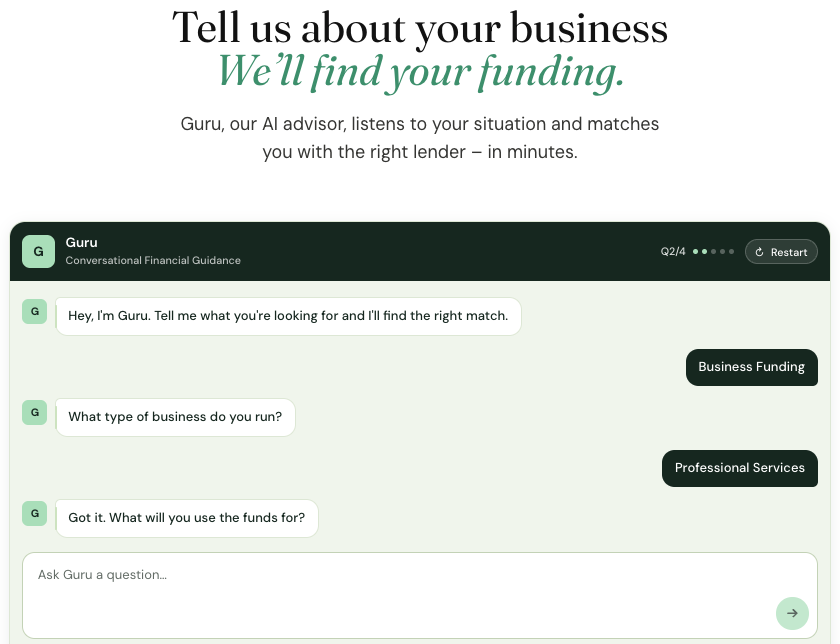
Here’s what to expect: you tell Guru about your situation, personal or business, income or revenue, what you need the line of credit for, and your general credit picture. Guru uses that conversation to surface lending partners whose criteria are a realistic fit, without an initial hard credit pull. Once you’re matched, the partner lender takes over. They’ll request the formal documentation covered above (pay stubs, tax returns, bank statements, and possibly a 4506-C), and they make the actual decision on approval, rate, and terms.
Lending Gurus doesn’t approve loans, set rates, or guarantee outcomes. Guru’s job is matching you to the right conversation faster. If you’re ready to see which lending partners fit your situation, see how the matching process works or head straight to Lending Gurus to get started.
This article is general information, not a substitute for advice from a qualified financial advisor. Consult a qualified financial professional about your own circumstances before acting on anything here.
