
Yes, many personal loans accept a cosigner, and adding one can improve your approval odds and sometimes lower your rate. The trade-off is real: your cosigner accepts full legal liability for the debt, even though they never touch the funds. Before you move forward, confirm the lender’s cosigner policy and read the Notice to Cosigner they are legally required to receive.
Table of Contents
- What is a cosigner, and how is it different from a co-borrower?
- How does adding a cosigner change your approval odds and rate?
- What risks does the cosigner take on, and what protections should you seek?
- How do you apply with a cosigner, and what should you ask the lender?
- What alternatives exist if you can’t or don’t want to use a cosigner?
- How Lending Gurus helps you find lenders that fit your situation
- How does a cosigner affect your credit and your responsibility for the loan?
- Who benefits most from having a cosigner on a personal loan?
- What happens legally if the primary borrower defaults?
- How do you find and approach a potential cosigner?
- When I recommend cosigning, and when I don’t
- Get matched to lenders that fit your situation with Lending Gurus
- Where this information comes from
- Sources
- FAQ
What is a cosigner, and how is it different from a co-borrower?
A cosigner signs a loan agreement to guarantee repayment if you fall behind. They take on full liability for the debt, but they typically have no ownership stake in whatever the loan funds and no access to the money itself, according to Experian’s guidance on cosigners and co-borrowers. A co-borrower is different. They apply jointly with you, share ownership of the loan proceeds, and carry equal responsibility for repayment from day one.
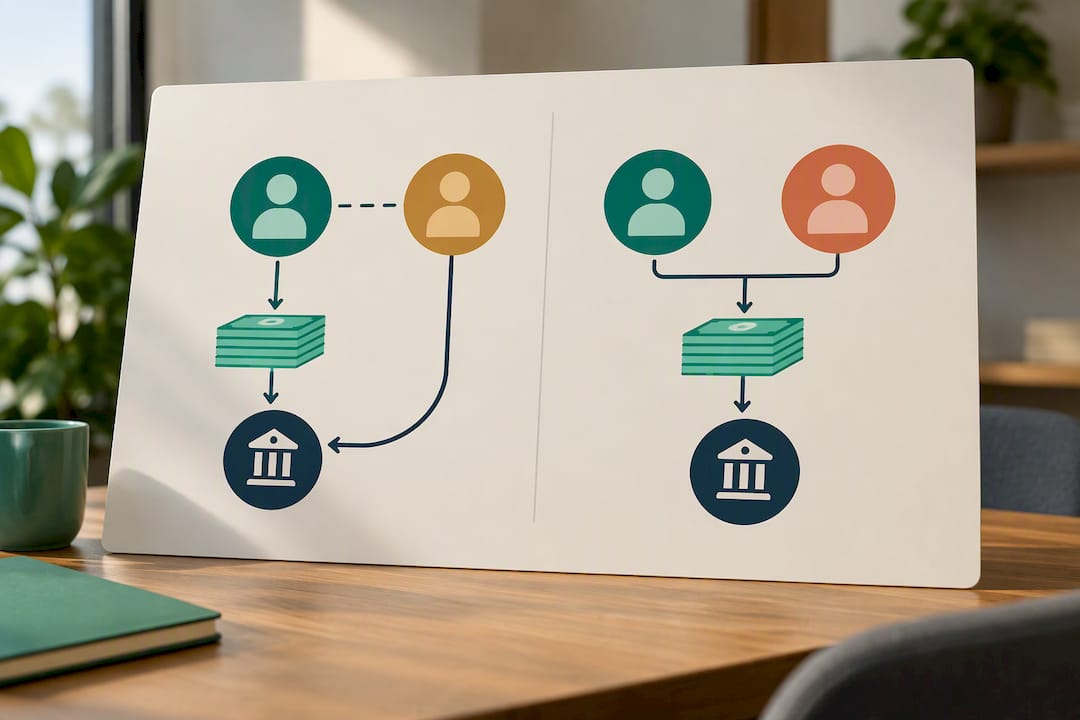
Lenders treat these two roles differently during underwriting. For a cosigner, the lender looks at their income and credit primarily as a backstop, a way to reduce risk if you can’t pay. For a co-borrower, the lender evaluates both incomes and credit profiles as part of a shared application, since both parties are borrowing the money together.
Each structure fits different situations:
- Cosigners are common on personal loans for people with thin credit files or limited income history.
- Private student loans frequently require a cosigner when the primary borrower has no credit history.
- Auto loans sometimes use cosigners when a buyer’s credit doesn’t quite meet a lender’s threshold.
- Co-borrowing fits situations where both people will use and benefit from the loan, such as a couple financing a shared purchase.
Choosing the right structure matters because it determines who owns what, who can access the funds, and how much liability each person carries if payments stop.
How does adding a cosigner change your approval odds and rate?
Adding a creditworthy cosigner gives the lender a second source of repayment to lean on, which can move a borderline application from a decline to an approval. Lenders weigh the combined credit history and income of both parties, so a cosigner with strong credit and stable income can offset weaknesses in your own file.
That said, a cosigner never guarantees a specific rate or loan amount. Every lender sets its own underwriting criteria, and approval decisions, rates, and terms come from the lender, not from the act of adding a cosigner. What a cosigner can do is widen your options: some lenders that would otherwise decline your application may approve it with a qualified cosigner attached, and the approved rate may land lower than what you’d receive alone.
A $30,000 loan’s monthly payment depends entirely on the disclosed APR and repayment term, not on whether a cosigner is attached. A longer term lowers the monthly payment but increases the total interest paid over the life of the loan, so a cosigner that helps you qualify for better terms is only useful if you compare the full cost, not just the payment size.
Keep these points in mind when a cosigner enters the picture:
- A cosigner can help you qualify, but the lender still sets the final rate and terms.
- Comparing total interest paid, not just the monthly payment, shows the real cost difference between offers.
- A larger approved amount isn’t automatically a better deal if it stretches your term and raises total interest.
What risks does the cosigner take on, and what protections should you seek?
A cosigner’s liability is not symbolic. If you miss payments, the lender can pursue the cosigner for the full remaining balance, including late fees, and can send the account to collections or pursue legal action, since the loan agreement typically allows the lender to act against either party without exhausting options against you first. The missed payments also show up on the cosigner’s credit report, often dragging down their score even though they never received the loan proceeds.
Federal rules require lenders to disclose this risk clearly. Under the FTC’s Credit Practices Rule, lenders must give cosigners a Notice to Cosigner before they sign, warning them that they may have to pay the full debt and that a default can be reported to their credit file. If your cosigner never receives this notice, that’s worth flagging before anyone signs anything.
Before your cosigner commits, put these protections in place:
- Ask the lender whether cosigners automatically receive monthly statements, or whether your cosigner will need to request them.
- Put a written agreement in place between you and your cosigner spelling out how you’ll notify them if a payment is going to be late.
- Ask the lender directly whether cosigner release is available and what track record of on-time payments it requires.
- Consider a separate indemnification agreement, drafted with a legal professional, that spells out your obligation to reimburse your cosigner if they’re forced to pay.
The CFPB’s guidance for cosigners recommends that cosigners request statements and monitor the account directly rather than relying on the primary borrower to pass along information, since problems are easier to catch early than after a missed payment has already been reported.
Pro Tip: Ask your cosigner to set up account alerts directly with the lender so they see payment activity in real time instead of hearing about a problem after it’s already hurt their credit.
How do you apply with a cosigner, and what should you ask the lender?
Applying with a cosigner means both of you supply documentation, though the specific requirements vary by lender. Typically, you’ll each need government-issued identification, proof of income such as pay stubs or tax returns, employment verification, and recent bank statements.
Expect credit checks for both parties. Most lenders run a hard credit pull on the cosigner as well as the primary borrower once you formally apply, since the cosigner’s creditworthiness is part of what the lender is underwriting. If the lender declines the application or offers terms less favorable than its best rates, both you and your cosigner are entitled to an adverse-action notice or a risk-based pricing notice explaining why, under existing consumer protection rules.
Before you commit to a lender, ask these questions directly:
- Do you accept cosigners on this loan product, and are there restrictions on who qualifies?
- Is cosigner release available, and what’s the minimum number of on-time payments required?
- How are missed or late payments reported, and do they appear on both the borrower’s and cosigner’s credit files?
- Will the cosigner automatically receive account statements, or do they need to request access separately?
Gather these items before you start the application:
- Government-issued photo ID for both the borrower and cosigner.
- Recent pay stubs or two years of tax returns for self-employed applicants.
- Bank statements from the last two to three months.
- Proof of current employment or income source.
Getting clear answers to these questions upfront saves both of you from surprises once the loan is funded.
What alternatives exist if you can’t or don’t want to use a cosigner?
A cosigner isn’t the only path to approval. Secured loans, backed by collateral such as a savings account or vehicle, shift risk away from the lender and toward the asset you pledge, which can open approval doors without involving another person’s credit. A secured credit card works on a similar principle for building credit history without a cosigner at all.
Requesting a smaller loan amount or agreeing to a longer repayment term can also help you qualify on your own, since it reduces the lender’s monthly repayment risk even without a second party attached. Taking time to improve your credit score before applying, by paying down revolving balances or correcting errors on your credit report, is a slower but durable alternative.
Lender-matching services offer another route. Lending Gurus, for example, matches borrowers to lending partners without a hard credit pull during the initial matching stage, which lets you see what’s realistically available before committing to a full application or asking someone to cosign.
Consider these options if a cosigner isn’t the right fit:
- A secured loan or secured credit card reduces lender risk using collateral instead of a second signer.
- A smaller loan amount or longer term can bring your application within a lender’s approval range on its own.
- Improving your credit score before applying, even modestly, can open better terms without a cosigner.
- A lender-matching platform can surface options that fit your file without an initial hard pull.
How Lending Gurus helps you find lenders that fit your situation
A conversational tool can match you with lending partners based on your needs, whether that’s a personal loan, a cosigner-friendly product, or an alternative path entirely. The matching process doesn’t use a hard credit pull, so you can explore options without an inquiry landing on your credit report first.
Guru asks about your situation and surfaces partners that may fit, including ones that accept cosigners or offer other structures if a cosigner isn’t available to you. From there, the lending partners themselves make the actual decisions. They set approvals, rates, terms, and loan amounts, and their cosigner policies can vary, so it’s worth confirming directly with each partner using the questions covered earlier in this article.
Once you have a shortlist of matches, ask each partner whether they accept cosigners, whether release is available, and how they report missed payments. That combination, a fast initial match plus direct answers from the lender, gives you a clearer picture before anyone signs anything.
How does a cosigner affect your credit and your responsibility for the loan?
Adding a cosigner does not change your legal responsibility for the debt. You remain fully liable for repayment, and the loan appears on your credit report the same way it would without a cosigner attached. What changes is the underwriting decision itself, not your obligation once the loan is funded.
Your payment history, on-time or late, reports to your credit file exactly as it would on any personal loan. A cosigner doesn’t shield you from the credit consequences of missed payments; it simply gave you a better shot at approval or terms going in. If you default, both your credit and your cosigner’s credit take the hit, since the account reports to both credit files.
This is worth sitting with before you ask someone to cosign: their signature helps you get funded, but it doesn’t reduce your responsibility to repay. It adds a second person’s credit and finances to the risk, without lightening your own load at all. Treating the loan as entirely your obligation, regardless of who cosigned, is the mindset that protects both your credit and your cosigner’s.
Who benefits most from having a cosigner on a personal loan?
Certain borrower profiles see the clearest benefit from adding a cosigner. Someone with a thin credit file, such as a recent graduate or a person who has avoided credit products, often lacks the history lenders want to see, even if their income is stable. A cosigner with an established credit history can fill that gap.
Borrowers rebuilding credit after a rough patch, such as a past bankruptcy or a string of late payments, frequently find that a cosigner opens doors that would otherwise stay closed, since the lender has a second, stronger credit profile to rely on. Self-employed applicants with irregular income documentation sometimes face similar friction, and a cosigner with steady W-2 income can offset that unpredictability in the lender’s eyes.
People applying for a larger loan than their income alone comfortably supports also benefit, since a cosigner’s income and credit can help justify a bigger approval. In each of these cases, the common thread is a gap, in credit history, income stability, or loan size, that a cosigner’s stronger profile can help close.
What happens legally if the primary borrower defaults?
If you default on a cosigned personal loan, the lender can pursue either you or your cosigner for the full remaining balance, since most loan agreements don’t require the lender to exhaust collection efforts against you before turning to the cosigner. Your cosigner’s obligation is not secondary or symbolic. It’s a direct, enforceable promise to pay if you don’t.
Consequences can include collection calls, late fees added to the balance, and the debt being reported as delinquent on both your credit file and your cosigner’s. In more serious cases, the lender can pursue legal action, potentially resulting in a judgment against either party, or both.
This is exactly what the FTC’s Notice to Cosigner is designed to make clear before anyone signs: the cosigner may have to pay the full debt, and default can follow them onto their own credit report. Reading that notice carefully, together with your cosigner, before you apply is one of the simplest ways to make sure everyone understands what’s actually at stake if repayment goes sideways.
How do you find and approach a potential cosigner?
Start with people who already understand your finances and trust your repayment plan: a parent, a sibling, a spouse, or a close friend with an established credit history. The relationship matters as much as the credit score, since you’re asking someone to take on real financial risk on your behalf.
Approach the conversation directly and early. Explain what the loan is for, how much you’re borrowing, and what your repayment plan looks like, including a backup plan if your income changes. Walk through the FTC’s Notice to Cosigner together so your cosigner understands the liability they’re accepting before they agree.
Consent has to be informed, not just polite. A cosigner should have time to ask questions, review the loan terms, and say no without straining the relationship. Some families use a written side agreement, separate from the loan contract, that spells out repayment expectations and what happens if things go wrong. That kind of documentation protects the relationship as much as it protects the money.
When I recommend cosigning, and when I don’t
Cosigning makes sense when the borrower has a documented repayment plan, stable income, and a relationship strong enough to survive a hard conversation if payments slip. It works best when both people treat the loan agreement, not just their trust in each other, as the real source of truth.
I’d avoid it when the borrower’s income is unpredictable, when there’s no fallback plan if a job changes, or when the relationship can’t tolerate transparency about money. A cosigner should never sign out of guilt or pressure.
Whichever way you land, keep monitoring the account after funding, and revisit cosigner release or refinancing options as soon as the primary borrower’s credit and income can stand on their own.
— Chris
Get matched to lenders that fit your situation with Lending Gurus
Figuring out whether you need a cosigner, or whether another loan structure fits better, gets easier once you can see real options instead of guessing at eligibility. Some lender-matching platforms use conversational tools that listen to your situation and match you with lending partners without a hard credit pull during the matching process.
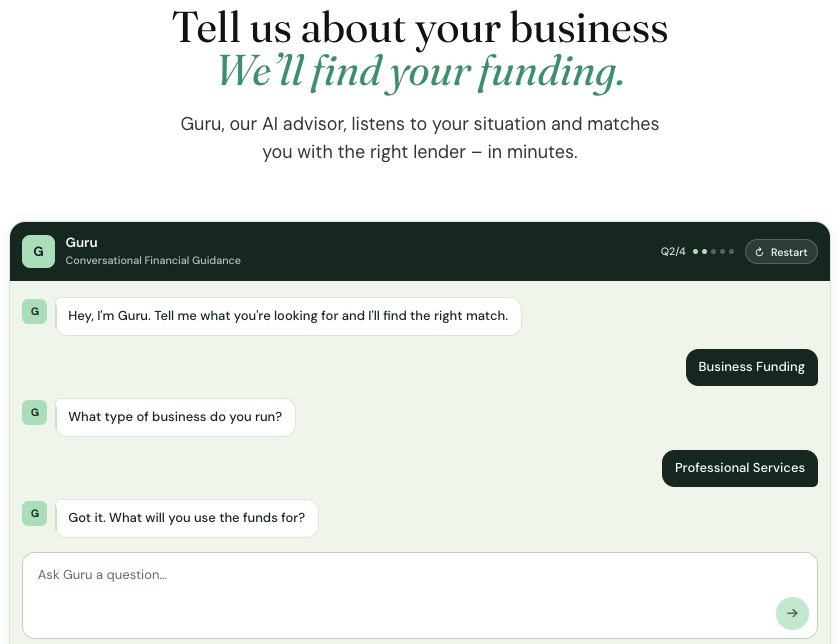
You’ll get matched based on what you actually need, whether that’s a personal loan with a cosigner, working capital, a line of credit, or another product entirely from Lending Gurus’ full range of loan types. Partners make the final call on approvals, rates, and terms, so always confirm a lender’s cosigner and release policies directly once you’re matched. Reviewing the platform’s terms beforehand also helps you understand exactly what to expect from the matching process.
Start a conversation with Guru today and see which lending partners fit your situation.
Where this information comes from
This article draws on the FTC’s Credit Practices Rule guidance, CFPB tips for cosigners, FDIC guidance on Regulation B and additional signers, and Experian’s consumer guidance on cosigners and co-borrowers. Reading the FTC Notice to Cosigner and the CFPB’s cosigner tips directly is worth the time before anyone signs a loan agreement.
This article is general information, not a substitute for advice from a qualified financial advisor. Consult a qualified financial professional about your own circumstances before acting on anything here.
Sources
- FTC — Complying with the Credit Practices Rule
- CFPB — Tips for student loan co-signers
- Experian — What is a cosigner / co-borrower
- FDIC — FIL-9-2002 Attachment (spousal signature rules, Regulation B)
FAQ
Is it possible to have a cosigner on a personal loan?
Yes, many personal loan lenders allow a cosigner, though policies vary by lender. A cosigner guarantees repayment but usually has no ownership or access to the loan funds, unlike a co-borrower.
How much would a $30,000 personal loan cost per month?
The monthly payment on a $30,000 loan depends entirely on the APR and repayment term the lender discloses, not on any fixed formula. A longer term lowers the monthly payment but increases the total interest paid, so comparing full loan offers matters more than comparing payment size alone.
Can you get a $10,000 loan with a cosigner?
Many lenders will consider personal loan applications with a qualified cosigner, especially if your own credit or income doesn’t fully meet their criteria alone. Approval, rate, and final loan amount are still decided by the individual lender, so terms vary case by case.
Can you get a $5,000 loan without a cosigner if you have bad credit?
Some lenders work with borrowers who have weaker credit, often through secured loan products or by requesting a smaller loan amount, without requiring a cosigner. A lender-matching service can help surface options without an initial hard credit pull, letting you see what’s realistically available before committing to a full application.
