
What are the top Bluevine alternatives for US small business banking and lending?
The strongest Bluevine alternatives in 2026 are Relay, Novo, Mercury, Brex, Bank of America, Chase, Silicon Valley Bank, OnDeck Capital, and Lendio. Each one addresses a gap Bluevine leaves open, whether that’s multi-account cash flow management, fee-free checking, short-term lending, or traditional branch access.
The comparison below covers the dimensions that matter most when you’re choosing a banking or lending partner.
| Provider | Best For | Pricing and Fees | Account Features | Lending Offerings | Accounting Integration | Customer Support | Rating |
|---|---|---|---|---|---|---|---|
| Relay, Inc. | Cash flow control and multi-account workflows | Free; Pro at $30/month | Up to 20 sub-accounts, auto-transfer rules | None | QuickBooks, Xero | Email, chat | 4★ (1) |
| Novo | Fee-free checking for lean operations | No fees | No maintenance, overdraft, or deposit fees | None | QuickBooks, Stripe | 2★ (56) | |
| Mercury | High-balance treasury and startup UX | Free checking; Mercury Treasury available | Clean dashboard, virtual cards | None | QuickBooks, Xero | Email, chat | — |
| Brex | Corporate card plus banking on one platform | Free per user | Card, expense management, Brex Yield | None | NetSuite, QuickBooks | Email, phone | — |
| Bank of America | Branch access and established banking | Monthly maintenance fees apply | Full-service branches, wire transfers | Business loans, lines of credit | QuickBooks | Phone, branch | 3.3★ (56) |
| Silicon Valley Bank | Tech startups needing specialized banking | Not publicly listed | Startup-focused products, venture debt | Venture debt, growth capital | Limited | Phone, relationship manager | 3.7★ (6) |
| OnDeck Capital | Fast short-term loans | Rates not publicly listed before signing | Term loans and lines of credit | $5K–$400K loans; $6K–$200K credit lines | QuickBooks | Phone, email | 4.5 Trustpilot rating |
| Lendio | Loan matching across multiple lenders | No hidden fees; no credit score impact | Marketplace access | $1K to over $1M across loan types | QuickBooks, Xero | Phone, email | — |
Key differentiators at a glance:
- Relay is the only option with up to 20 sub-accounts on a free plan, built for Profit First budgeting.
- Novo charges zero fees across maintenance, deposits, overdrafts, and invoicing.
- Lendio’s marketplace connects businesses to multiple lenders without any credit score impact when checking eligibility.
- OnDeck has funded over 185,000 businesses and delivered $25 billion across the US since 2006.
How to select the optimal Bluevine alternative for your business needs
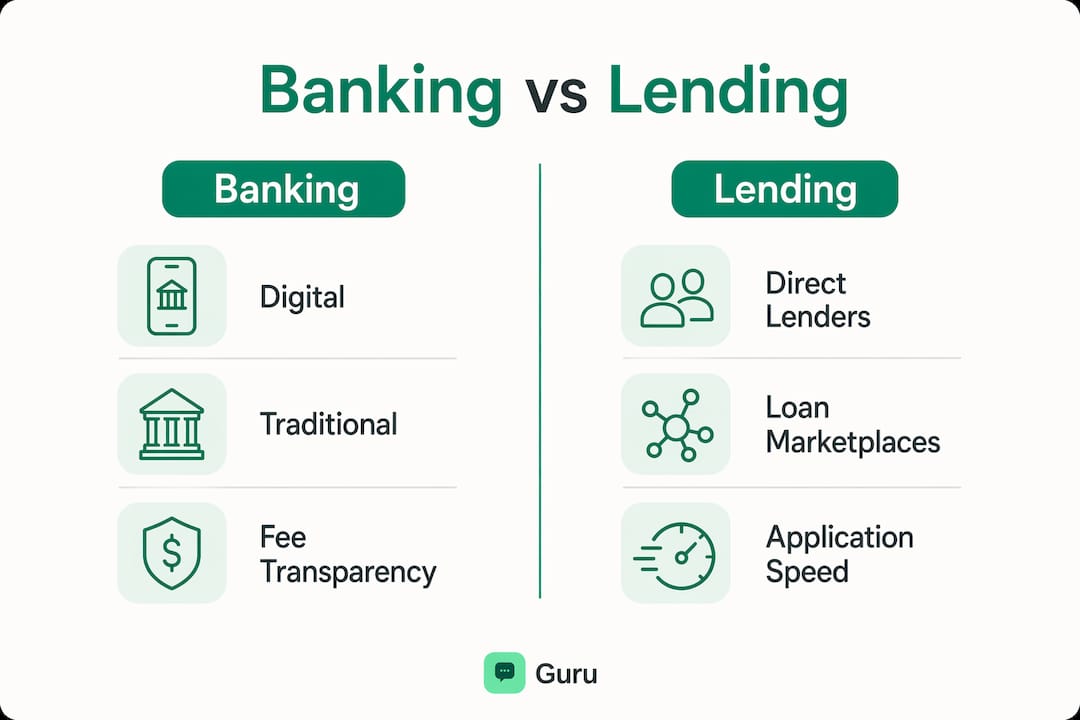
Separating your banking needs from your lending needs is the single most useful framework here. Treating them as one decision often leads to platform lock-in, where you stay with a provider because switching feels complicated, not because it’s the best fit.
When evaluating any alternative, work through these factors:
- Fees: Monthly maintenance, wire transfers, ACH, and cash deposit fees add up fast on narrow margins.
- Account features: Sub-accounts, virtual cards, and auto-transfer rules matter if you manage cash across multiple purposes.
- Lending options: Know whether you need a line of credit, a term loan, or SBA access before you compare lenders.
- Accounting software integration: A banking platform that syncs with QuickBooks or Xero cuts manual reconciliation time significantly.
- Customer support: Phone support matters more when something goes wrong at a critical moment.
- Loan flexibility: Repayment terms, draw fees, and prepayment penalties vary widely across lenders.
Pro Tip: Before switching, connect your shortlisted banking platform to your accounting software in a test environment. Platforms that sync transactions automatically with QuickBooks or Xero can reduce your monthly bookkeeping hours more than any fee savings will.
Bluevine’s Premier tier charges $95 per month, which starts eating into interest gains once your balance crosses $250,000. If your operating cash sits above that threshold, a treasury-linked account is worth the switch.
Which digital banking platforms are the best Bluevine alternatives?
Relay
Relay’s basic account is free, and the Pro tier costs $30 per month. What sets Relay apart is its 20 individual checking accounts under one login, each with its own routing number and debit card. That structure makes it the natural fit for business owners running Profit First or any envelope-based budgeting method. Auto-transfer rules execute percentage splits automatically, so revenue routes into separate buckets without manual moves.

Novo
Novo charges no account maintenance fees, deposit fees, overdraft fees, or invoicing fees. For a business running on tight margins, that zero-fee structure is a genuine advantage over Bluevine, which charges $4.95 per cash deposit and $2.50 for out-of-network ATMs. Novo doesn’t offer interest on checking balances, so it’s best suited for businesses that prioritize cost control over yield.
Mercury
Mercury offers free checking with no ACH, wire, or maintenance fees. It doesn’t pay interest on checking balances, but Mercury Treasury earns roughly 4% APY on idle cash above the $250,000 threshold, which beats Bluevine Premier net of its monthly fee for high-balance operators. The interface is widely considered the cleanest in the digital banking category.
Brex
Brex Essentials is free per user and bundles a corporate card with rewards, expense management, bill pay, and Brex Yield treasury at roughly 3.66% APY on idle cash with no balance minimum. If you’re currently running Bluevine for banking and a separate expense tool for cards, Brex consolidates both into one platform.
Businesses with international payments should note: most fintech platforms including Bluevine handle USD-only transactions. If you invoice clients in GBP or EUR, you’ll need a multi-currency solution like Wise Business alongside any of these options.
How do traditional banks compare as Bluevine alternatives?
Traditional banks offer something no fintech can fully replicate: physical branch access and the institutional trust that comes with decades of operation. The trade-off is fees.
Bank of America
Bank of America suits business owners who need in-person banking, wire services, and a full-service relationship under one roof. It carries monthly maintenance fees and wire transfer fees that are higher than Bluevine’s, but it also offers business loans and lines of credit directly, which most digital-only alternatives don’t. For businesses that regularly handle cash or need branch-based services, that physical infrastructure has real value.
Chase
Chase is the most recognizable traditional banking option for small businesses and carries a wide range of business checking tiers. Like Bank of America, it comes with monthly maintenance fees, ACH fees, and wire fees. Chase is the stronger choice when your business needs a well-known brand for vendor or client credibility, or when you want a single institution for both checking and credit.

Silicon Valley Bank
Silicon Valley Bank focuses specifically on technology companies and venture-backed startups. Its products include venture debt and growth capital structures that general-purpose banks don’t offer. For a pre-revenue or early-stage tech startup with institutional investors, SVB’s relationship-based model and industry-specific expertise are difficult to replicate elsewhere.
What are the best business lending alternatives to Bluevine?
OnDeck Capital
OnDeck offers term loans from $5,000 to $400,000 and lines of credit from $6,000 to $200,000, with repayment terms up to 24 months. Same-day funding is available, and instant funding applies to draws between $1,000 and $10,000 at no extra cost. The speed is real, but so is the cost: OnDeck’s average APR for lines of credit is 57.1%. Use OnDeck when you need capital fast and have exhausted lower-rate options, not as a first choice.
Lendio
Lendio operates as a loan marketplace connecting small businesses to multiple lenders through a single application, covering loan amounts from $1,000 to over $1 million across term loans, SBA loans, and lines of credit. Checking eligibility has no credit score impact. Lendio has over 15 years of experience and holds a 4.5 Trustpilot rating across more than 21,750 reviews. For businesses that want to compare multiple offers without filling out separate applications, Lendio is the most efficient starting point.
How Lending Gurus uses AI to simplify lender matching
Lending Gurus takes a different approach from both direct lenders and traditional marketplaces. Its conversational AI advisor, Guru, matches your business to suitable lenders without a hard credit pull, covering working capital, lines of credit, equipment financing, invoice financing, and debt consolidation.
The process works like this:
- You describe your funding needs through a conversational interface, no lengthy forms.
- Guru analyzes your profile and matches you to lenders suited to your situation.
- You receive personalized options without any obligation to proceed.
- No hard credit inquiry occurs during the matching process.
AI-driven lender matching reduces the time and friction involved in finding appropriate business financing, especially for owners who don’t know which loan type fits their situation. Lending Gurus is particularly useful when you’re comparing multiple funding types at once and want a single starting point rather than five separate applications.
How does customer support compare across these alternatives?
Support quality varies sharply between digital and traditional options. OnDeck and Lendio both offer phone and email support, which matters when you’re mid-application and need a fast answer. Bank of America and Chase provide branch access on top of phone support, giving you a human option in person.
Digital banks like Relay, Novo, and Mercury rely primarily on email and chat. That’s fine for routine questions but can feel slow when a transaction is frozen or an account issue needs immediate resolution. Brex adds phone support for higher-tier accounts. If real-time phone access is non-negotiable for your business, traditional banks and OnDeck are the safer choices.
What do user reviews say about these alternatives?
Lendio and OnDeck hold strong customer ratings with substantial numbers of reviews. Both scores reflect consistent feedback on funding speed and application simplicity.
Among traditional banks, Bank of America and Silicon Valley Bank show lower ratings, which typically reflects the friction of fee structures and branch-dependent service rather than product quality. Novo’s 2-star average points to customer service gaps that are worth researching before committing, particularly around dispute resolution and account access.
How long does the application process take?
Digital lenders move fastest. OnDeck can fund a loan within minutes for draws up to $10,000, with one to three business days for larger amounts. Lendio connects you to lender offers quickly through its marketplace, though actual funding timelines depend on the matched lender.
Digital banks like Relay, Novo, and Mercury typically approve and open accounts within one to two business days, with no branch visit required. Traditional banks take longer. Bank of America and Chase require more documentation, and approval timelines for business loans can run several weeks. Silicon Valley Bank’s relationship-based model means timelines vary based on your assigned banker.
What fee structures should you understand before switching?
Fee transparency varies widely. Novo and Mercury are genuinely fee-free on their core checking accounts. Relay’s free tier covers the basics, with the $30/month Pro tier adding faster transfers and deeper accounting integrations.
Traditional banks charge monthly maintenance fees that can often be waived by meeting minimum balance or transaction thresholds. Wire transfer fees, ACH fees, and cash deposit fees are standard. On the lending side, OnDeck does not publicly list its rates before you sign, though its average line of credit APR of 57.1% is disclosed on its site. Lendio charges no hidden fees and has no credit score impact for eligibility checks. Always read the full fee schedule before opening an account or accepting a loan offer.
Lending Gurus makes finding the right lender faster
Sorting through digital banks, traditional banks, and direct lenders takes time most business owners don’t have. Lending Gurus cuts that process down by matching you to the right lender in minutes, not days.

The platform’s AI advisor, Guru, listens to your funding needs and matches you to suitable lenders across working capital, equipment financing, invoice financing, and more, all without a hard credit pull. There’s no obligation, no lengthy paperwork, and no cost to you. Whether you’re looking for a short-term line of credit or a larger term loan, Lending Gurus gives you a personalized starting point instead of a generic list. See how it works and get matched to lenders suited to your business today. You can also review the platform terms before you begin.
Key Takeaways
The most effective approach to finding a Bluevine alternative is to separate your banking needs from your lending needs and evaluate each category on its own merits, making use of expert tax preparation in Boise, ID services to streamline your business finances.
| Point | Details |
|---|---|
| Separate banking from lending | Treating them as one decision leads to lock-in; specialized providers deliver better outcomes in each category. |
| Fee-free digital banks lead on cost | Novo, Mercury, and Relay charge no core account fees, unlike Bluevine’s cash deposit and wire fees. |
| OnDeck funds fast but costs more | Same-day funding is available, but the average line of credit APR is 57.1%, so use it selectively. |
| Lendio suits broad loan comparison | Its marketplace covers $1K to over $1M with no credit score impact to check eligibility. |
| Lending Gurus for AI-powered matching | The platform matches your business to suitable lenders without a hard credit pull and at no cost to you. |
