
What are the best credit card consolidation loans right now?
The best credit card consolidation loans combine low APRs, flexible credit score requirements, and fast funding to help you replace high-interest card balances with a single, manageable monthly payment. Based on current lender offerings across the US market, here are the top options worth your attention.
| Lender | Best For | APR Range | Loan Amounts | Funding Speed | Standout Feature |
|---|---|---|---|---|---|
| Lending Gurus | All credit profiles | Varies by match | — | Same day possible | AI advisor, no hard credit pull |
| Upstart | Fair/limited credit | 5.96% to 35.99% | — | a few business days | Education & employment underwriting |
| SoFi | Good to excellent credit | — | — | Same day possible | No origination fee, member perks |
| LendingPoint | Fair credit | — | — | Next business day | Flexible terms, low minimum credit |
| Upgrade | Fair to good credit | — | — | a few business days | Credit health tools included |
A few things stand out immediately. APR varies sharply by credit band: borrowers with excellent credit receive significantly lower rates than those with poor credit. That gap makes your credit profile the single biggest lever you have before you apply.
Standout features at a glance:
- Lending Gurus: Matches you to lenders through a conversational AI advisor with no hard credit pull, giving you real options without any credit score risk.
- Upstart: Weighs your education and employment history alongside your credit score, opening the door for borrowers with thin or fair credit files.
- SoFi: Charges no origination fee and offers unemployment protection, making it a strong pick if you have solid credit and want to keep costs low.
- LendingPoint: Funds as fast as the next business day and accepts credit scores starting around 580, useful if your credit is still rebuilding.
- Upgrade: Bundles credit monitoring and financial health tools with every loan, so you can track progress while you pay down debt.
Table of Contents
- How do you choose the best credit card consolidation loan?
- A closer look at the top credit card debt consolidation lenders
- How do credit card consolidation loans actually work?
- How AI-powered matching changes the way you find consolidation loans
- Lending Gurus makes finding your best consolidation loan faster
- Key Takeaways
How do you choose the best credit card consolidation loan?
Choosing the right loan comes down to matching your financial profile to the lender’s actual strengths, not just the headline rate. Here is what to evaluate before you commit.
Credit score and eligibility requirements
Your credit score determines which lenders will approve you and at what rate. Lenders generally segment borrowers into tiers: excellent (720+), good (690–719), fair (630–689), and poor (below 630). Credit score requirements vary widely across lenders, with some like Upstart using education and employment data to help lower-credit borrowers qualify where traditional scoring alone would not. If your score is below 670, focus on lenders built for fair-credit borrowers rather than applying broadly and collecting hard inquiries.

Beyond your score, lenders look at your debt-to-income ratio (DTI), employment status, and monthly income. Most prefer a DTI below 40%, though some will go higher with compensating factors. Knowing your DTI before you apply helps you filter out lenders whose thresholds you do not meet.
Your credit score’s role in refinancing extends beyond approval: even a 20-point improvement before you apply can shift you into a lower rate tier and save hundreds over the loan’s life.
Loan terms, fees, and total cost
The interest rate matters, but the total cost of the loan is what you actually pay. Origination fees typically range from 0% to 10% of the loan amount and are often deducted from your disbursement, meaning you receive less than you borrowed. A loan with a 6% rate and a 5% origination fee can easily cost more than a loan with an 8% rate and no fee, depending on the term length.
Personal loans for consolidation generally carry fixed rates ranging from 5.96% to 35.99% APR, with repayment terms between 12 and 120 months. Longer terms lower your monthly payment but increase total interest paid. Run the numbers on both a 36-month and a 60-month term before deciding.
Funding speed and customer experience
If you are carrying high-interest balances on multiple cards, every week of delay costs you money. Several online lenders now fund within one business day after approval. Traditional banks and credit unions often take longer, sometimes a week or more, though they may offer lower rates to existing members with strong credit histories.

Read verified customer reviews on platforms like Trustpilot before applying. A lender with a low rate but a history of funding delays or poor communication can turn a straightforward process into a frustrating one.
Key factors to weigh before applying:
- Compare the APR, not just the interest rate, since APR includes fees.
- Check whether the lender charges a prepayment penalty if you want to pay off early.
- Confirm whether the lender pays your creditors directly or deposits funds into your account.
- Ask about hardship programs or payment deferral options in case your income changes.
- Verify the lender is registered through the NMLS Consumer Access database before sharing personal information.
Pro Tip: Pre-qualify with multiple lenders using soft credit pulls before submitting a formal application. Pre-qualifying via a soft pull lets you see estimated rates and terms without any impact to your credit score, so you can compare real offers side by side and choose the best one before a hard inquiry ever appears on your report.
A closer look at the top credit card debt consolidation lenders
Each lender on this list serves a distinct borrower profile. Understanding those differences helps you target the right application rather than guessing.
Upstart
Upstart’s underwriting model is genuinely different from most lenders. Rather than relying solely on FICO scores, it factors in your education level, field of study, and employment history. That approach opens consolidation loans to borrowers who have limited credit histories but strong earning potential. APRs for credit card consolidation loans range from 5.96% to 35.99% depending on your credit profile, and loans typically fund within a few business days. Origination fees are charged on some products, so calculate the full cost carefully.
SoFi
SoFi targets borrowers with good to excellent credit and rewards them with no origination fees, no prepayment penalties, and access to member benefits like career coaching and financial planning. Loan amounts can be quite high, and same-day funding is available for qualified applicants. If you have a good credit profile and want to keep fees at zero, SoFi belongs near the top of your list.
LendingPoint
LendingPoint is built for borrowers in the fair-credit range. Loan amounts cover most credit card consolidation scenarios. Funding can arrive quickly, and the application process is fully online. APRs vary widely depending on your credit profile and income. LendingPoint also reports to all three major credit bureaus, which means consistent on-time payments will actively build your credit history while you pay down debt.
Upgrade
Upgrade stands out for bundling credit monitoring and financial health tools directly into the borrower experience. You can track your credit score, see what factors are affecting it, and get personalized recommendations, all within the same platform where you manage your loan. APRs and loan amounts vary, and funding typically takes a few business days. Upgrade also offers a secured loan option for borrowers who want to use a vehicle as collateral.
Lending Gurus
Lending Gurus takes a different approach from every lender listed above. Rather than being a direct lender, it is an AI-powered matching platform that connects you to a network of lenders suited to your specific situation. The conversational AI advisor, Guru, gathers your requirements without triggering a hard credit pull, then surfaces personalized lender matches within minutes. That means you get real options fast, without the credit score risk of applying to multiple lenders individually. For borrowers who are unsure which lender fits their profile, or who want to compare multiple offers before committing, Lending Gurus removes the guesswork from the process.
Lender comparison by key parameters:
| Lender | Min. Credit Score | APR Range | Max Loan | Origination Fee | Funding Time |
|---|---|---|---|---|---|
| Lending Gurus | Varies by match | Varies | — | Varies | Same day possible |
| Upstart | — | 5.96% to 35.99% | $50,000 | Up to 12% | a few business days |
| SoFi | — | — | — | None | Same day |
| LendingPoint | ~580 | — | — | 0%–8% | Next day |
| Upgrade | ~580 | — | $50,000 | — | a few business days |
What separates online lenders from banks and credit unions:
- Online lenders typically offer faster approvals and funding, often within 24 hours, compared to the multi-day or multi-week timelines at traditional banks.
- Credit unions often provide lower rates to members with strong credit histories, but membership requirements and slower processes can be a barrier.
- Traditional banks may offer relationship discounts if you already hold accounts with them, but their credit score minimums tend to be stricter.
- Online lenders generally have more transparent pre-qualification tools, letting you check rates without commitment.
How do credit card consolidation loans actually work?
A credit card consolidation loan is a personal loan you use to pay off multiple credit card balances at once. You end up with a single monthly payment at a fixed interest rate, replacing several variable-rate card payments. The core appeal is straightforward: if your new loan’s rate is meaningfully lower than your cards’ average APR, you pay less interest over time and simplify your finances.
Consolidation is most beneficial when the loan rate is significantly lower than your current card APR. The average credit card APR in the US has been running above 20% for most borrowers, so a personal loan at 12% or 15% can represent real savings, especially on balances you cannot pay off quickly.
How the process works
You apply for a personal loan in the amount needed to cover your card balances. Once approved, the lender either pays your creditors directly or deposits the funds into your bank account for you to pay them off. From that point, you make fixed monthly payments on the personal loan until it is paid in full. The term you choose, typically 24 to 60 months, determines your monthly payment and total interest cost.
Consolidation loans vs. balance transfer cards vs. home equity loans
Balance transfer cards can be cost-effective if you can realistically pay off the full balance within the introductory 0% APR period, which usually runs 12 to 21 months. Fixed-rate consolidation loans suit borrowers who need longer repayment timelines or who carry balances too large to clear within a promotional window. Home equity loans offer lower rates but put your home at risk if you miss payments, making them a higher-stakes option that most borrowers should approach carefully.
When consolidation makes sense and when it does not
Consolidation is a strong move when:
- Your new loan rate is at least 3–5 percentage points below your average card APR.
- You have a steady income and can commit to fixed monthly payments.
- You want to simplify multiple payments into one predictable bill.
- You are disciplined enough not to run up new balances on the cards you just paid off.
Watch out for these common pitfalls:
- Paying a high origination fee that wipes out the interest savings.
- Choosing a term so long that you pay more total interest than you would have on the cards.
- Continuing to use the paid-off cards and accumulating new debt on top of the loan.
- Applying to multiple lenders with hard pulls before comparing pre-qualified offers.
One point worth emphasizing: consolidation does not reduce the amount you owe. It restructures it. Borrowers who treat the freed-up card credit as new spending room often end up in a worse position than before. The loan works when your behavior changes alongside your debt structure.
How AI-powered matching changes the way you find consolidation loans
Traditional loan shopping is inefficient. You visit lender websites one by one, fill out forms, and often trigger hard credit inquiries before you even know whether you qualify. AI-driven platforms have changed that process significantly for borrowers who want to compare options without the credit score risk.
AI-powered platforms let borrowers avoid multiple hard credit pulls, which accelerates the matching process and protects your credit health during what can be a stressful financial decision. Instead of applying blind, you describe your situation to a conversational interface, and the platform surfaces lenders whose criteria you actually meet.
How Lending Gurus’ AI advisor works
Lending Gurus built its platform around a conversational AI advisor called Guru. You tell Guru what you need: the amount you want to consolidate, your general credit situation, and your repayment goals. Guru processes that information and matches you to lenders in its network without triggering a hard credit pull. The whole process takes minutes, not days. You see real options tailored to your profile, compare them, and choose the one that fits before any formal application begins.
That approach matters most for borrowers who are uncertain about their credit standing or who want to shop multiple lenders without the anxiety of watching their score drop with each inquiry. It also speeds up the path to funding, since you are not starting from scratch with each lender.
Why personalized matching beats generic rate shopping
Generic rate comparison tools show you advertised ranges, which are often the best-case rates available only to top-tier borrowers. Personalized matching, by contrast, shows you offers calibrated to your actual profile. The difference between a 12% offer and a 22% offer on a $15,000 loan over 48 months is substantial in real dollar terms. Getting to the right offer faster, without credit score damage along the way, is a genuine advantage.
Pro Tip: When using an AI matching platform like Lending Gurus, have your key financial details ready before you start: your total card balances, approximate credit score range, monthly income, and current monthly debt payments. The more accurate your inputs, the more precisely the platform can match you to lenders whose approval criteria you meet.
Lending Gurus makes finding your best consolidation loan faster
Sorting through lender options, comparing APRs, calculating origination fees, and pre-qualifying across multiple platforms takes real time and effort. Lending Gurus cuts that process down to minutes by doing the matching for you.
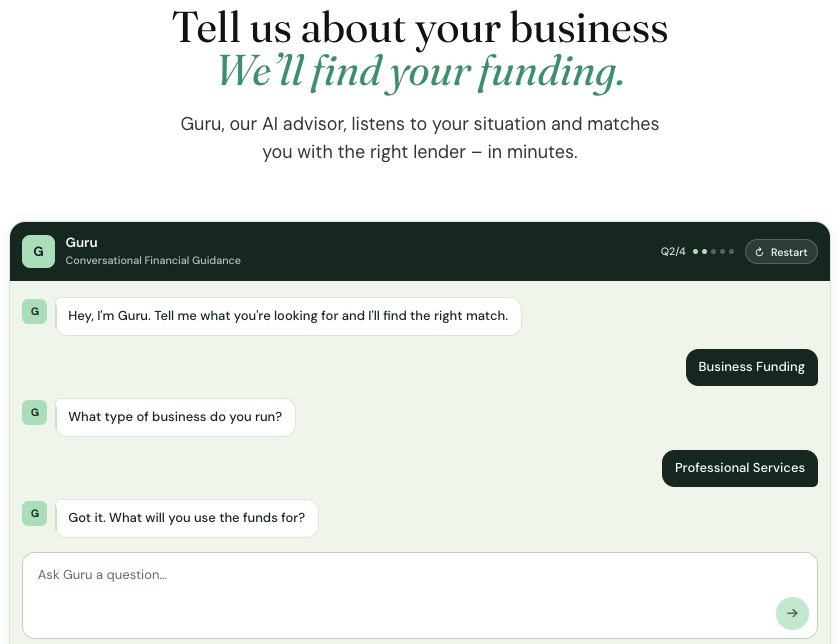
The platform’s AI advisor, Guru, listens to your situation and connects you to lenders suited to your credit profile and loan goals, all without a hard credit pull. There is no obligation to accept any match, and no fee to use the platform. Whether you are consolidating $5,000 in card debt or $50,000, Lending Gurus surfaces options you can actually qualify for rather than sending you to apply and get declined.
For borrowers who have already read through the lender comparisons above and want to see which options apply to their specific situation, the next step is straightforward. Visit Lending Gurus to start a conversation with Guru, review your personalized lender matches, and move toward a consolidation loan that fits your financial goals. You can also review the platform’s terms and process before you begin if you want to understand exactly how the matching works and what protections are in place.
Key Takeaways
The best credit card consolidation loan is the one with a rate meaningfully lower than your current card APR, fees you have calculated into the total cost, and a term short enough to keep total interest in check.
| Point | Details |
|---|---|
| APR varies by credit profile | Excellent credit borrowers average 9.34% APR; poor credit borrowers average 29.34% APR. |
| Origination fees affect total cost | Fees ranging from 0% to 10% must be included in your cost calculation before committing. |
| Pre-qualify before applying | Soft-pull pre-qualification lets you compare real offers without any credit score impact. |
| Balance transfers vs. personal loans | Balance transfers suit short payoff timelines; fixed-rate loans suit longer repayment needs. |
| Lending Gurus matches you without risk | Lending Gurus’ AI advisor connects you to lenders with no hard credit pull and no obligation. |
