
For most U.S. small businesses, Lending Gurus is the recommended first stop: it matches you to vetted lenders in minutes using a conversational tool called Guru, with no hard credit pull and no cost to you. If your needs are more specialized, here is a quick shortlist to orient you before diving deeper.
Quick shortlist by borrower type:
- Fastest match, no hard pull: Lending Gurus — best for businesses that want to compare options quickly without affecting their credit score
- Broad lender network, multiple loan types: Large multi-lender marketplaces — best for borrowers who want to see SBA, term, and line-of-credit offers side by side
- SBA-focused: SBA-specialist platforms — best for established businesses pursuing 7(a) or 504 loans with longer timelines and lower rates
- Invoice and equipment financing: Asset-based marketplace categories — best for businesses with outstanding receivables or capital equipment needs
- Short-term, fast-funding: Alternative-lender marketplaces — best for businesses needing capital in days, often with flexible revenue-based repayment
The FDIC’s 2024 Small Business Lending Survey confirms that credit access and demand patterns have shifted meaningfully, making it more important than ever to shop across lenders rather than applying to just one. The Kansas City Fed’s regional survey found that small-business lending continued to increase into Q4 2025, which means more lenders are competing for your business right now.
Table of Contents
- How do the best business loan marketplaces compare side by side?
- What does each marketplace category actually do, and who should use it?
- How do you choose the right business loan marketplace?
- How we evaluated these marketplace categories
- Lending Gurus matches you to lenders without the guesswork
- Sources
How do the best business loan marketplaces compare side by side?
Not every marketplace works the same way. The two most important dimensions to understand before you apply are the execution model and the hard-pull policy.
Execution model explained:
- Introduction-only: The marketplace sends your information to lenders, and lenders contact you directly. Faster to start, but you manage the process from there.
- Managed execution: The marketplace helps you gather documents, communicate with lenders, and close the loan. More support, but sometimes a longer timeline.
Hard-pull policy matters because every hard credit inquiry can lower your personal credit score by a few points. Marketplaces that use soft prequalification let you see realistic offers first, with no credit impact. Nav’s marketplace demonstrates how soft prequalification tools reduce friction for small-business owners comparing multiple products at once.
Trust signals to check on any marketplace listing: network size and lender types listed, NMLS or state licensure where applicable (verify at NMLS Consumer Access), a current BBB profile, a clear privacy policy, and on-site educational tools or calculators.
Statistic callout: The Kansas City Fed’s Q4 2025 regional survey shows small-business lending is still growing, which means lender competition is real and shopping across a marketplace network can yield meaningfully different offers from the same borrower profile.
What does each marketplace category actually do, and who should use it?
The Forbes roundup of best small business loans for 2026 and Finder’s business loan comparison both highlight that borrower fit, not just rate, is the most important selection criterion. Here is what each category does in practice.
Lending Gurus: AI-matching marketplace
Lending Gurus is a lead aggregator, not a lender. Guru, its free conversational tool, listens to your business profile and matches you to vetted lending partners without a hard credit pull. Partners set their own approval criteria, rates, and terms. You are never obligated to accept a match.

How it works: You describe your financing need through Guru. The platform identifies partners whose products fit your profile and connects you. From there, the lender you choose handles underwriting and funding.
Strengths:
- No hard credit pull at the matching stage
- Free to use; lenders pay referral fees, not you
- Covers working capital, lines of credit, equipment financing, invoice financing, and more
- Fast initial match, often within minutes
Weaknesses:
- Partners control approvals, amounts, and timelines; Lending Gurus cannot guarantee outcomes
- Lender network is vetted but not exhaustive; SBA-specific options may be limited
Typical borrower: A small business owner who wants to compare options quickly, has not yet identified a specific lender, and does not want to risk their credit score exploring possibilities.
Broad multi-lender marketplaces
These platforms aggregate offers from banks, credit unions, and fintechs in one place. Lendio, LendingTree for business, and Fundera (by NerdWallet) fall into this category. They typically offer the widest loan-type coverage, from SBA 7(a) to merchant cash advances.
Strengths:
- Wide lender variety increases approval odds for mid-range credit profiles
- Side-by-side offer comparison in one dashboard
- Often include educational resources and calculators
Weaknesses:
- Some platforms share your data with many lenders simultaneously, which can lead to multiple contacts
- Execution model varies; some are introduction-only, leaving you to manage the process
Typical borrower: A business with at least one year of operating history, fair-to-good credit, and a need for a term loan or line of credit in the $25,000–$500,000 range.
Pro Tip: Before submitting your information on any multi-lender marketplace, read the privacy policy to understand how many lenders receive your data and whether you can opt out of specific lender types.
SBA-specialist platforms
Platforms focused on SBA loans connect borrowers to SBA-approved lenders and CDFIs. Biz2Credit and Bridge Marketplace both have SBA-focused offerings. The tradeoff is time: SBA loans typically take 30–90 days to close, but they carry lower rates and longer repayment terms than most alternatives.
Strengths:
- Access to SBA 7(a) and 504 programs with government-backed terms
- Lower interest rates and longer amortization than most fintech products
- Some platforms offer dedicated reps who manage document collection
Weaknesses:
- Longer funding timelines; not suitable for urgent capital needs
- Stricter eligibility (typically 2+ years in business, good personal credit, personal guarantee required)
- More documentation required upfront
Typical borrower: An established business with strong financials seeking $150,000 or more for expansion, real estate, or equipment, and willing to wait for better terms.
Invoice and equipment financing marketplaces
These platforms specialize in asset-based lending. Invoice factoring marketplaces advance a percentage of outstanding receivables; equipment financing marketplaces connect you to lenders who use the asset as collateral. Funding can be faster than traditional loans because the asset or invoice reduces lender risk.
Strengths:
- Funding speed for invoice factoring can be 1–10 business days
- Credit score is less central; the asset or receivable drives approval
- Useful for businesses with strong revenue but thin credit history
Weaknesses:
- Factor rates on invoice advances can be high relative to APR equivalents
- Equipment loans require a clear asset description and sometimes an appraisal
- Not useful for businesses without qualifying receivables or equipment needs
Typical borrower: A B2B service business waiting on slow-paying clients, or a contractor or manufacturer needing to finance a specific piece of equipment.
Short-term and alternative lending marketplaces
These platforms connect businesses to merchant cash advances, revenue-based financing, and short-term loans. Nav.com aggregates many of these products alongside traditional options. Approval is fast, often within 24–72 hours, but costs are higher.
Strengths:
- Fastest path to capital for businesses that qualify
- Soft prequalification common; many platforms check business revenue, not just credit
- Accessible for businesses with 6+ months of history and consistent revenue
Weaknesses:
- Factor rates and daily/weekly repayment can strain cash flow
- Total cost of capital is often significantly higher than term loans or SBA products
- Limited post-funding support; most platforms are digital-only
Typical borrower: A startup or thin-credit business needing quick capital for inventory, payroll, or a short-term opportunity.
How do you choose the right business loan marketplace?
Work through these steps before you submit a single application.
- Define your use case and amount. Working capital, equipment, invoice, or expansion? The loan type narrows your marketplace category immediately.
- Check the execution model. Do you want the marketplace to help manage documents and lender communication, or are you comfortable handling that yourself after an introduction?
- Verify lender types and network breadth. A marketplace with only fintech lenders will not place an SBA 7(a) loan. Confirm the lender mix matches your product need.
- Examine fee placement. Platform fees are rare but exist. Origination fees appear on the lender side. Understand where costs land before you compare offers.
- Confirm the prequalification method. Ask directly: does the marketplace perform a hard credit pull, or is the initial match based on a soft inquiry?
- Check support availability. Can you reach a human if a lender requests additional documents? Introduction-only platforms often provide no post-match support.
Questions to ask before you apply:
- Does this marketplace charge me any platform or referral fee directly?
- Which lenders in your network handle my loan type and amount?
- Will applying trigger a hard credit pull on my personal credit?
- Who services the loan after funding — the lender or a third party?
- How does the marketplace handle disputes if a lender’s offer changes after prequalification?
Red flags to watch:
- Vague or missing fee disclosures before you submit your information
- Any guarantee of approval or a specific rate before underwriting
- No privacy policy or unclear data-sharing practices
- No documentation guidance or lender-type transparency
- Pressure to accept an offer within hours without time to compare
Documents and timeline checklist:
Have these ready before you start any application:
- Last 3–6 months of business bank statements
- Most recent 2 years of business tax returns
- Current profit and loss statement
- Payroll records (if applicable)
- Outstanding invoices (for invoice financing)
- Equipment quote or invoice (for equipment loans)
Realistic funding windows: AI-matching and alternative platforms, days to 2 weeks; broad multi-lender marketplaces, 1–4 weeks; SBA-specialist platforms, 30–90 days.
How we evaluated these marketplace categories
Evaluation criteria used:
- Borrower fit: does the platform serve the widest range of business profiles, or only a narrow segment?
- Execution model: introduction-only vs. managed, and how that affects time-to-fund and documentation burden
- Lender network breadth: variety of lender types (banks, fintechs, CDFIs, alternative lenders) and loan products
- Transparency: fee disclosure, privacy policy clarity, and data-sharing practices
- Educational tools: calculators, prequalification tools, and borrower guides available on-platform
- Customer support: availability of human reps, documentation help, and post-match assistance
- Public trust signals: BBB profile, user reviews, and NMLS or state licensure where applicable
Data sources consulted for this 2026 evaluation:
- FDIC 2024 Small Business Lending Survey for national lending trend context
- Kansas City Fed Q4 2025 regional small-business lending survey for current market conditions
- Forbes 2026 small business loan roundup for cross-checking marketplace feature sets
- Nav.com marketplace product pages for loan-type and prequalification behavior examples
- Finder’s 2026 business loan comparison for scoring methodology and table structure
- BBB business review records for customer-experience signals
- Marketplace help pages, privacy statements, and terms pages reviewed directly
Limitations: Lender panels change frequently. A marketplace that lists 75 lenders today may adjust that network next quarter. Partner lenders control all approval decisions, pricing, and funding timelines. Use this evaluation as a starting framework, then verify current lender availability directly with each platform before applying.
What the author recommends based on this research
Start with Lending Gurus if you are a U.S. small business owner who wants to compare options without a hard credit pull and without paying a platform fee. That covers the majority of borrowers reading this. If you need an SBA loan specifically, move to an SBA-specialist platform after you have a clear picture of your financials. If speed is the priority and cost is secondary, an alternative-lender marketplace gets you to funding fastest.

Your next steps are straightforward: gather your bank statements and tax returns, then start a match through a single marketplace rather than applying to five at once. Multiple simultaneous applications can complicate lender conversations and make your profile look less organized than it is.
Pro Tip: When you submit your business profile to any marketplace, lead with your revenue and cash flow documentation rather than your credit score. Lenders in most marketplace networks weight monthly revenue and time in business more heavily than personal credit, and strong cash flow documentation often broadens your options more than a higher score alone.
Lending Gurus matches you to lenders without the guesswork
You have just compared the major business loan marketplace categories. Most small business owners do not need to work through all of them. What you need is a fast, honest first look at which lenders actually fit your profile.
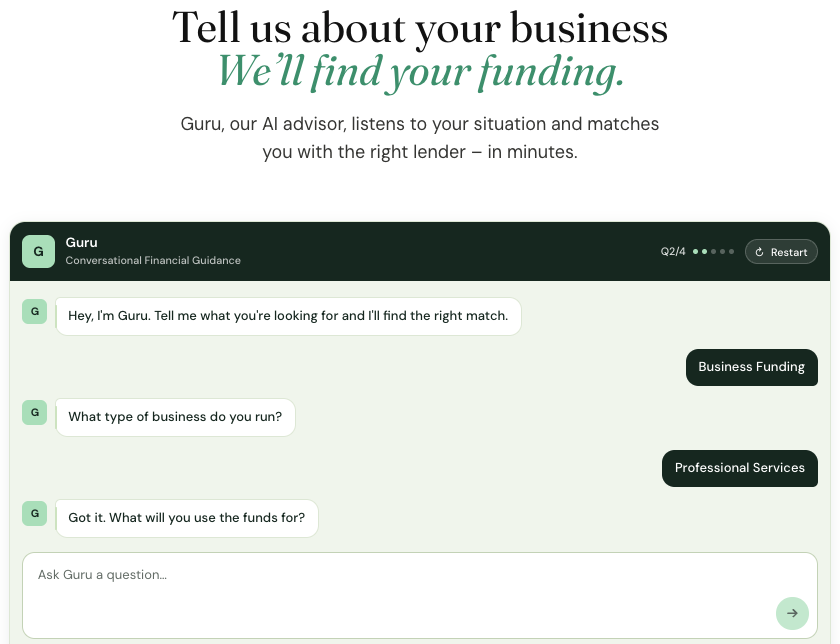
Lending Gurus gives you that through Guru, a free conversational tool that listens to your business situation and matches you to vetted lending partners in minutes. No hard credit pull. No platform fee. No obligation to accept any offer. Partners in the Lending Gurus network cover working capital, lines of credit, equipment financing, invoice financing, and more. You describe your need; Guru does the matching; lenders compete for your business.
See how the matching process works and start your profile today. Review the terms and conditions if you want to understand exactly how your data is handled before you begin.
This article provides general information about business loan marketplaces and is not a substitute for professional financial or legal advice. Loan availability, rates, and terms are set by individual lenders. Confirm current eligibility requirements and costs directly with any lender or marketplace before applying.
Sources
- FDIC issues 2024 small business lending survey report
- Small-business lending continues to increase — Q4 2025
- Small Business Loans – Nav
How to vet any marketplace link you click: Check for a current privacy policy before entering any financial data. Look for NMLS registration or state lending licensure on the platform’s “About” or legal pages. Search the platform name on BBB and read recent reviews, not just the overall rating. If a marketplace cannot tell you clearly which lender types are in its network, that is a reason to pause.
