
Working capital loan rates in 2026 typically run from about 8% APR for SBA and bank-qualified borrowers up to well over 60% effective APR for short-term online products quoted as factor rates. Your fastest path to comparing real offers without hurting your credit is to shortlist across these routes:
- Banks and credit unions for the lowest rates if you qualify
- SBA-backed lines and loans for longer terms and lower payments
- Fintech and online lenders for speed when time matters more than cost
- Merchant cash advances only as a last resort for urgent cash gaps
- Lending Gurus to compare matched offers from vetted partners in minutes, without a hard credit pull
Your actual rate depends heavily on your monthly revenue, time in business, cash flow, and credit profile. Two businesses with identical revenue can get very different quotes based on how consistent their deposits look and how long they’ve been operating.
Table of Contents
- What Do Working Capital Loan Rates Look Like Right Now?
- How Do You Convert a Factor Rate Into an APR?
- What Types of Working Capital Financing Are Available?
- What Determines the Rate a Lender Offers You?
- How Do You Compare Offers and What Should You Ask Every Lender?
- Which Lenders Should You Consider for Working Capital Financing?
- How Were These Lenders and Rates Selected?
- Should You Use a Matching Service or Apply Direct?
- How Does Lending Gurus Help You Compare Working Capital Offers?
- Where Can You Find Official Information on Business Lending?
- Sources
What Do Working Capital Loan Rates Look Like Right Now?
Rates vary by lender type more than almost anything else. A bank line of credit and a merchant cash advance can serve the same cash flow gap and land 40 or more percentage points apart in effective cost. Here’s how the major categories stack up.
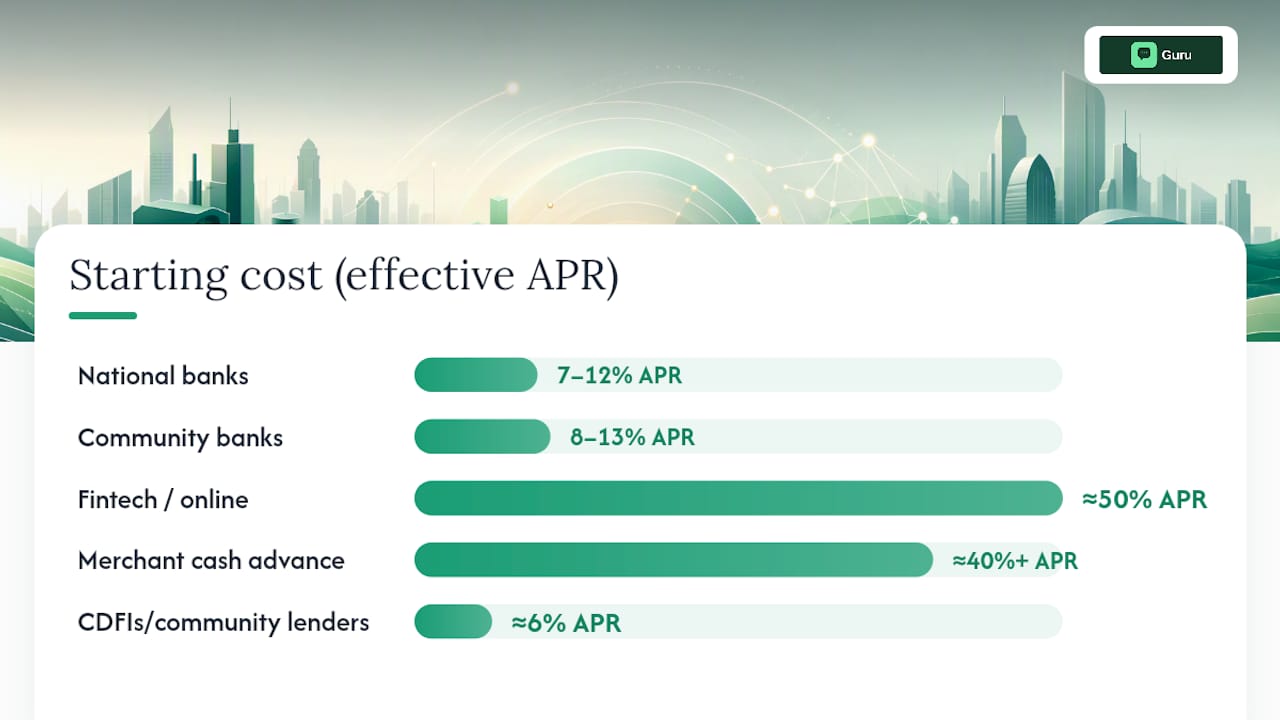
| Lender type | Best for | Starting cost | Loan amount range | Repayment schedule | Funding speed | Qualification signals |
|---|---|---|---|---|---|---|
| National banks | Established businesses with strong financials | Roughly 7 to 12% APR | $10,000 to — | Monthly, 1 to 5 years | 1 to 4 weeks | 2+ years in business, strong credit, profitability |
| Community banks/credit unions | Local relationships, moderate rates | Roughly 8 to 13% APR | $10,000 to — | Monthly, 1 to 5 years | 1 to 3 weeks | Local presence, decent credit, established banking relationship |
| Fintechs/online lenders | Speed and flexible qualification | Factor rates around 1.1 to 1.5 (roughly 50% effective APR) | $5,000 to — | Daily or weekly, 3 to months | Same day to 3 days | 6+ months in business, monthly revenue |
| Merchant cash advance providers | Urgent short-term gaps for card-heavy businesses | Factor rates around 1.5 (often 40% or higher effective APR) | $5,000 to $250,000 | Daily, tied to card sales | Same day to 2 days | Consistent card revenue, minimal paperwork |
| CDFIs/community lenders | Underserved businesses needing flexible underwriting | Roughly 6% APR | $500 to — | Monthly, 6 months to 5 years | 1 to 6 weeks | Mission fit, community ties, willingness to accept coaching |
| Lending Gurus (matching service) | Comparing multiple offers fast without a hard pull | Set by matched partner, not by Lending Gurus | Set by matched partner | Set by matched partner | Minutes to match; funding speed depends on partner | Revenue, time in business, and cash flow shared through Guru |
Banks and credit unions win on price if your financials check out, but they’re slow and picky. A three-year-old business with $40,000 in monthly revenue and clean bank statements has real leverage here.
Fintech and online lenders trade cost for speed. If you need $30,000 in your account by Friday to cover payroll, a factor-rate product might be the only realistic option, even though the effective annual cost dwarfs a bank line.

Merchant cash advances sit at the expensive end and deserve real scrutiny. They work off your daily card volume, which makes them tempting for retail and restaurant owners, but the Forbes Finance Council notes that community lenders frequently beat online, payday-style funders on total fees for comparable needs.
CDFIs and community development lenders fill a gap banks won’t touch: newer businesses, thinner credit files, or owners in underserved areas. Rates are often close to bank pricing, but underwriting takes longer and paperwork can be heavier.
A quick note on the table above: cells marked as APR reflect an annualized cost including fees. Cells marked as factor rate show a flat multiplier (borrow $10,000 at a 1.3 factor rate and you repay $13,000 total, regardless of how fast you pay it off). The two numbers are not directly comparable until you convert one to match the other, which is exactly what the next section walks through.
How Do You Convert a Factor Rate Into an APR?
A factor rate is not an interest rate. It’s a flat multiplier applied to the amount you borrow, and confusing the two is the single most common way small business owners underestimate what a loan actually costs.
Here’s the vocabulary you need before you compare any two offers:
- APR (annual percentage rate): the annualized cost of the loan including interest and most fees, expressed as a percentage.
- Factor rate: a decimal (typically 1.1 to 1.5) multiplied by your loan amount to get the total repayment amount.
- Flat fee: a one-time charge, often expressed as a percentage of the loan or a fixed dollar figure, separate from interest.
- Origination fee: a fee charged to process the loan, usually 1 to 5% of the loan amount, taken off the top or added to the balance.
- Simple interest: interest calculated only on the outstanding principal, common with bank term loans and SBA products.
- Effective annualized cost: what you get after you translate any fee structure into a single percentage you can compare across offers.
The conversion math looks like this. Say you borrow $50,000 at a 1.3 factor rate, repaid daily over six months. You’ll repay $65,000 total, meaning $15,000 in cost. Spread over a six-month term, that $15,000 charge annualizes to roughly 60% APR, even though the factor rate itself, 1.3, sounds mild on paper. Onramp Funds walks through this exact conversion logic, noting that the shorter the repayment window, the more a modest-looking factor rate balloons once annualized.
That’s the trap. A 1.15 factor rate on a four-month term can carry a higher effective APR than a 22% APR bank loan repaid over three years, because the cost gets compressed into so little time.
Statistic Callout: Bankrate’s coverage of working capital lending shows published rate ranges spanning single-digit APRs for the strongest borrowers up to considerably higher rates for short-term and alternative products, underscoring how much loan structure, not just your credit profile, drives the final cost.
Always ask a lender to state the effective APR, not just the factor rate or the flat fee. If they can’t or won’t give you that number, calculate it yourself before you sign anything.
What Types of Working Capital Financing Are Available?
Your options for working capital financing generally differ based on repayment length and method. Term loans provide a lump sum repaid in fixed monthly installments over a set period, often with relatively lower costs if you qualify.
Business lines of credit let you draw funds as needed and pay interest only on what you use. They’re ideal for smoothing out seasonal revenue dips, and FIU’s GrowBiz program highlights how retail businesses use working capital financing to manage inventory swings tied to holidays or seasonal buying patterns.

Merchant cash advances (MCAs) aren’t technically loans. You sell a portion of future card sales for upfront cash, repaid daily as a percentage of revenue. Costs are quoted as factor rates and funding often lands within a day or two, but the effective cost usually runs highest among all working capital products.
Invoice financing (also called accounts receivable financing) advances you cash against unpaid invoices, typically 80 to 90% of the invoice value upfront. It’s priced with fees per week or month your invoice remains outstanding, and it fits businesses with slow-paying B2B clients rather than retail cash flow gaps.
Business credit cards work for smaller, recurring expenses and offer revolving access without a formal loan application.
SBA-backed working capital options, including SBA Express and 7(a) lines, differ from the rest in both pricing structure and speed. They’re pegged to a base rate rather than a flat rate, which means your payment can shift when that base rate moves. The Small Business Administration outlines these programs as a route to lower long-term costs, in exchange for a slower approval process, often several weeks, and more documentation upfront.
Short-term financing across the board, according to Britannica’s overview of business finance terms, typically runs one to two years and carries higher interest with stricter repayment terms than medium-term (two to five years) or long-term options. That trade-off, speed and flexibility against cost, is the core decision running through every product on this list.
What Determines the Rate a Lender Offers You?
Lenders price risk. The lower the risk they see in your business, the lower the rate they’ll quote, and a handful of factors carry most of the weight.
- Monthly revenue: consistent, growing deposits signal you can handle repayment; this is often the single biggest driver for online and fintech lenders.
- Time in business: businesses operating two or more years typically unlock better pricing and more lender options than startups under a year old.
- Cash flow stability: smooth, predictable cash flow beats high revenue with wild swings, even if the swings average out over the year.
- Business credit profile: your business credit file, separate from your personal score, affects both pricing and which lenders will even consider you.
- Personal credit score: it matters, especially for newer businesses, but it’s a secondary factor behind revenue and cash flow for most working capital lenders.
- Collateral: secured loans, backed by receivables, equipment, or a blanket lien, typically price lower than unsecured products.
- Industry risk: lenders price certain industries, like restaurants or construction, differently based on historical default patterns.
- Seasonality: predictable seasonal dips (retail in January, landscaping in winter) are manageable if you can document the pattern; unexplained volatility is not.
Pro Tip: Pull your last four months of bank statements before you apply anywhere. If you spot erratic deposit patterns, smooth them out by consolidating multiple small deposits into fewer, larger ones where possible; lenders read consistency as lower risk, and it can move your quoted rate.
Pro Tip: If you invoice clients, tighten your receivables collection cycle before applying. A business collecting invoices in 30 days looks far less risky to an underwriter than one averaging 75 days, even with identical revenue.
How Do You Compare Offers and What Should You Ask Every Lender?
Every offer needs to get converted to the same unit before you compare it to anything else. Skip this step and you’re comparing apples to gravel.
Run every quote through this checklist:
- Convert the total cost to APR or effective annual cost, not just the headline rate quoted.
- Check the repayment schedule: daily, weekly, or monthly withdrawals hit your cash flow differently even at the same total cost.
- Ask whether early payoff reduces your total cost or if you owe the full factor-rate amount regardless of timing.
- Confirm whether the loan is recourse (you’re personally liable) or non-recourse.
- Get the full fee list in writing: origination, maintenance, late payment, and any hidden draw fees on lines of credit.
Bring these ten questions to any lender, whether you’re applying direct or reviewing offers matched through Lending Gurus:
- What is the total effective APR, including all fees?
- Is this rate fixed or variable, and what index does it track if variable?
- What’s the exact repayment schedule and withdrawal frequency?
- Is there a prepayment penalty if I pay this off early?
- Is this loan secured by collateral or a personal guarantee?
- What happens if I miss a payment, and what are the late fees?
- How long does funding take once I’m approved?
- Are there any origination, application, or maintenance fees?
- Can you show me the total repayment amount in dollars, not just the rate?
- What documentation do you need, and how will you verify my revenue?
Watch for these red flags before you sign anything:
- Fee structures the lender won’t explain clearly or put in writing.
- Repayment plans that only offer rollover or refinancing instead of a clear payoff date.
- Payback windows so short relative to your cash flow cycle that you’d need a second loan to cover the first one’s payments.
Which Lenders Should You Consider for Working Capital Financing?
Here’s how the major lender categories break down, including the well-known names small business owners search for most, alongside what to have ready when you apply.
OnDeck focuses on fast online term loans and lines of credit for established small businesses. Starting costs run as APR on term products, typically ranging into double digits depending on your profile, with loan amounts commonly from $5,000 to $250,000. Funding often lands within one to three business days. It works best for businesses with at least a year of operating history and steady monthly revenue; qualification leans heavily on bank statement consistency over personal credit alone.
National Funding offers both working capital loans and equipment financing with an emphasis on speed for established businesses. Costs are quoted with factor-rate structures on shorter products, and loan sizes range widely depending on revenue and time in business. It fits owners who’ve been operating a couple of years and want a single lender that also handles equipment needs.
Fora Financial specializes in short-term working capital and revenue-based financing with a relatively fast approval process. Repayment is typically structured around fixed daily or weekly debits tied to your bank account rather than card sales specifically, which makes it a fit for businesses without heavy card volume but consistent bank deposits.
Lendzi operates as an online marketplace connecting small businesses to a network of funding partners, similar in structure to matching platforms. Rates and terms depend entirely on which partner in their network picks up your file, so the range of outcomes can be wide.
Wells Fargo Business offers traditional bank lines of credit and term loans with some of the most competitive pricing available if you qualify. Loan amounts scale up meaningfully, often into the hundreds of thousands, but approval requires strong financials, solid time in business, and often an existing banking relationship. Funding timelines run slower than online lenders, frequently several weeks.
Accion Opportunity Fund is a nonprofit CDFI focused on underserved small business owners, including startups and businesses that don’t fit traditional bank criteria. Rates tend to be more moderate than online alternative lenders, loan amounts are generally smaller (often under $250,000), and the underwriting process often includes access to coaching and technical assistance alongside the loan itself.
American Express Business provides working capital lines and loans primarily to existing cardmember businesses, with terms tied to your American Express relationship and spending history. It’s a strong option if you already run significant business expenses through an Amex card, since that data can support faster underwriting.
Credibly offers working capital loans and merchant cash advances aimed at businesses that need funding quickly and may not qualify for bank financing. Costs lean toward factor-rate structures, and approval criteria weight monthly revenue and bank deposit history more than credit score alone.
SMB Compass functions as a lending marketplace connecting small businesses to a range of loan products, including working capital, equipment, and SBA options, through a network of funding sources. Like other marketplace models, actual rates depend on which lender in the network extends an offer.
Lending Gurus takes a different approach from every option above. Instead of applying to one lender and hoping it fits, you talk to Guru, a free conversational tool that asks about your revenue, time in business, and funding need, then matches you to vetted lending partners, without a hard credit pull during the matching step. Lending Gurus doesn’t set your rate, decide your approval, or promise a specific amount or timeline; the partner you’re matched with controls all of that. To get stronger matches, have your monthly revenue figures, time in business, and a rough sense of how you’d use the funds ready before you start. Referral relationships exist between Lending Gurus and its lending partners, and Lending Gurus may receive compensation when a match results in funding, a standard structure across matching platforms in this space.
How Were These Lenders and Rates Selected?
Lender types in this roundup were chosen to represent the realistic range of options a small business owner encounters, from traditional banks to fintech products to CDFIs, cross-checked against publicly disclosed rate information and industry-standard rate coverage where lenders publish it. Rate ranges reflect published industry snapshots rather than individual lender-specific pricing, since actual quotes depend on your business profile and change over time.
Lending Gurus is a matching service, not a lender. Partners in its network set all rates, terms, and approval decisions; nothing in this article should be read as a guarantee of approval, rate, or funding amount.
…
Should You Use a Matching Service or Apply Direct?
If you want to compare several offers quickly without racking up multiple hard credit inquiries, a matching approach like Lending Gurus makes the most sense. You answer a handful of questions once, and Guru surfaces options instead of you filling out five separate applications and triggering five separate credit pulls.
Applying direct still makes sense in narrower cases: if you have a long-standing relationship with a community bank or credit union that already knows your business, or if you need a specific SBA product with requirements a general matching flow won’t capture. For most owners comparing working capital financing rates for the first time, starting broad and narrowing down beats guessing which single lender to approach first.
How Does Lending Gurus Help You Compare Working Capital Offers?
Applying to five lenders one at a time to see who offers the best deal costs you time and, in most cases, five separate hard credit pulls on your file. Lending Gurus flips that process: you talk to Guru once about your revenue, time in business, and what you need the funding for, and Guru matches you to vetted lending partners without a hard credit check during that matching step.
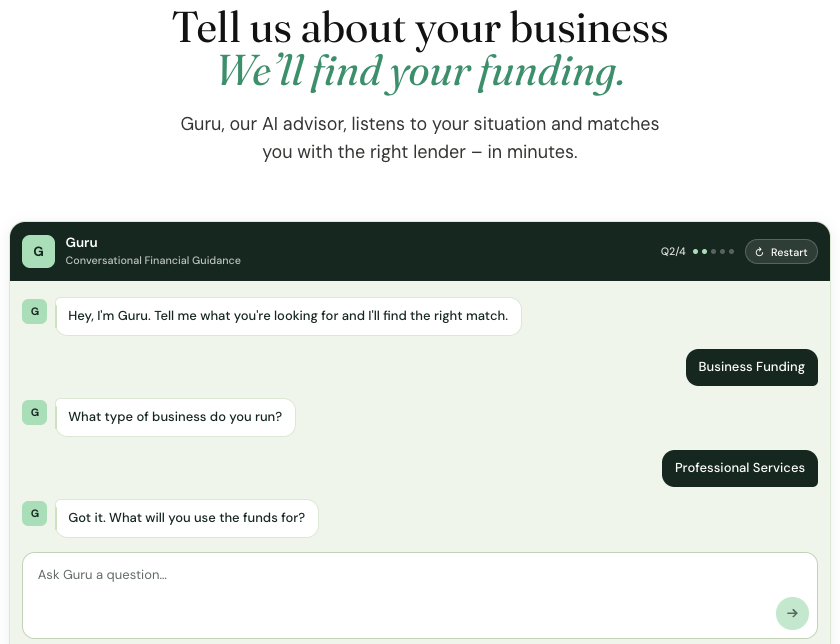
Guru doesn’t set your rate or guarantee your approval. The partner you’re matched with makes those decisions, including your final APR or factor rate, loan amount, and funding timeline. What Guru does is cut out the part where you’re guessing which lender to even try first. Before you start, have your average monthly revenue, time in business, and intended use of funds ready. The more specific your answers, the better your matches. You can learn more about how the matching process works or head straight to Lending Gurus to start comparing offers today.
Where Can You Find Official Information on Business Lending?
- Sba: the federal source for SBA loan program structures, eligibility, and government-backed working capital options.
- Consumer Financial Protection Bureau: guidance on borrower protections and how to evaluate lender practices before you sign.
- NMLS Consumer Access: the official registry to confirm a lender’s licensing status before you apply.
- Britannica’s overview of short-term financing: a clear breakdown of how loan term length affects cost and structure.
This article is general information, not a substitute for advice from a qualified financial advisor. Consult a qualified financial professional about your own circumstances before acting on anything here.
