
Most personal loan approvals take anywhere from a few minutes to 3 business days. Funding after approval typically follows within the same day to 5 business days, depending on the lender type and your bank’s ACH processing schedule. FDIC-regulated banks and NCUA-insured credit unions operate under different processing norms, which is why the range is wider than most borrowers expect. Lending Gurus matches you to vetted lending partners using a soft credit pull so you can compare options without affecting your score.
Fastest vs. slowest cases at a glance:
- Fastest: Online lender with automated underwriting, complete documents, and a bank account linked for instant verification. Decision in minutes; funds same day or next business day.
- Typical: Traditional bank or credit union with standard document review. Approval in 1–3 business days; funding in 2–5 business days.
- Slowest: Manual underwriting triggered by complex income, a large loan amount, or a documentation mismatch. Approval can stretch to 5+ business days; funding follows after that.
One critical distinction: approval is not the same as funded. Getting a decision means the lender agreed to lend. The money still has to move through ACH or wire transfer, and your bank’s own clearing schedule determines when you can actually spend it. Weekends and federal holidays do not count as business days for either lenders or banks.
Table of Contents
- How long does personal loan approval take by lender type?
- What factors speed up or slow down your approval?
- Why approval doesn’t mean the money is in your account
- How can you speed up personal loan approval and funding?
- What timeline should you expect based on your situation?
- What causes unexpected delays, and when should you follow up?
- Why underwriting style controls your approval speed
- What does the full loan timeline look like from application to payoff?
- How does your credit score affect how fast you get approved?
- Which fees and costs can delay your funding?
- What borrowers often miss about personal loan timelines
- Lending Gurus matches you to lenders built for speed
- Sources
How long does personal loan approval take by lender type?
The lender category you choose is the single biggest variable in your personal loan timeline. According to Experian, online lenders are consistently the fastest for both approvals and funding, while banks and credit unions tend to take longer.
Online lenders use automated underwriting systems that evaluate your application algorithmically. Many return a conditional decision within minutes. A verified, final offer still requires income and identity confirmation, but the process is largely digital and can be completed the same day.

Traditional banks often approve applications within the same day to 1 business day for existing customers, but funding commonly takes 2–5 business days. Internal transfer processes and compliance checks slow disbursement even when the approval itself is fast.
Credit unions frequently rely on more manual verification steps. NCUA-insured credit unions may take 1–3 business days for approval and up to a week to fund, particularly for members who are newer to the institution or requesting larger amounts.
A few other factors shape where you land in those ranges:
- Loan amount: Larger requests often trigger additional review regardless of lender type.
- Profile complexity: Self-employment income, recent credit events, or inconsistent deposits can push any lender toward manual review.
- Prequalification vs. verified offer: A soft-pull prequalification gives you a conditional decision instantly. The verified offer, which is what you actually sign, requires document checks that add time.
What factors speed up or slow down your approval?
Underwriting style is the primary determinant of personal loan processing time. Automated underwriting produces near-instant decisions; manual underwriting, where a human reviews your file, commonly adds 1–3 business days, according to Bankrate. But underwriting is not the only lever you control.
Documentation completeness matters more than most borrowers realize. A missing pay stub or an expired ID can pause an automated process and trigger a manual review that would not have happened otherwise.
Other major factors affecting approval speed:
- Income verification type: W-2 employees can often verify income digitally in minutes. Self-employed borrowers typically need two years of tax returns, which adds review time.
- Credit history complexity: Multiple open accounts, recent inquiries, or a thin credit file require more analysis.
- Identity and fraud checks: Lenders run automated fraud screening. Mismatches between your application and your credit file flag manual review.
- Application errors: Inconsistent information, such as a different address on your application versus your credit report, almost always triggers a manual hold.
- Lender cutoff times: Most lenders have a daily cutoff (often 5:00 PM ET) for same-day processing. Apply after that window and your file moves the next business day.
- Weekends and federal holidays: Neither lenders nor banks process ACH transfers on non-business days, which can add 2–3 calendar days to your effective timeline.
Pro Tip: Link your bank account for instant verification when the lender offers it. This single step replaces manual bank statement review and is one of the most reliable ways to avoid a manual underwriting trigger.
Why approval doesn’t mean the money is in your account
Approval is the lender’s decision to lend. Funding is the actual transfer of money to your bank account. These two events can be separated by hours or days, and the gap is often controlled by your bank, not the lender.
Common funding methods and their typical timing:
- ACH transfer: The standard method. The lender initiates the transfer, but CNBC Select reports that ACH clearing at your bank can add 1–2 business days even after the lender sends the funds.
- Same-day wire: Faster than ACH, but lenders often charge a fee and require you to request it explicitly before a cutoff time.
- Internal bank transfer: If you borrow from the same institution where you hold a checking account, the transfer can be nearly instant. This is the fastest possible funding path.
- Paper check: Rare for personal loans today, but some lenders still use them. Mailing and clearing time can add 5–7 business days.
A realistic scenario: you get approved at 2:00 PM on a Thursday, the lender initiates an ACH transfer that afternoon, but your bank does not post the funds until Monday morning. That is a four-calendar-day gap with no one doing anything wrong. Applying early in the day and asking about wire options can close that gap meaningfully.
How can you speed up personal loan approval and funding?
Speed comes from preparation and lender selection, not luck. Experian recommends applying early and having documents ready as two of the most reliable ways to meet same-day cutoffs.
- Prequalify first. Use soft-pull prequalification tools to identify lenders likely to approve you before you submit a full application. This narrows your list without adding hard inquiries.
- Gather your documents before you apply. Have your government-issued ID, two recent pay stubs (or two years of tax returns if self-employed), proof of address, and your bank account and routing numbers ready.
- Choose lenders with automated underwriting. Online lenders built on algorithmic review are structurally faster than institutions that default to manual processes.
- Link your bank account for instant verification. This replaces manual bank statement review and removes one of the most common manual-review triggers.
- E-sign everything immediately. Delays in signing your loan agreement pause the funding clock. Sign as soon as documents arrive.
- Apply early in the business day. Most lenders have cutoff times for same-day processing. A morning application gives you the best chance of clearing that window.
- Respond to lender requests within the hour. If the lender asks for additional documentation, a slow response can push your file to the next business day.
- Ask about wire transfer options. If you need funds faster than ACH allows, ask whether a same-day wire is available and what the fee is before you commit.
Dos and don’ts:
- Do use consistent information across your application, ID, and credit file.
- Don’t apply for multiple loans simultaneously; multiple hard inquiries can complicate your file.
- Do request a smaller loan amount if speed is the priority; larger amounts more often trigger manual review.
- Don’t apply on a Friday afternoon if you need funds by Monday; ACH and lender cutoffs make weekend funding rare.
Pro Tip: If your lender offers instant bank verification through a service like Plaid, use it. It replaces 2–3 days of manual bank statement review with a connection that takes under a minute.
What timeline should you expect based on your situation?
Your borrower profile shapes your realistic personal loan approval duration more than any single action you take. The table below maps common scenarios to typical approval and funding ranges.
| Borrower Scenario | Typical Approval Time | Typical Funding After Approval | Fastest Path |
|---|---|---|---|
| W-2 employee, good credit, small loan | Minutes to same day | Same day to 2 business days | Online lender, instant bank verification |
| W-2 employee, fair credit, mid-size loan | Same day to 1 business day | 1–3 business days | Online lender, complete docs ready |
| Self-employed, tax returns required | 1–3 business days | 2–5 business days | Prepare 2 years of returns in advance |
| Large loan amount (manual review likely) | 2–5 business days | 3–5 business days | Apply early, respond to requests same day |
| Credit union member | 1–3 business days | Up to 5–7 business days | Existing member relationship helps |
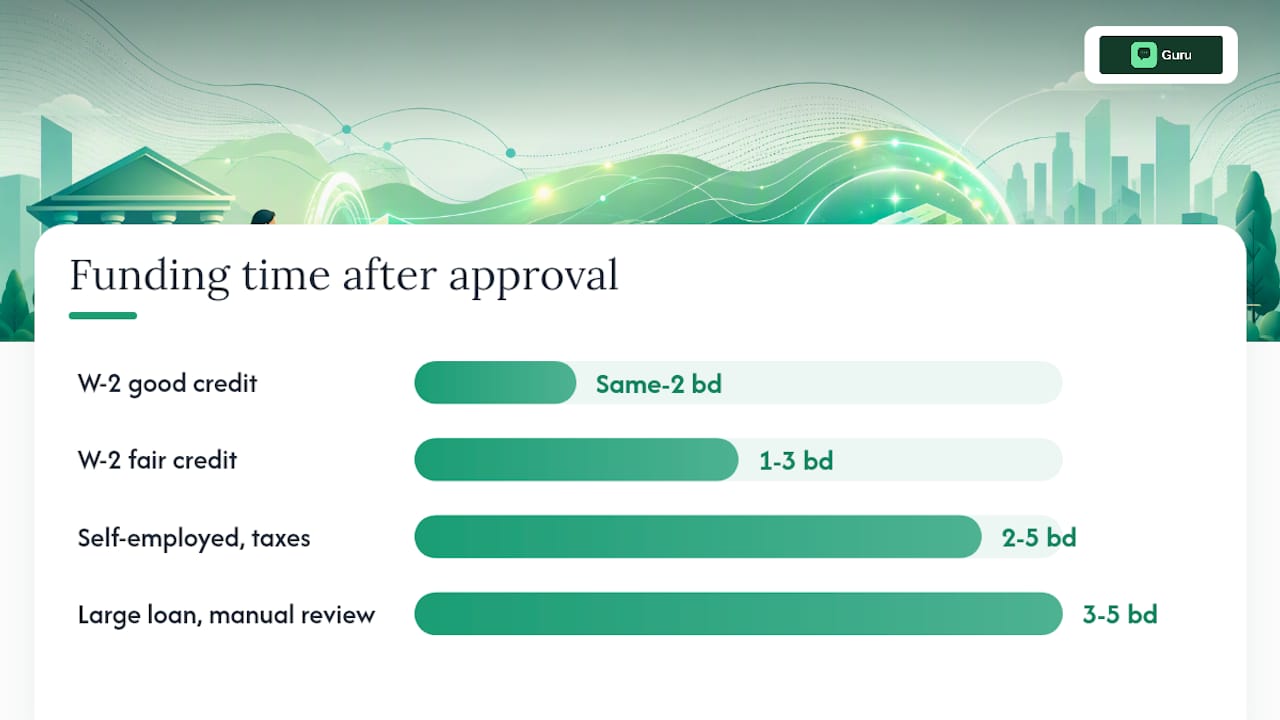
These ranges assume no application errors and timely document submission. A mismatch in your file or a slow response to a lender request can push any scenario into the next tier.
What causes unexpected delays, and when should you follow up?
Most delays fall into a small set of categories. Knowing which one you are dealing with tells you whether to wait or act.
Common delay causes:
- Manual underwriting trigger: Complex income, recent credit events, or a large loan amount routes your file to a human reviewer.
- Document mismatch: Your stated income differs from what your pay stubs or tax returns show.
- Identity verification flag: Your name, address, or Social Security number does not match your credit file exactly.
- ACH hold at your bank: Your bank applies a standard hold on incoming transfers, which is a bank policy issue, not a lender issue.
- Fraud review: Unusual application patterns (new address, large amount, recent credit activity) can trigger automated fraud screening.
- Public holidays: Federal holidays pause ACH processing entirely, adding a full business day to any transfer in progress.
When to follow up:
- No decision after 2 business days from a lender that advertises same-day approval: call and ask for a status update and whether any documents are outstanding.
- No funds after 3 business days from an approved loan: contact the lender first to confirm the transfer was initiated, then contact your bank to ask about incoming ACH holds.
What to say when you call: “I submitted my application on [date] and have not received a decision. Can you confirm whether my file is complete and give me an expected timeline?” Keep it direct. Ask specifically whether any documents are missing before asking about timing.
If the lender confirms funds were sent but your bank shows nothing, ask your bank whether an ACH hold is applied to incoming transfers from new sources. Many banks hold first-time ACH deposits for 1–2 business days as a fraud precaution.
Why underwriting style controls your approval speed
Lenders revert to manual review even when their default system is automated. Triggers include self-employment income, inconsistent deposit history, recent credit events, or a loan amount above their automated approval threshold.
Key insight from CNBC Select: Same-day funding is an ideal-case outcome that depends on the lender’s internal cutoff time and the receiving bank’s ACH processing speed. It is not an unconditional promise, and most borrowers should plan for 1–2 business days after approval as a realistic baseline. CNBC Select
What each authoritative source contributes:
- CNBC Select: ACH timing constraints and same-day funding caveats.
- Experian: Lender-type comparisons and document preparation guidance.
- FDIC: Bank operational norms and consumer protections relevant to deposit availability.
- NCUA: Credit union processing norms and federal oversight context.
Lending Gurus disclaimer: Lending Gurus is a matching platform, not a lender. Guru connects you to vetted lending partners using a soft credit pull. Those partners make all approval and funding decisions. Lending Gurus does not guarantee approval, specific loan amounts, rates, or timelines.
ACH processing at your bank, not just the lender’s speed, determines when funds are actually available in your account.
What does the full loan timeline look like from application to payoff?
The personal loan timeline does not end at funding. Here is a realistic picture of the full arc:
Application to funding: Minutes to 5 business days, depending on lender type, underwriting method, and document readiness.

Loan term: Personal loans in the U.S. typically run 12–84 months. A 24-month loan funded today means your final payment lands roughly two years from now.
First payment due date: Most lenders set the first payment 30 days after funding. Some offer a 45-day window. Confirm this in your loan agreement before signing.
Early payoff: Many personal loans have no prepayment penalty, meaning you can pay off the balance early and reduce total interest paid. Check your loan agreement for any prepayment fee language before assuming this applies.
The practical takeaway: the approval and funding window is the part you can influence most. Once the loan is funded, the timeline is fixed by your agreement.
How does your credit score affect how fast you get approved?
Credit score affects both your eligibility and the complexity of your review, which directly connects to approval speed. Borrowers with strong credit profiles tend to clear automated underwriting faster because their files present fewer questions for the system to resolve.
Broadly, here is how score ranges interact with the approval process:
- Excellent credit (roughly 750 and above): Automated approval is most likely. Fewer verification steps, faster decisions, and access to the widest range of lenders.
- Good credit (roughly 700–749): Still likely to clear automated underwriting at most online lenders, though some may request additional income documentation.
- Fair credit (roughly 640–699): More lenders may route your file to manual review, adding 1–3 business days. Fewer lenders will approve at this range, which also means fewer options for fast funding.
- Poor credit (below 640): Automated denial is common at most traditional lenders. Approval, if available, typically requires manual review and may involve secured products or co-signers, both of which extend the timeline.
Credit score is one input into underwriting, not the only one. Income stability, debt-to-income ratio, and employment type all factor into how quickly a lender can reach a decision.
Which fees and costs can delay your funding?
Fees do not just affect your loan cost. Some of them directly affect when you receive your money.
Origination fees are deducted from your loan principal before disbursement. This is not a delay in timing, but it is a reduction in the amount that hits your account. Confirm the net disbursement amount before signing so you are not surprised.
Wire transfer fees are charged when you request same-day wire funding instead of standard ACH. The fee is typically modest, but the lender must process the wire request before their daily cutoff. Missing that cutoff means the wire goes out the next business day anyway.
Verification fees are rare but exist at some lenders for third-party income or identity verification services. These are usually disclosed in the loan agreement and do not delay funding on their own, but they can slow the document review step if you dispute or delay authorizing them.
Prepayment penalties do not affect funding timing but matter for your total cost if you plan to pay off the loan early. Not all lenders charge them, but checking upfront prevents a surprise later.
The most funding-relevant cost to understand is the origination fee deduction. Borrowers who need a specific net amount should request a slightly higher loan principal to account for it.
What borrowers often miss about personal loan timelines
The conventional wisdom on personal loan approval time focuses almost entirely on the lender’s speed. That framing misses half the picture. Your bank’s ACH processing schedule, your own document readiness, and the time of day you apply all shape your real-world timeline as much as the lender’s underwriting system does.
The other thing borrowers underestimate is how much lender selection matters before the application. Choosing a lender with automated underwriting and instant bank verification is not just a preference. It is a structural decision that can cut your approval time from days to hours. Comparing lenders on underwriting method, not just rate, is the move most borrowers skip.
Prequalification is underused for exactly this reason. A soft-pull prequalification tells you which lenders are likely to approve you and at what terms, without starting the formal clock. Using it to filter for lenders that offer automated underwriting and same-day funding options is the single highest-leverage step most borrowers never take.
Lending Gurus matches you to lenders built for speed
Waiting days for a loan decision is frustrating when you need funds quickly. Lending Gurus gives you a faster starting point: Guru, the platform’s free conversational advisor, matches you to vetted lending partners in minutes using only a soft credit pull. No hard inquiry, no obligation, no paperwork before you see your options.
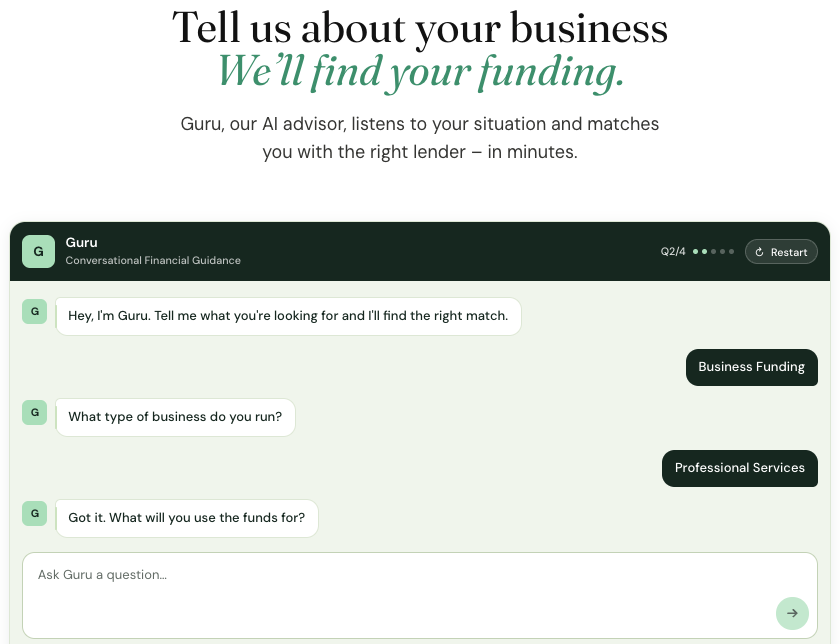
Matching through Lending Gurus does not guarantee approval or a specific timeline. Partner lenders make all approval and funding decisions independently. What the platform does is cut the time you spend searching, comparing, and applying to lenders that are unlikely to approve your profile. That means you spend less time on dead ends and more time moving through the process with lenders that fit your situation.
Ready to see which lenders match your profile? Try Guru now and get matched without affecting your credit score. Review the platform terms for full details on how matching and data use work.
Sources
- How Fast Can You Get a Personal Loan? | CNBC Select
- How long does it take to get a personal loan? | Experian
- FDIC
- NCUA
This article provides general information about personal loan timelines and is not a substitute for advice from a licensed financial professional. Confirm current terms, rates, and eligibility requirements directly with any lender before applying.
