
TL;DR:
- The best OnDeck alternatives include online lenders, lending marketplaces, and SBA-backed loans, tailored to different business needs. Matching tools like Lending Gurus help compare multiple offers without affecting credit scores, saving time and money. Choosing the right option depends on your funding amount, speed requirements, and long-term costs.
The strongest OnDeck alternatives fall into four categories: fast online lenders, revolving line-of-credit providers, lending marketplaces, and SBA-backed loans. Which one fits your business depends on how fast you need funding, how much you need, and what you can qualify for today. The fastest route to a real comparison is a matching tool like Lending Gurus, which surfaces multiple offers without a hard credit pull.
Speed costs money. SBA loans carry the lowest rates but take weeks to close. Online lenders fund in hours but charge more. Matching tools like Lending Gurus let you see both ends of that spectrum before you commit to anything.
Table of Contents
- What are the best OnDeck alternatives right now?
- What does each alternative actually offer?
- How do you choose the right alternative for your business?
- How do costs, eligibility, and funding speed compare to OnDeck?
- How does Lending Gurus work compared to applying directly?
- Which alternative fits your situation?
- Why matching beats picking one lender and hoping
- Start comparing offers without a hard credit pull
- Useful sources and where to read more
What are the best OnDeck alternatives right now?
The table below maps each alternative to the decision factors that matter most: product type, funding speed, typical amounts, eligibility signals, cost transparency, and how the application works.

How this shortlist was chosen: Each option was evaluated on product variety, eligibility flexibility, funding limits, speed, and fee transparency. The goal is to give you a practical starting point, not an exhaustive ranking.
| Lender / Platform | Best for | Product type | Typical funding speed | Typical amount range | Eligibility signals | Cost transparency | Application |
|---|---|---|---|---|---|---|---|
| Lending Gurus | Comparing multiple offers fast | Matches across term loans, lines of credit, equipment, invoice financing | Varies by matched partner | Varies by matched partner | No hard pull to start; partners set criteria | Partners disclose terms | Online chat with Guru; no hard pull initially |
| Fora Financial | Large funding amounts | Term loans, merchant cash advances | A few business days | Up to $1.5 million | Shorter time-in-business accepted; soft pull option | Factor rates disclosed | Online application |
| BlueVine | Revolving line of credit | Business line of credit | ~24 hours for approved draws | — | Revenue and time-in-business weighted; soft pull initially | Rates disclosed per draw | Online; minimal docs |
| Fundbox | Newer or smaller businesses | Revolving line of credit | Same or next business day | Smaller amounts | Short history accepted; per-draw fees | Fees per draw disclosed | Online; bank connection |
| Lendio | Comparing many lender types | Marketplace: term loans, SBA, lines of credit, equipment | Varies by matched lender | Wide range | Single soft-pull application routes to many lenders | Varies by lender | Single online form |
| National Funding | Equipment and working capital | Term loans, equipment financing | A few business days | Up to $500,000 (equipment) | Revenue-weighted underwriting | Factor rates and fees | Online application |
| Kabbage (by American Express) | Flexible line of credit access | Business line of credit | Fast draw access | Up to $250,000 | Revenue and account history weighted | Monthly fees disclosed | Online; account linking |
| SBA loans | Lowest long-term cost | 7(a), 504, microloans | 30–90 days | Up to several million | Stronger credentials, full documentation | Regulated rates; lowest cost | Bank or SBA lender; full docs |
Quick picks by use case
- Best for revolving credit: BlueVine or Kabbage, both offering lines of credit with fast draw access
- Best for large funding amounts: Fora Financial, which funds up to $1.5 million and accepts shorter business histories
- Best for newer businesses: Fundbox, with shorter time-in-business requirements and same- or next-day draw funding
- Best for comparing many options at once: Lendio or Lending Gurus, both using soft pulls to surface multiple offers
- Best for lowest long-term cost: SBA 7(a) or 504 loans, which carry government-backed rates but require more time and documentation
- Best for equipment purchases: National Funding, with dedicated equipment financing up to $500,000
What does each alternative actually offer?
Lending Gurus
Lending Gurus is a free matching platform, not a lender. You describe your needs to Guru, the platform’s conversational tool, and it matches you to vetted lending partners across term loans, lines of credit, equipment financing, invoice financing, and more. No hard credit pull happens during the matching conversation. Partners set their own approval criteria, rates, and terms. Best for: business owners who want to compare multiple offers before committing to a single application.
Fora Financial
Fora Financial offers term loans and merchant cash advances, with reported funding reaching large amounts and a soft-pull option for initial qualification checks. It accepts businesses with shorter operating histories than many traditional lenders require. A practical use case: a retailer needing a large inventory purchase before a peak season who cannot wait for SBA timelines. Best for: established businesses that need larger amounts than typical online lenders provide.

BlueVine
BlueVine focuses on business lines of credit with moderate funding limits, with approved draws funding in about 24 hours. The initial application uses a soft pull. That revolving structure makes it useful for businesses with recurring cash flow gaps, like a contractor covering payroll between project payments. Best for: businesses that need ongoing, flexible access to working capital rather than a one-time lump sum.
Fundbox
Fundbox offers a revolving line of credit with shorter time-in-business requirements than most online lenders, and qualifying draws can fund quickly, often the same or next business day. Fees are charged per draw rather than as a traditional origination interest rate, so you only pay when you use the line. A staffing agency covering a payroll gap while waiting on client invoices is a natural fit. Best for: newer or smaller businesses that need fast access to a revolving credit line.
Lendio
Lendio operates as a marketplace. One application, using a soft pull, routes to a network of lenders offering term loans, SBA products, lines of credit, and equipment financing. You compare matched offers side by side without filling out multiple full applications. Best for: business owners who want to see the widest range of product types and lender options from a single starting point.
National Funding
National Funding provides term loans and equipment financing, with equipment funding available for substantial purchases. Underwriting leans heavily on revenue and cash flow rather than credit score alone. A trucking company buying a new vehicle or a restaurant upgrading kitchen equipment fits this profile well. Best for: businesses with a specific equipment purchase or working capital need and strong monthly revenue.
Kabbage (by American Express)
Kabbage offers a business line of credit with fast draw access, monthly fee pricing, and account-linking for underwriting. It weights revenue and account history. The monthly fee structure means you should calculate the effective annual cost before drawing, since it can be higher than it appears. Best for: businesses already banking with American Express or those comfortable with a monthly-fee line structure.

SBA loans
SBA 7(a) and 504 programs can fund amounts up to several million dollars at lower, government-backed rates. The tradeoff is time: expect 30–90 days from application to funding, plus full documentation requirements including tax returns, financial statements, and business formation records. For a business planning a major expansion six months out, SBA financing often makes more sense than a fast online loan at a higher cost. Best for: businesses with strong credentials that can wait for funding and want the lowest long-term cost.
Eligibility signals to watch across all options:
- Time in business (most online lenders want at least 6 months; SBA typically wants 2+ years)
- Monthly revenue (lenders weight this heavily, often more than credit score)
- Cash flow consistency (bank statements showing regular deposits matter)
- Personal credit score (a factor, but rarely the only one for business loans)
On customer service: marketplace platforms like Lendio and Lending Gurus tend to offer advisor-assisted matching, while direct lenders like BlueVine and Kabbage lean toward self-serve online portals. If you prefer talking through options before applying, a marketplace or matching tool gives you more support upfront.
How do you choose the right alternative for your business?
Work through these decisions before you apply anywhere.
- How much do you need, and is it a one-time amount or ongoing access? A term loan fits a single capital expense. A line of credit fits recurring gaps.
- How fast do you need the money? Same-day needs point to Fundbox or BlueVine draws. A week or two opens more options. Sixty-plus days makes SBA viable.
- Can you provide collateral or a personal guarantee? OnDeck commonly requires both a personal guarantee and a blanket lien on business assets. Some alternatives do not, or offer non-recourse structures for invoice financing.
- Can your cash flow handle daily or weekly payments? Many online lenders pull payments frequently. Monthly repayment schedules are less common outside SBA and some term loan products.
- Do you want a revolving line or a fixed term? Revolving lines let you borrow, repay, and borrow again. Term loans give you a lump sum with a set payoff schedule.
Questions to ask every lender before you accept an offer:
- Do you run a hard credit pull now, or only at final approval?
- Are payments daily, weekly, or monthly?
- Are there origination fees, draw fees, or prepayment penalties?
- Is a personal guarantee required? Is there a blanket lien?
- What is the APR equivalent or total cost of capital for this offer?
Red flags to watch for:
- Daily automatic withdrawals not clearly disclosed upfront
- Factor rates presented without an APR equivalent (making cost comparison difficult)
- Bundled insurance or add-on products automatically included in the loan
- Vague prepayment terms that lock you in even if you pay early
Documents to have ready before you apply:
- Last 3–6 months of business bank statements
- Most recent business and personal tax returns
- Driver’s license or government-issued ID
- Business formation documents (LLC operating agreement, articles of incorporation)
- Estimated monthly revenue figure
Having these ready cuts application time significantly and speeds up underwriting decisions.
How do costs, eligibility, and funding speed compare to OnDeck?
Cost and transparency
Analysts consistently recommend comparing effective cost, not just advertised speed. Online lenders trade fast funding for higher cost. SBA loans take longer but carry significantly lower rates. The gap between the two can be substantial over a 12-month term, so always ask for the APR equivalent or total repayment amount before signing.
Some alternative products, like invoice financing and revenue-based financing, avoid traditional loan structures entirely. Non-recourse invoice financing shifts customer-credit risk away from your business and often uses flat-fee pricing rather than an APR, which can make cost comparison easier.
Funding speed by product category
| Product category | Typical time to fund |
|---|---|
| Online term loans | 1–3 business days |
| Lines of credit (approved draws) | Same day to 24 hours |
| Lending marketplaces | 1–7 business days (varies by matched lender) |
| SBA 7(a) / 504 loans | 30–90 days |
| Invoice financing | 1–3 business days |
Eligibility reality check
Lenders weight monthly revenue, cash flow, and time in business more heavily than credit score alone. A business with two years of consistent revenue and moderate credit often qualifies for better terms than a newer business with a high personal score but thin revenue history. Know which metrics your business presents most strongly before you apply.
Pro Tip: Use a matching tool that avoids hard credit pulls during the initial shopping phase. Several online lenders and marketplaces use soft inquiries for initial qualification; a hard pull typically happens only near final approval. Preserving your personal credit score while comparing offers is straightforward if you start with the right tools.
How does Lending Gurus work compared to applying directly?
Using Lending Gurus takes a few steps and skips the hard pull that a direct application usually triggers.
How the process works:
- Start a conversation with Guru on the Lending Gurus platform.
- Describe your business needs: how much you need, what for, and your rough monthly revenue and time in business.
- Guru matches you to vetted lending partners whose products fit your profile.
- Review the matched options and connect directly with the partners you want to pursue.
What you get vs. applying directly to one lender:
- No hard credit pull during the matching conversation
- Side-by-side access to multiple product types (term loans, lines of credit, equipment financing, invoice financing)
- A starting point that reflects your actual situation, not a generic product page
- No obligation to proceed with any match
What Lending Gurus does not provide:
- Guaranteed approval (partners make all approval decisions)
- Set rates or terms (partners set those independently)
- A promise of specific funding amounts or timelines
Mandatory disclosure: Lending Gurus is a free matching tool. Partner lenders make all final approval decisions and set their own rates, terms, and amounts. Review Lending Gurus’ terms and conditions before starting.
What to have ready before you start with Guru:
- Business name and type (LLC, sole proprietor, corporation)
- Estimated monthly revenue
- Time in business (months or years)
- Funding amount needed and intended use
- Last few months of bank statements (for partner applications)
Which alternative fits your situation?
- Need a revolving credit line for recurring gaps: Lines-of-credit providers like BlueVine or Kabbage. Fast draw access, soft pull to start.
- Need a large one-time amount: Fora Financial or a marketplace that routes to bank lenders. Fora funds up to $1.5 million with shorter history requirements.
- Running a newer business with limited history: Fundbox. Shorter time-in-business requirements and same- or next-day draw funding.
- Want to compare many lender types at once: Lendio or Lending Gurus. Single soft-pull entry point, multiple product types surfaced.
- Need the lowest long-term cost and can wait: SBA 7(a) or 504. Government-backed rates, but plan for a 30–90 day process and full documentation.
- Buying equipment: National Funding. Equipment-specific underwriting and funding up to $500,000.
- Invoice-driven business needing fast cash: Invoice financing products. Flat-fee pricing, non-recourse options available, typically funded in 1–3 days.
Before you apply anywhere, check whether the offer requires a personal guarantee or a blanket lien on your business assets. That exposure matters as much as the rate.
Why matching beats picking one lender and hoping
The conventional advice is to pick the fastest lender or the one with the highest advertised limit and apply. That approach costs you in two ways: it often triggers a hard credit pull before you know whether the terms are competitive, and it locks you into one product type before you have compared alternatives.
Matching your financing product to your cash flow cycle is the more reliable framework. A seasonal retailer with predictable revenue gaps needs a revolving line, not a term loan with fixed monthly payments. A manufacturer buying equipment needs a longer repayment window, not a 6-month merchant cash advance. Speed is a feature, not a strategy.
The other thing most business owners underestimate: the difference between a factor rate and an APR. A factor rate of 1.3 on a $50,000 advance sounds manageable until you calculate what that costs over 6 months versus a 12-month term loan at a lower effective rate. Always ask for the total repayment amount and the payment frequency before you sign. Prioritize offers with clear APR equivalents and transparent fee disclosures, even when the lender leads with speed.
Start comparing offers without a hard credit pull
Sorting through lenders one by one takes time you probably don’t have. Lending Gurus gives you a faster path: describe your needs to Guru, and the platform matches you to vetted lending partners across term loans, lines of credit, equipment financing, and invoice financing, all without a hard credit pull during the matching conversation.
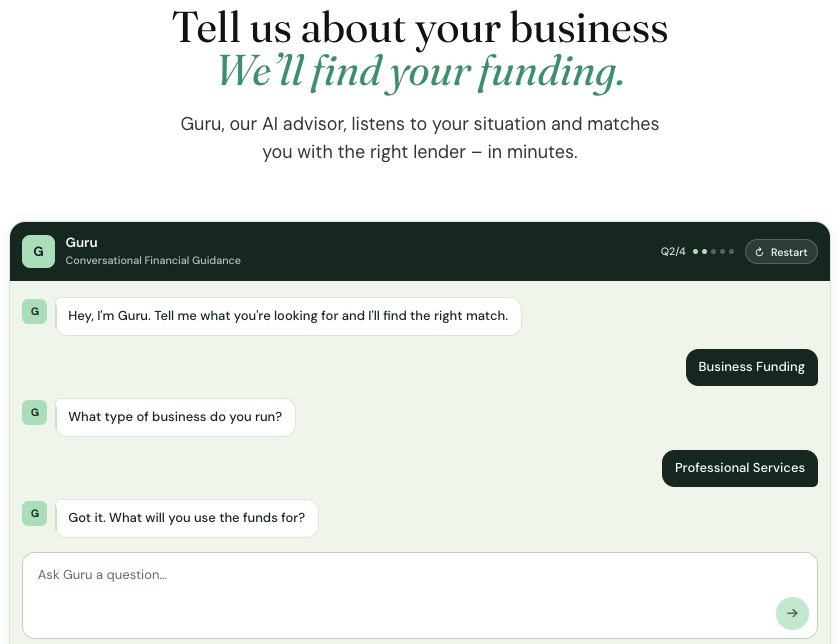
To get started, have your estimated monthly revenue, time in business, and funding amount ready. Guru will ask a few straightforward questions and surface partners whose products fit your profile. You review the options, then connect directly with the lenders you want to pursue.
Disclosure: Lending Gurus is a free matching tool. Partner lenders make all final approval decisions and set their own rates, terms, and amounts. No specific outcomes are guaranteed. See how it works or start matching now.
This article is general information, not financial or legal advice. Confirm current lender terms, rates, and eligibility requirements directly with each lender or a qualified financial professional before applying.
Useful sources and where to read more
The following sources informed this article. Read lender terms and disclosures directly before applying, since rates, eligibility, and product availability change.
- SBA: Fund Your Business — official SBA loan program overview, including 7(a) and 504 programs
- Money: Best Small Business Loans — editorial comparison of lender types, personal guarantee requirements, and cost factors
- Fora Financial: OnDeck Alternatives — lender-specific comparison covering BlueVine, Fundbox, Lendio, SBA, and Fora Financial
- eBoost Partners: OnDeck Alternatives — analysis of soft-pull practices, cost transparency, and eligibility factors
- Resolve: OnDeck Alternatives — covers invoice financing and non-recourse product structures as alternatives to traditional loans
Lending Gurus can connect you to vetted lending partners, but partner terms govern all approvals, rates, and amounts. Start your match to see which options fit your business today.
