
For most contractors, an equipment loan or a capital lease is the right starting point for long-life machines. Save SBA 504 for very large, fixed-asset purchases, and lean on a short-term lease or line of credit when you need flexibility more than ownership. Start by gathering your financials, then use a conversational financial tool to compare lender fits without a hard credit pull.
Table of Contents
- What financing routes are available for construction equipment?
- What do lenders check before approving equipment financing?
- How does SBA 504 financing work for heavy equipment?
- What tax rules affect the buy versus lease decision?
- How do you apply for construction equipment financing?
- How does Lending Gurus help you compare equipment lenders?
- A contractor’s rule of thumb on financing equipment
- Ready to compare equipment financing offers?
- Where to verify these numbers yourself
- Sources
- FAQ
What financing routes are available for construction equipment?
Contractors typically choose from four routes, and each one changes your monthly cost, your tax picture, and what happens when the term ends.
- Equipment loan: You borrow against the machine, own it once paid off, and take depreciation deductions along the way.
- Capital (finance) lease: Structured like a loan with a nominal buyout, often a $1 purchase option, so you build toward ownership with predictable payments.
- Operating (FMV) lease: Lower monthly payments, the lender keeps the asset risk, and you return, renew, or buy at fair market value when the term ends.
- Equipment line of credit: A revolving limit you draw against for multiple purchases or rentals, useful when your project calendar is unpredictable.
- Captive or manufacturer finance programs: Dealer-affiliated financing that sometimes bundles maintenance plans or seasonal payment schedules tied to your busy season.
A loan or capital lease fits equipment you will run for years, like excavators or cranes. An FMV lease or a line of credit suits shorter jobs, rented-then-replaced attachments, or a business still building its financial track record.
What do lenders check before approving equipment financing?
Lenders weigh your monthly revenue and cash flow most heavily, followed by time in business and your ability to cover the new payment alongside existing debt. Credit score matters, but it is one factor among several, not the deciding one.
Before you apply, assemble these in order:
- Bank statements, usually the last three to six months, to show consistent cash flow.
- Profit and loss statement covering the current year and the prior year.
- Business tax returns for the last one to two years.
- A signed equipment quote from the vendor, including specs and total price.
- Business formation documents and your EIN.
- Proof of insurance when the lender or lease requires it before funding.
Pro Tip: If you’re financing more than one piece of equipment this year, ask about bundling it under a single lease. Lenders often streamline paperwork and sometimes improve pricing for a bundled deal, according to SBA guidance on equipment financing.
A short, one-page case showing how the machine will generate revenue, more billable hours, fewer subcontractor costs, gives underwriters something concrete to point to. A vendor like Vic Sawing shows how a detailed quote paired with a clear cost estimate makes that case easier to build.
How does SBA 504 financing work for heavy equipment?
An SBA 504 loan provides long-term, fixed-rate financing of up to $5 million for major fixed assets, including construction machinery with a useful remaining life of at least 10 years. A Certified Development Company (CDC) partners with a conventional lender to fund the deal, splitting the loan between the two.
- You typically need at least two years in business and must be current on existing debt to qualify.
- Refinancing of eligible existing debt is allowed under the program when those borrower conditions are met.
- The long, fixed rate makes 504 attractive when you are planning capital spending years ahead and want payment certainty.
Talk to a CDC directly when you are eyeing a purchase in the high six or seven figures. For smaller or shorter-life equipment, a conventional loan or lease usually moves faster.
What tax rules affect the buy versus lease decision?
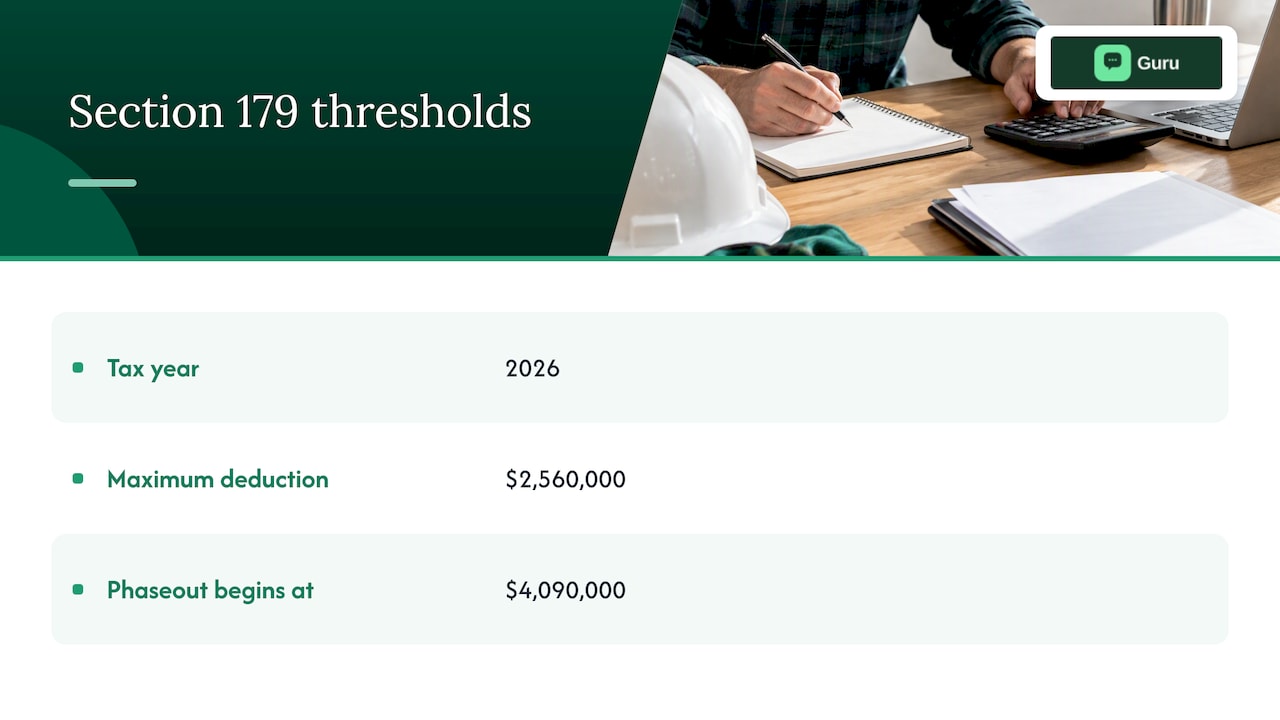
For tax years beginning in 2026, the maximum Section 179 deduction for qualifying equipment is $2,560,000, with the deduction phasing out once total equipment placed in service exceeds $4,090,000, according to IRS Publication 946. That threshold determines whether buying now delivers an immediate write-off or a slower depreciation schedule.
Bonus depreciation and MACRS also apply to qualifying property, with specific treatment for certain qualified production property placed in service after 2025, as outlined in the IRS’s draft depreciation guidance. If you use financed equipment to build a capital improvement rather than for direct billable work, uniform capitalization rules may require you to capitalize that depreciation into the improvement’s basis instead of deducting it outright. A tax professional can confirm how your specific purchase lands.
How do you apply for construction equipment financing?
- Get a vendor quote with full specs, price, and delivery timeline before you approach any lender.
- Assemble your financial package: bank statements, P&L, tax returns, and formation documents.
- Choose your route (loan, lease, line of credit, or SBA 504) and submit applications to two or three lenders.
- Negotiate terms, then verify end-of-term options before you sign.
Ask every lender the same questions: What are the fees? Is there a residual or buyout price at term end? Who handles maintenance? Keep every signed document and set your payment schedule to land after your typical invoice cycle, not before it.
How does Lending Gurus help you compare equipment lenders?
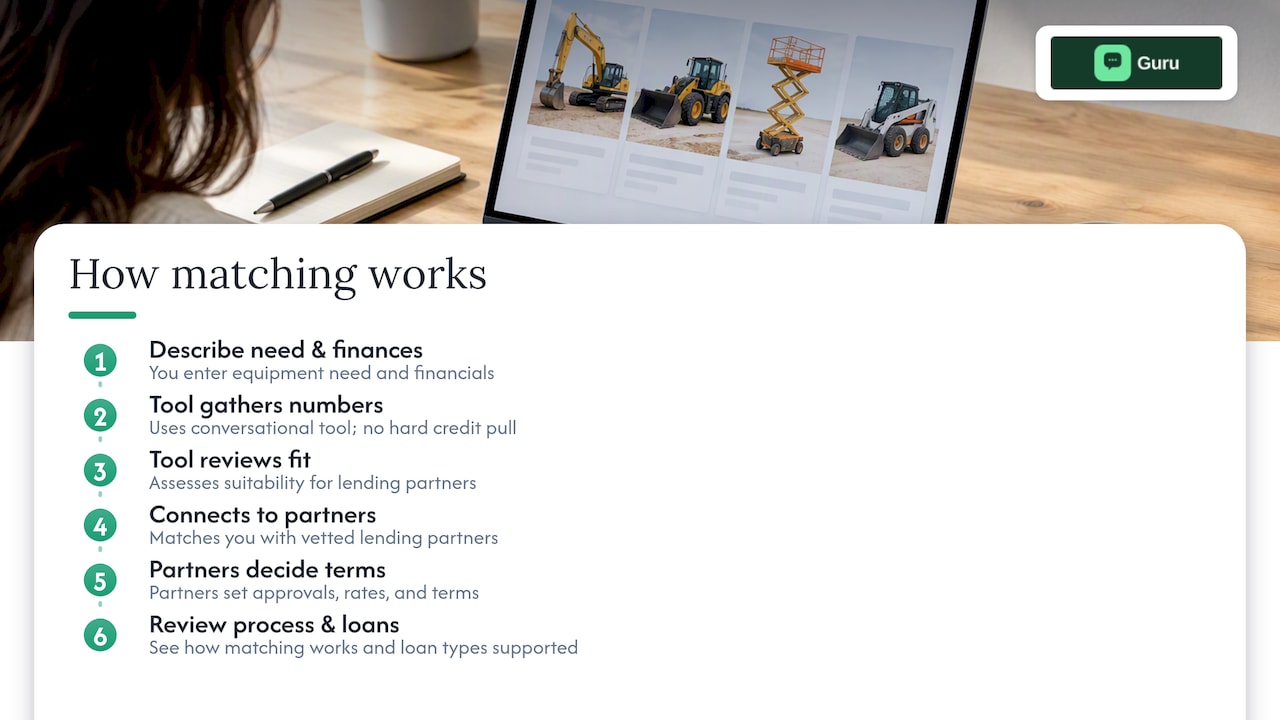
There are platforms that offer free matching to vetted lending partners using conversational tools that gather your numbers without a hard credit pull. You describe your equipment need and your financials, and the tool reviews the fit to connect you to partners suited to your situation. Partners, not Lending Gurus, decide approvals, rates, and terms. You can review how the matching process works before you start, and see the full range of loan types supported.
A contractor’s rule of thumb on financing equipment
Match the term of your financing to the useful life of the machine, never stretch a loan past the point the equipment stops earning. Preserve cash for payroll and materials before you preserve ownership. Save SBA 504 for the big, fixed purchases you will run for a decade, and rent instead of finance when you are testing new equipment on a single job.
— Chris
Ready to compare equipment financing offers?
Getting matched costs nothing, and the intake takes minutes: you talk to Guru, describe the equipment and your business, and skip the hard credit pull that a stack of individual lender applications would trigger.
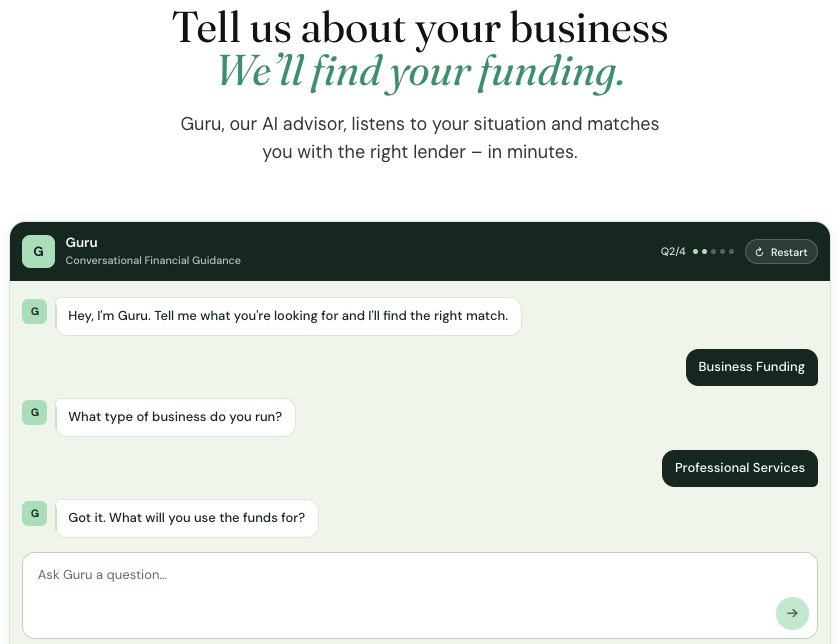
- Free intake: Guru asks about your equipment need and your financials in plain conversation.
- Fast matching: You get connected to lending partners suited to your situation, often within minutes.
- You stay in control: Partners contact you to complete the application; they set the final approval, rate, and terms, not Lending Gurus.
Start your equipment financing match and see which lending partners fit your project.
Where to verify these numbers yourself
Check IRS Publication 946 for depreciation and Section 179 limits, and the SBA’s 504 loan page for program rules.
This article is general information, not a substitute for advice from a qualified financial advisor. Consult a qualified financial professional about your own circumstances before acting on anything here.
Sources
FAQ
What are the largest equipment finance companies in the United States?
Bank-affiliated lenders, independent finance companies, and manufacturer captive finance divisions all compete in this space, and market share shifts year to year. Rather than chasing a “biggest” list, compare rate, term, and end-of-term flexibility across a few lenders matched to your specific equipment and revenue profile.
What are the current construction equipment financing rates?
Rates vary by lender, your credit profile, time in business, and cash flow, so there is no single published rate for the industry. SBA 504 loans offer fixed, long-term rates set through the CDC-lender structure, while conventional loans and leases are priced individually by each lender based on your application.
What are the best ways to finance construction equipment?
For equipment you will run for years, an equipment loan or capital lease usually makes sense because you build toward ownership. For large, fixed-life machinery, an SBA 504 loan offers fixed rates for major capital purchases, while a line of credit or FMV lease suits shorter-term or lower-commitment needs.
Do you have to put 20% down on a construction loan?
Down payment requirements vary by lender and loan type. Rather than assume a fixed percentage, confirm the specific down payment and terms with the lender or partner reviewing your application, since SBA 504 and conventional equipment loans structure this differently.
What documents do I need before applying for equipment financing?
Lenders generally want recent bank statements, a profit and loss statement, business tax returns, a vendor quote for the equipment, and your business formation documents. Having these ready before you apply, as recommended in SBA guidance on equipment financing, speeds up review and gives you more room to negotiate terms.
