
Use a business loan for large, one-time investments you’ll repay over years. Use a business credit card for recurring expenses, short-term purchases, or bridging cash-flow gaps you can clear within a billing cycle or two.
Best for large capital needs: Business loan (equipment, real estate, major expansion)
Best for everyday spending: Business credit card (supplies, subscriptions, travel, payroll gaps)
Best for exploring both: Lending Gurus matches you to vetted lending partners at no cost, without a hard credit pull upfront. Partners set all rates, terms, and approval decisions.
The U.S. Small Business Administration offers SBA-backed loan programs specifically designed to reduce lender risk and improve access for small businesses. Experian and Equifax both maintain business credit files separate from your personal credit, and which product you choose affects both.
Table of Contents
- What is a business loan, and when does it make sense?
- What is a business credit card, and what is it good for?
- How do business credit cards and loans compare side by side?
- When should you pick a loan vs. a business credit card?
- How do you choose? A checklist, questions to ask, and red flags
- What other financing options should you know about?
- How Lending Gurus matches you to lenders
- Are interest and fees on business financing tax-deductible?
- How do you transition from a credit card to a loan, or vice versa?
- Why the “just get a card” default costs small businesses more than they realize
- See what lenders are available for your business with Guru
- Further reading and authoritative sources
What is a business loan, and when does it make sense?
A business loan, often called a term loan, gives you a lump sum upfront that you repay on a fixed schedule, typically with set monthly payments over a defined period. It’s an installment product, not revolving, so once you spend the funds, you can’t draw from it again.

Term loans are best suited for one-time, long-lived investments that generate revenue over multiple years, such as purchasing equipment, buying commercial real estate, funding a major renovation, or financing a significant growth initiative.
Pros of a business loan:
- Generally lower interest rates than credit cards for multi-year borrowing
- Predictable fixed monthly payments make budgeting straightforward
- Larger borrowing amounts, potentially from tens of thousands up to multiple millions
- Builds business credit when the lender reports to commercial bureaus like Dun & Bradstreet
Cons of a business loan:
- Longer approval process and more documentation required (often two years of tax returns, bank statements, and financial projections)
- May require collateral depending on loan size and lender
- Funds are non-revolving; you can’t redraw once spent
- Approval timelines can range from days to several weeks
Lenders weigh monthly revenue, time in business, and cash flow most heavily when evaluating applications. Your credit score matters, but it’s rarely the sole deciding factor.
What is a business credit card, and what is it good for?
A business credit card is a revolving line of credit with a set credit limit. You draw from it as needed, make at least a minimum monthly payment, and the available balance replenishes as you pay it down. Monthly statements give you a built-in record of business spending.

Business credit cards help separate business and personal expenses, offer rewards on purchases, and often include expense-tracking tools that simplify bookkeeping. Some cards report activity to commercial credit bureaus, which can strengthen your business credit profile over time.
Pros of a business credit card:
- Fast approval, often within minutes for online applications
- Flexible access to funds without reapplying each time
- Rewards programs (cash back, travel points) can reduce net operating costs on high-frequency purchases, provided you pay balances in full
- Grace periods give you a short-term float when waiting on receivables
Cons of a business credit card:
- Higher APRs than term loans, especially if you carry a balance month to month
- Variable APRs mean your interest cost can rise with market rates
- Some issuers report to consumer bureaus, which can affect your personal credit score
Pro Tip: Ask your card issuer directly whether they report to business credit bureaus like Dun & Bradstreet or Equifax Business, or to consumer bureaus like Experian and TransUnion. The answer affects both your business credit profile and your personal credit score.
How do business credit cards and loans compare side by side?
The table below covers the seven dimensions that matter most when choosing between these two business financing choices.

| Dimension | Business Loan | Business Credit Card |
|---|---|---|
| Funding structure | Lump sum, non-revolving | Revolving credit line |
| Interest & fees | Generally lower APR; may include origination fees | Higher variable APR; annual fee possible |
| Repayment terms | Fixed schedule (months to years) | Flexible minimums; full balance avoids interest |
| Typical amounts | Tens of thousands to millions | Typically lower limits, varies by issuer |
| Qualification | Revenue, time in business, cash flow, documentation | Credit score, personal guarantee common |
| Credit impact | Builds business credit if reported to commercial bureaus | May affect personal credit depending on issuer |
| Time to funding | Days to several weeks | Often same day to a few business days |
Understanding APR mechanics and fee structures is critical when comparing these two products. A loan’s fixed rate and amortizing payment structure means you know your exact monthly outflow from day one. A credit card’s revolving balance compounds interest monthly if you don’t pay in full, and the effective cost rises quickly on large balances carried over time.
To make this concrete: imagine you need $20,000 for a purpose you’ll repay over 24 months. A term loan with a fixed rate gives you a predictable monthly payment for the full term. The same $20,000 carried on a credit card at a higher variable APR, with only minimum payments, would cost substantially more in total interest and take far longer to clear. The right comparison exercise is to calculate total repayment cost under each scenario for your specific amount and timeline.
Quick takeaways from this comparison:
- Loans win on total cost when repayment extends beyond a few months
- Cards win on speed and flexibility for short-term or recurring needs
- Cards carry higher interest risk if balances aren’t cleared promptly
- Loans require more upfront documentation but offer more borrowing power
- Credit reporting practices differ by product and issuer; always confirm before applying
When should you pick a loan vs. a business credit card?
The practical dividing line is your repayment horizon. If you can repay within one billing cycle or a few months, a card is often cheaper and more flexible. If repayment will stretch over years, a loan typically lowers total interest and gives you predictable payments.
Common scenarios and recommended choices:
- Buying equipment or machinery: Use a loan. The purchase is large, one-time, and generates value over years. A term loan’s lower rate and fixed schedule matches the asset’s useful life.
- Covering a payroll gap or short cash-flow shortfall: Use a business credit card or line of credit. You expect to clear the balance within 30–60 days once receivables come in.
- Seasonal inventory buildup: A card works if the inventory turns quickly and you’ll pay the balance within a billing cycle. A line of credit is better if the cycle is longer.
- A marketing push with predictable ROI: A card with cash-back rewards makes sense for recurring ad spend you’ll pay off monthly. A loan is overkill for this.
- Purchasing commercial real estate or funding a major expansion: A term loan or SBA-backed loan is the right tool. Cards can’t match the borrowing amounts or the rate structure.
Decision triggers to run through before applying:
- How much do you need, and is that amount realistic for a card’s credit limit?
- How long will repayment realistically take?
- Is this a one-time purchase or an ongoing expense?
- How predictable is your cash flow over the repayment period?
- Are you comfortable with a personal guarantee if required?
When your card balance starts creeping up and you’re carrying it month to month, that’s the clearest signal to transition to a loan. Refinancing revolving card debt into a fixed-rate term loan often reduces total interest cost and gives you a clear payoff date.
How do you choose? A checklist, questions to ask, and red flags
Before you apply for either product, run through this checklist:
- Define the amount and purpose. Know exactly how much you need and what it’s for. Lenders price risk based on purpose.
- Calculate total cost, not just monthly payment. Compare total repayment across the full term for a loan vs. the projected interest cost on a card balance.
- Check prepayment penalties. Some loans charge fees if you pay off early. Confirm this before signing.
- Confirm credit bureau reporting. Ask whether the product reports to business bureaus (Dun & Bradstreet, Equifax Business, Experian Business) or consumer bureaus. This affects your business credit profile.
- Assess your documentation. Loans typically require two years of tax returns, recent bank statements, and sometimes a business plan. Cards require less.
Questions to ask lenders or card issuers:
- What documentation do you require, and what’s the typical approval timeline?
- Does this product report to business credit bureaus, consumer bureaus, or both?
- Is a personal guarantee required?
- What factors most affect approval for my business profile?
- Are there prepayment penalties or early payoff fees?
- What fees apply beyond the stated interest rate (origination, annual, late payment)?
Red flags to watch for:
- Vague or undisclosed fees not listed in the agreement
- Aggressive prepayment penalties that make early payoff costly
- Requests for upfront escrow deposits or payments to unverified third parties before funding
- Pressure to decide immediately without time to review terms
Pro Tip: Lending Gurus lets you answer a few questions and get matched to vetted lending partners without a hard credit pull during the initial process. This gives you a starting point for comparing real offers before you commit. Partners make all final decisions on approval, rates, and terms.
What other financing options should you know about?
A business loan and a credit card aren’t your only choices. Several alternatives fill specific gaps that neither product covers well.
- Business line of credit: You draw as needed and pay interest only on what you use. Lines of credit typically have variable rates and renew annually, making them well-suited for working capital and unpredictable cash-flow needs. They’re a hybrid between a card and a loan.
- Equipment financing: The equipment itself serves as collateral, which often makes approval easier and rates competitive. Use this when the purchase is specifically a piece of equipment or machinery.
- Invoice financing: You borrow against outstanding invoices. Useful when you have strong receivables but need cash before clients pay. The cost is tied to invoice value and collection timeline.
- Merchant cash advance: A lender advances funds in exchange for a percentage of future sales. Fast to access, but typically the most expensive option. Reserve this for short-term, high-urgency needs when other options aren’t available.
The general rule: use a loan for predictable, long-term repayment on a defined asset or investment. Use revolving options (cards, lines of credit) for variable, short-term needs. Use specialized products (equipment financing, invoice financing) when the asset or receivable itself can secure the funding.
How Lending Gurus matches you to lenders
Lending Gurus is a free matching platform, not a lender or broker. Guru, the platform’s conversational advisor, listens to your needs and surfaces vetted lending partners without performing a hard credit pull during the initial process.
Here’s how it works:
- Answer a few questions. Guru asks about your business, funding need, and timeline. No hard credit pull at this stage.
- Get matched to vetted partners. The platform identifies lending partners whose products fit your profile.
- Review your options. Partners present their offers. You compare rates, terms, and amounts directly.
- Apply with your chosen partner. The partner handles the full application, documentation, and approval process.
- Partners decide everything. Approval, rates, amounts, and timelines are set entirely by the lending partner, not by Lending Gurus.
Lending Gurus does not guarantee approval, specific rates, or funding timelines. The platform connects you to options; partners make all final decisions. Use it as a starting point to see what’s available for your business, not as a promise of what you’ll receive.
This article was written by Chris, who covers small business financing and credit strategy for Lending Gurus.
Are interest and fees on business financing tax-deductible?
Generally, yes. Interest paid on a business loan is deductible as a business expense under IRS rules, provided the loan is used for legitimate business purposes. The same applies to interest charged on a business credit card when the purchases are business-related.
Fees are treated similarly. Origination fees on a loan may be deductible, though the timing and method of deduction can vary depending on how the loan is structured. Annual fees on a business credit card used exclusively for business expenses are typically deductible.
Two important caveats. First, if you use a business credit card for a mix of personal and business purchases, only the business-related interest and fees are deductible. Keep clean records. Second, tax treatment depends on your business structure (sole proprietor, LLC, S-corp, C-corp) and your specific situation. Consult a tax professional or CPA to confirm how these deductions apply to your business before filing.
This article is general information, not tax or financial advice. Confirm current rules with a qualified tax professional for your own situation.
How do you transition from a credit card to a loan, or vice versa?
Business financing needs evolve. A credit card that worked fine in your first year may become a liability once balances grow and interest compounds. Knowing when and how to shift products keeps your cost of capital in check.
Moving from a credit card to a loan: The clearest trigger is a growing revolving balance you’re no longer clearing monthly. Refinancing that balance into a fixed-rate term loan typically reduces your interest rate and gives you a defined payoff date. Before applying, document your revenue, cash flow, and time in business, since lenders will want this. The loan proceeds pay off the card balance, and you resume card use only for expenses you can clear each month.
Moving from a loan to a credit card: This usually happens as your business matures and your financing needs shift from large capital investments to ongoing operational expenses. Once a term loan is paid off and your business credit profile is established, a business credit card with rewards becomes a practical tool for day-to-day spending. The key is to use it for expenses within your monthly cash flow, not as a substitute for capital you’d otherwise borrow.
Building toward better options over time: Both products, used responsibly, build your business credit profile. Consistent on-time payments on a loan reported to commercial bureaus, combined with low utilization on a business credit card, position you for better rates and higher limits on future financing.
Why the “just get a card” default costs small businesses more than they realize
Most small business owners default to a credit card because it’s fast and familiar. That’s a reasonable starting point, but it becomes expensive the moment a balance lingers past the grace period.
The real issue isn’t which product is better in the abstract. It’s that most owners don’t run the total-cost comparison before they commit. A card at a high variable APR, carrying a $15,000 balance for 18 months, can cost more in interest than a term loan would have for the same amount, even after accounting for the loan’s origination fee. The math is rarely obvious until you do it.
What I’d push back on is the idea that loans are “complicated” and cards are “simple.” The simplicity of a card is a feature when you use it correctly and a trap when you don’t. A loan’s documentation requirement is a friction point, but it also forces you to articulate exactly what you’re borrowing for and whether the return justifies the cost. That discipline is worth something.
The businesses that manage financing well tend to do one thing consistently: they match the product to the purpose before they apply, not after. A card for recurring, short-cycle expenses. A loan for capital investments with a multi-year payoff. A line of credit for variable working capital needs. The product is a tool; the strategy is what makes it work.
See what lenders are available for your business with Guru
Choosing between a business loan and a credit card is clearer when you can see real offers side by side. Guru, Lending Gurus’ free matching tool, connects you to vetted lending partners in minutes, without a hard credit pull during the initial process.
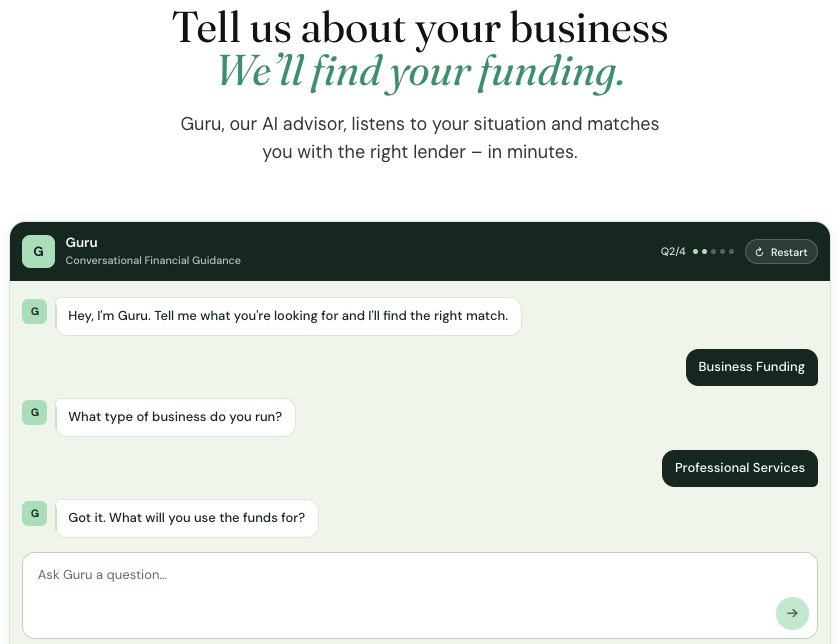
You answer a few questions about your business and funding need. Guru surfaces partners whose products match your profile. You review the options and decide whether to move forward. There’s no obligation, and partners handle all approvals, rates, and terms. Lending Gurus does not guarantee any specific offer, rate, or timeline.
If you’re ready to see what’s available for your business, start with Guru and get matched to lenders without the guesswork of applying blind.
Further reading and authoritative sources
These resources cover business financing in depth and are worth reviewing as you compare your options.
- U.S. Small Business Administration — Loans: The primary federal resource for SBA-backed loan programs, eligibility requirements, and approved lenders. Start here if you’re considering an SBA 7(a) or microloan.
- Citizens Bank — Choosing the Right Business Financing: Practical guidance on matching financing type to business purpose, covering term loans, lines of credit, and when each fits.
- Capital One — Business Credit Card vs. Business Loan: A direct comparison of the two products covering amounts, timelines, and qualification differences.
- Experian — Pros and Cons of Business Credit Cards: Covers APR tradeoffs, personal credit reporting risks, and when cards make sense for business owners.
- Bill.com — Benefits of Business Credit Cards: Explains rewards, expense tracking, and how cards can support business credit history.
- Truist — Business Credit Card Benefits: Covers cash-flow float, grace periods, and practical use cases for business cards.
- Lending Gurus — How It Works: Step-by-step overview of the Lending Gurus matching process, including what to expect and how partners make decisions.
