
For most small businesses, the best first step is Lending Gurus: a free matching platform that connects you to vetted lending partners without a hard credit pull. From there, your best fit depends on how long you’ve been in business, your monthly revenue, and how fast you need funding. The U.S. Small Business Administration confirms that unsecured business funding is evaluated on creditworthiness rather than specific collateral, with lenders leaning heavily on monthly revenue, time in business, and cash flow when making decisions.
Quick verdict:
- Lending Gurus — best first step for most owners; free matching, no hard credit pull, multiple vetted partners
- Online revenue-based lenders — best for businesses with strong recent revenue needing fast working capital
- Merchant cash advance providers — best for businesses with steady daily card sales needing immediate cash
- Traditional banks — best for established businesses that qualify for lower-cost unsecured options
- SBA/nonprofit lenders — best for larger, lower-cost financing when you can wait for a longer process
Pro Tip: Before you apply anywhere, know your last three months of average monthly revenue. That single number shapes which lenders will consider you and at what cost.
| Option | Best for | Loan type | Speed |
|---|---|---|---|
| Lending Gurus | Comparing multiple offers fast | Matching platform | Minutes to match |
| Online revenue-based lenders | Strong revenue, fast capital | Term loan / line of credit | 24–72 hours |
| Merchant cash advance | Daily card sales, urgent cash | MCA / revenue advance | Same day |
| Traditional banks | Established, lower-cost needs | Term loan / line of credit | Weeks–months |
| SBA/nonprofit lenders | Larger amounts, lower rates | SBA-guaranteed loan | Weeks–months |
| Lending marketplaces | One application, multiple offers | Varies | 24–72 hours |
Table of Contents
- Which unsecured business loan options should you compare?
- What is an unsecured business loan and how does it actually work?
- When does an unsecured loan make sense for your business?
- How do you qualify for an unsecured business loan?
- What costs and loan terms should you expect?
- Pros and cons of unsecured business financing
- How do you choose the best unsecured loan offer?
- How these picks were selected
- How to apply for an unsecured business loan: step by step
- What Lending Gurus does and what it does not do
- See how Lending Gurus matches you to unsecured loan options
- Authoritative sources and further reading
Which unsecured business loan options should you compare?
The table below covers the full shortlist: Lending Gurus as the recommended starting point, plus the major lender categories and named platforms that appear consistently in top-ranked comparisons.
| Lender / Category | Best for | Loan type offered | Typical amount range | Time in business | Min. revenue | Credit flexibility | Funding speed | Cost transparency |
|---|---|---|---|---|---|---|---|---|
| Lending Gurus | Comparing multiple vetted offers | Matching platform | Varies by partner | Varies by partner | Varies by partner | High (partners vary) | Minutes to match | Partners disclose |
| Online revenue-based lenders (Bluevine, Fundbox, OnDeck, Kapitus, Fora Financial, Headway Capital, National Funding) | Strong revenue, fast working capital | Term loan, line of credit | $5K–$500K | 6–24 months | $10K/mo typical | Moderate to flexible | 24–72 hours | APR often disclosed |
| Merchant cash advance / factor providers (Fora Financial, National Funding, Kapitus) | Steady card sales, urgent cash | MCA, revenue advance | $5K–$500K | 3–6 months | Varies | Flexible | Same day | Factor rate; ask for APR |
| Traditional banks (Bank of America, Wells Fargo, Wells Fargo Business) | Established businesses, lower cost | Term loan, line of credit | $1M+ | 2+ years typical | Higher thresholds | Stricter | Weeks–months | APR disclosed |
| SBA / nonprofit lenders (SBA, Accion, altbanq, iBusiness Funding, AltLINE) | Larger amounts, lower rates | SBA 7(a), microloan | $500–$5M | Varies | Varies | Moderate | Weeks–months | Fully disclosed |
| Lending marketplaces (Lendio, Fundible, SMB Compass) | One app, multiple offers | Varies | $1K–$5M | Varies | Varies | Varies | 24–72 hours | Varies by partner |
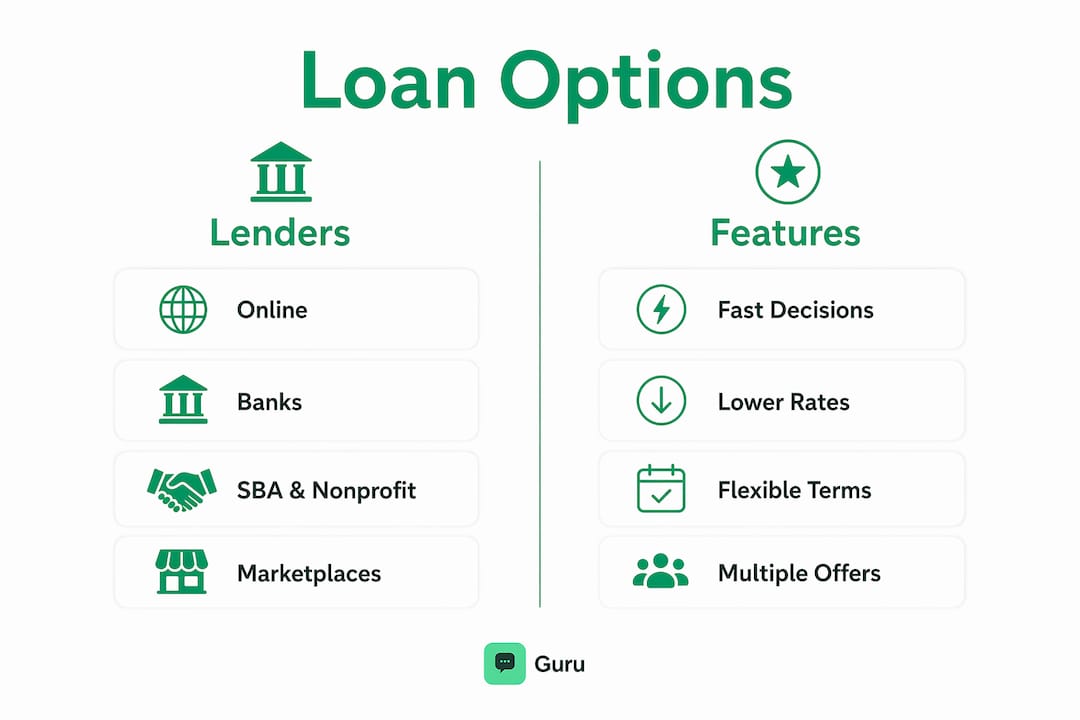
A note on Lending Gurus: Lending Gurus is a lead aggregator, not a lender. Guru matches you to vetted partners based on your revenue, time in business, and stated needs. Partners control approvals, rates, and amounts. No approval is guaranteed at the matching stage.
Online revenue-based lenders
This category includes well-known names like Bluevine, Fundbox, OnDeck, Kapitus, Fora Financial, Headway Capital, and National Funding. They underwrite primarily on recent bank deposits and revenue trajectory rather than collateral, which is why they can move faster than banks. The trade-off is cost: rates are higher than bank products, and some use daily or weekly ACH remittance that affects your cash flow.

Pros: Fast decisions, flexible credit requirements, accessible to businesses under two years old.
Cons: Higher APR than bank loans, frequent remittance schedules, smaller maximum amounts than SBA options.
Merchant cash advance and factor providers
MCAs are not technically loans. You receive an upfront payment in exchange for a percentage of future sales, collected daily or weekly. Fora Financial, National Funding, and Kapitus all offer MCA-style products alongside term loans. Funding can arrive the same day, but the effective cost is often the highest of any unsecured option.
Pros: Very fast funding, minimal documentation, accessible to businesses with lower credit.
Cons: High effective cost, daily remittance reduces cash flow, no fixed payoff date.
Traditional banks
Bank of America and Wells Fargo both offer unsecured business loans and lines of credit, but eligibility standards are stricter. Expect requirements of two or more years in business, higher minimum revenue, and a thorough documentation review. The payoff is lower cost when you qualify.
Pros: Lower interest rates, established relationship banking, potential for larger credit lines.
Cons: Longer decisions, stricter eligibility, more documentation required.
SBA and nonprofit lenders
The SBA 7(a) program and nonprofit lenders like Accion, altbanq, iBusiness Funding, and AltLINE serve businesses that need larger amounts at lower rates. Accion focuses on underserved and early-stage businesses. AltLINE specializes in invoice factoring. The application process is longer, but the cost of capital is meaningfully lower.
Pros: Lower rates, larger amounts, mission-driven lenders for underserved borrowers.
Cons: Longer timelines, more documentation, stricter program eligibility.
Lending marketplaces
Lendio, Fundible, and SMB Compass let you submit one application and receive offers from multiple lenders. This is convenient, but the quality of the partner network varies. Read each offer carefully before accepting.
Pros: Single application, multiple offers, easy comparison.
Cons: Partner quality varies, some marketplaces share your data broadly.
Pro Tip: When comparing marketplace offers, always ask each lender for the total repayment amount and APR in writing. A lower factor rate does not always mean a lower total cost.
What is an unsecured business loan and how does it actually work?
An unsecured business loan is financing that does not require you to pledge a specific asset, such as real estate or equipment, as collateral. As the SBA explains, the loan is supported by your creditworthiness rather than a specific asset. That does not mean lenders take on unlimited risk.
What “unsecured” really means in practice: Most unsecured business loans still require a personal guarantee, which makes you personally liable if the business cannot repay. Many lenders also file a UCC-1 blanket lien, giving them priority over your business assets in a default. Read guarantee and lien language carefully before you sign anything.
Lenders protect themselves in two main ways: the personal guarantee and the UCC-1 filing. The personal guarantee shifts repayment risk to you as the owner. The UCC-1 lien does not require a specific asset upfront, but it does give the lender a claim on business assets if you default. Both are standard practice across online lenders, banks, and SBA programs.
Common unsecured product types:
- Term loans — a lump sum repaid over a fixed schedule, typically monthly
- Lines of credit — revolving access to funds up to a set limit; you draw and repay as needed
- Merchant cash advances — an advance against future sales, repaid as a percentage of daily receipts
- Business credit cards — revolving credit with no collateral requirement; useful for smaller, recurring expenses
- Marketplace loans — term loans or lines sourced through a multi-lender platform
Underwriting for unsecured products focuses on monthly revenue, cash flow consistency, time in business, and credit score. Because there is no collateral to appraise, online lenders can approve and fund faster than banks, often within 24–72 hours. The absence of a collateral appraisal step is the primary reason for that speed advantage.
When does an unsecured loan make sense for your business?
Unsecured financing fits specific situations well and fits others poorly. Knowing the difference saves you money.
High-fit scenarios:
- Covering a short-term cash flow gap while waiting on receivables
- Buying inventory ahead of a seasonal peak when you know the ROI is quick
- Capturing a time-limited growth opportunity (a new contract, a bulk purchase discount)
- Bridging payroll or operating expenses during a slow period with a clear recovery timeline
- Testing a new revenue channel before committing to long-term capital
When to avoid it:
Using high-cost unsecured debt to fund long-term capital needs, such as equipment with a five-year useful life or a buildout, is a common and expensive mistake. The higher cost of unsecured financing makes it a poor fit for anything without a near-term return. If your need is long-term, look at secured term loans, SBA 7(a) loans, or equipment financing instead. If you are pre-revenue or very early stage, equity funding or nonprofit microloans through Accion may be a better starting point.
How do you qualify for an unsecured business loan?
Approval hinges most on three things: monthly revenue, time in business, and cash flow. Credit score matters, but lenders often accept weaker credit when recent revenue trends are strong and deposits are consistent. Here is what to prepare before you apply.
Step-by-step qualification checklist:
- Confirm your time in business. Most online lenders require six months to two years. Banks typically want two or more years. SBA programs vary by loan type.
- Calculate your average monthly revenue. Pull the last three to six months of bank statements and compute the average. This is the number lenders use most.
- Check your personal credit score. Even for business loans, most lenders review your personal credit. Know your score before applying so you can target lenders whose thresholds you meet.
- Gather your business bank statements. Three to six months is standard. Some lenders, especially bank-statement lenders, use these as the primary underwriting document.
- Pull your most recent business tax returns. Two years is typical for banks and SBA lenders. Online lenders may accept one year or waive this requirement.
- Have your business formation documents ready. Articles of incorporation, EIN confirmation, and any relevant licenses.
- Prepare a driver’s license or government-issued ID. Required by virtually every lender for identity verification.
- Optional but helpful: accounts receivable aging report. If you invoice clients, this shows lenders your incoming cash pipeline.
Typical funding timelines by lender category:
| Category | Decision timeline | Funding after approval |
|---|---|---|
| Online revenue-based lenders | Same day | 24–72 hours |
| Merchant cash advance providers | Same day–24 hours | Same day |
| Lending marketplaces | 24–72 hours | Varies by partner |
| Traditional banks | 1–4 weeks | 1–2 weeks after approval |
| SBA / nonprofit lenders | 2 weeks | 1–2 weeks after approval |
PNC’s guidance on unsecured loan qualification emphasizes that lenders analyze deposit history and cash flow consistency as primary signals of repayment ability. Steady, predictable deposits carry more weight than a single strong month.
Pro Tip: Open a dedicated business checking account if you have not already. Lenders look for clean separation between personal and business deposits. Mixed accounts slow decisions and can reduce your approved amount.
What costs and loan terms should you expect?
Unsecured loans cost more than secured ones because lenders take on more risk without a specific asset to claim. Understanding how cost is presented helps you compare offers accurately.
Cost components to watch:
- Interest rate / APR — the annualized cost of borrowing; always ask for APR, not just the monthly rate
- Origination fee — a one-time fee deducted from your loan proceeds, typically expressed as a percentage
- Factor rate — used by MCAs instead of APR; a multiplier (e.g., 1.25) applied to the advance amount; does not account for time, so it understates true cost on short-term advances
- ACH / wire fees — per-transfer fees some lenders charge for disbursement or remittance
- Prepayment penalties — some lenders charge a fee if you pay off early; others offer a discount
- Late fees — charged when a scheduled payment is missed
- Servicing fees — ongoing administrative fees, sometimes monthly
APR vs. factor rate: why it matters
APR accounts for the time value of money. A factor rate does not. A 1.30 factor rate on a six-month advance is a very different cost than a 1.30 rate on a 24-month term loan. Always convert factor rates to APR before comparing offers. Ask the lender directly: “What is the APR on this product?”
| Cost type | Where it appears | What to ask |
|---|---|---|
| APR | Term loans, lines of credit | “What is the full APR including all fees?” |
| Factor rate | MCAs, revenue advances | “What is the equivalent APR?” |
| Origination fee | Most loan types | “Is this deducted from proceeds or added to balance?” |
| Prepayment penalty | Term loans, some MCAs | “Is there a discount or penalty for early payoff?” |
| ACH fee | Online lenders | “How much per transfer, and how often?” |
Questions to ask every lender before you sign:
- What is the total repayment amount?
- What is the APR, including all fees?
- Can you provide a sample amortization schedule?
- Is there a prepayment penalty or early payoff discount?
- What triggers a default, and what happens to the personal guarantee?
Pros and cons of unsecured business financing
Pros:
- No specific asset appraisal required, so funding moves faster
- Simpler paperwork than secured or SBA loans
- Accessible to businesses without real estate or equipment to pledge
- Flexible use of funds in most cases
Cons:
- Higher interest rates and fees than secured financing
- Personal guarantee is almost always required, putting personal assets at risk
- UCC-1 blanket lien is common, giving lenders a claim on business assets
- Smaller maximum amounts than secured or SBA loans in most cases
- Daily or weekly remittance (MCAs) can strain cash flow
Accept these trade-offs when speed and flexibility matter more than cost, and when you have a clear, near-term repayment source.
How do you choose the best unsecured loan offer?
Start with one decision rule: the expected return from the funded activity should clearly exceed the total cost of the loan. If you cannot model that, the loan is a risk, not an investment.
Ranked decision criteria:
- Total cost transparency — can the lender give you APR and total repayment in writing before you sign?
- Repayment schedule fit — does the payment frequency and amount match your cash flow cycle?
- Guarantee and lien terms — what exactly does the personal guarantee cover, and is there a UCC-1 filing?
- Lender reputation and servicing — check reviews on Trustpilot and the Better Business Bureau; ask how disputes are handled
- Funding speed — does the timeline match your actual need?
Red flags to walk away from:
- No clear APR disclosure before signing
- Mandatory daily ACH remittance with no flexibility for slow periods
- Vague or unsigned personal guarantee language
- Pressure to sign same-day with no time to review documents
- Upfront fees required before any approval decision
Questions to ask when comparing offers:
- “What is the total I will repay, and what is the APR?”
- “What is the remittance schedule, and can it flex if revenue drops?”
- “What does the personal guarantee cover exactly?”
- “How do I contact servicing if there is a payment issue?”
- “What fees apply if I pay off early?”
How these picks were selected
The shortlist in this guide reflects a structured review process, not advertiser placement alone.
Selection criteria:
- Verified product types and loan structures (term loans, lines, MCAs, SBA programs)
- Funding speed relative to category peers
- Breadth of eligibility (credit flexibility, time-in-business thresholds, revenue minimums)
- Transparency of cost disclosures (APR availability, fee itemization)
- User experience and application simplicity
- Third-party reputation signals (Trustpilot, BBB, NMLS registration where applicable)
- Alignment with SBA guidance on unsecured financing standards
Advertiser disclosure: Lending Gurus operates as a lead aggregator and earns referral fees from vetted lending partners when a user is matched and funded. This relationship does not change the editorial criteria above. Vetted partners set their own approvals, rates, terms, and amounts. No outcome is guaranteed at the matching stage. This guide was reviewed against July 2026 SERP consensus to reflect current lender availability and market conditions.
How to apply for an unsecured business loan: step by step
Preparation before you apply is what separates a fast approval from a drawn-out back-and-forth with a lender.
Step 1: Know your numbers before you start. Calculate your average monthly revenue for the past three to six months. Identify your monthly fixed expenses and your net cash flow. These numbers will come up in every application.

Step 2: Check your credit. Pull your personal credit report from AnnualCreditReport.com. Dispute any errors before applying. If your score is below the typical threshold for your target lender, address the most impactful items first: payment history and utilization.
Step 3: Organize your documents. Gather business bank statements (three to six months), the most recent business tax return, your EIN, formation documents, and a government-issued ID. Having these ready cuts days off the process.
Step 4: Start with a matching platform. Submitting to Lending Gurus first gives you a read on which vetted partners are likely to work with your profile, without a hard credit pull at the matching stage. That protects your credit score while you gather real offers.
Step 5: Compare offers side by side. When partner offers come in, compare APR, total repayment, remittance schedule, and guarantee terms. Use the questions from the “how to choose” section above.
Step 6: Read the agreement before signing. Focus on the personal guarantee clause, the UCC-1 filing language, the default triggers, and any prepayment terms. If language is unclear, ask the lender to explain it in writing.
Step 7: Accept the offer that fits your cash flow, not just the highest amount. Lenders sometimes approve more than you need. Borrowing only what you need reduces total cost and repayment risk.
What Lending Gurus does and what it does not do
Lending Gurus matches your business to vetted lending partners quickly, without a hard credit pull at the matching stage. You describe your situation to Guru, and the platform identifies partners whose products align with your revenue, time in business, and funding need. That first step costs you nothing and does not affect your credit score.
What Lending Gurus does not do: it does not approve loans, set interest rates, or determine how much you can borrow. Those decisions belong entirely to the lending partners. Before you accept any offer from a matched partner, review the full cost disclosure, the personal guarantee terms, and the repayment schedule. Avoid borrowing more than your cash flow can comfortably support, and always ask for APR in writing before signing.
See how Lending Gurus matches you to unsecured loan options
Sorting through lender requirements on your own takes time you probably do not have. Lending Gurus gives you a faster starting point: describe your business and funding need to Guru, and the platform matches you to vetted lending partners whose products fit your profile, without a hard credit pull at the matching stage.
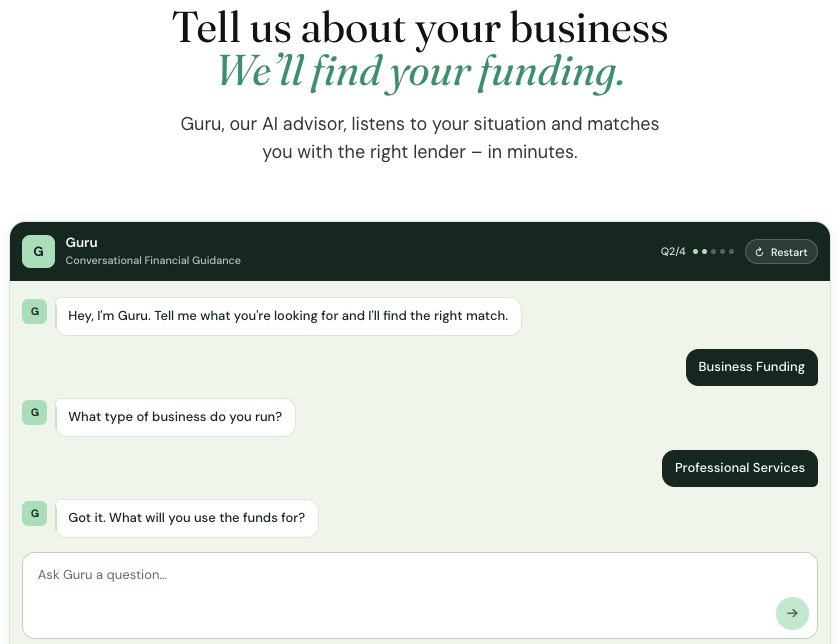
The process is free for business owners. Partners set their own approvals, rates, and terms, so no specific outcome is guaranteed. What you get is a shortlist of relevant options faster than applying to lenders one by one. Review the how it works page to understand exactly what happens after you submit your details, and check the terms and conditions for full disclosure on the referral relationship. When you are ready to see which partners match your business, start the process at Lending Gurus.
Authoritative sources and further reading
The claims in this guide draw on primary and authoritative sources. The list below points you to the most useful ones for deeper reading.
- SBA: Unsecured Business Funding for Small Business Owners Explained — The SBA’s own explanation of how unsecured financing works, the role of personal guarantees, and why lenders price unsecured products higher. Start here for policy-level context.
- SBA 7(a) Loan Program — Details on SBA-guaranteed loan types, amounts, and eligibility. Useful if you are evaluating SBA options alongside faster online products.
- Bankrate: Best Unsecured Business Loans — Market-level overview of lender categories, underwriting priorities, and speed comparisons. Good for benchmarking what typical approval criteria look like across lender types.
- Bank of America: Unsecured Business Loans and Financing — Bank of America’s product page explains their unsecured term loan and line of credit options, including eligibility and the graduation path from secured to unsecured credit.
- PNC: Unsecured Small Business Loans — Practical breakdown of qualification criteria from a bank perspective, including how deposit history and cash flow consistency factor into decisions.
- Credibly: Unsecured Business Loans Guide — Explains how online lenders use revenue trajectory and daily remittance structures, and why unsecured financing is best suited to short-term needs.
- Texas Bank Statement Loans: How It Works — A practical look at bank-statement underwriting mechanics for self-employed borrowers and businesses without traditional documentation.
| Source | Best for |
|---|---|
| SBA blog | Policy, personal guarantees, UCC-1 explanation |
| SBA 7(a) program page | SBA loan types, amounts, eligibility |
| Bankrate overview | Market benchmarks, underwriting priorities |
| Bank of America product page | Bank-level eligibility, graduation paths |
| PNC guidance | Qualification criteria, deposit history weighting |
| Credibly guide | Online lender mechanics, short-term use cases |
| Texas Bank Statement Loans | Bank-statement underwriting for self-employed |
This article is general information, not financial or legal advice. Confirm current eligibility requirements, rates, and terms directly with lenders or a qualified financial professional before applying.
